
Categories
Health

9 Ways reading makes you smarter

I have always loved reading… I was one of those kids who read with a flashlight under the covers when I was supposed to be going to sleep. One of my favourite features of the Kindle Reader I have now is that I can read it in bed without a flashlight…

As a practicing pharmacist, virtually all of my reading was non-fiction, learning information that would help me be a better pharmacist. But I always loved novels, especially historical ones and those about another culture or a country I’d never visited. Now I try to balance my reading between fiction and non-fiction.

So you can imagine how pleased I was to find an article based on science about the many ways reading fiction is good for your brain… couldn’t wait to share it with you!

Science-based ways reading improves brain function:

  1. Improves ability to detect and understand social cues This skill is known as “Theory of Mind” and helps us to interpret the actions and body language of others. If you’re a fan of “Big Bang Theory”, think of Sheldon, a character who reads only scientific literature and has great difficulty understanding the emotions of others and subtleties in language, such as sarcasm. Well-written literary fiction will “show” not “tell”… emotions are shown through actions of the character rather than describing the emotion itself (for example: if a character “storms from the room” the author doesn’t need to say he is angry).

  2. Increases empathy Fiction allows the reader to get in touch with the characters’ thoughts and feelings, imagining other realities and how they might feel in that situation themselves. Readers of fiction scored better than non-fiction-only readers on a test to guess a person’s feelings when shown only a photo of their eyes.

  3. Sharpens memory and engages imagination Simple 3-word phrases, like “red leather purse” were enough to activate the hippocampus, a center in the brain for memory, in functional MRI tests. When reading fiction, the reader needs to consider both what is being said and what is not said. Often spaces need to be filled in using the imagination. I have often described a good book as a “movie in your mind”, with pictures created by your imagination using cues and descriptions in the book. Unlike movies and television, where all the details are provided, books require the reader to create the pictures and “hear” the voices. And most books last much longer than the average TV show, requiring you to remember details from the beginning that may turn out to be important later on…

  4. Improves decision making and emotional processing Modern scanning techniques have shown that reading stimulates key areas of the brain. Any time you exercise part of your brain, it responds by creating new connections between brain cells to increase function. These are the areas of the brain that light up when reading:

    1. Prefrontal cortex – area for decision making and recall

    2. Lateral temporal cortex – area that deals with emotional association and visual memory

    3. Hippocampus – long term memory processing

    4. Parietal lobe – understanding emotions and interpreting sensory information

    5. Posterior cingulate cortex – memory recall

  5. Can create effective self-reflection Poetry, especially “high poetry”, such as works by Shakespeare, Wordsworth or Dickinson, activates “autobiographical” memory, your episodes of personal memories of experiences, objects, people and specific events experienced at a particular time and place. Poetry encourages reflection on these episodes to apply personal meaning and understanding to the poetry.

  6. Creates serious “mind building” Reading-connected activity in areas of the brain associated with comprehension continues for as long as 5 days. This “shadow activity” is similar to what occurs with muscle building. Reading is like lifting weights for your brain!

  7. Improves vocabulary and verbal skills Language constantly evolves. Different authors write in different ways, using different language, exposing you to more words used in a wide variety of ways. Reading a variety of authors teaches new ways of explaining ideas or creating images with words. There is a direct correlation between good verbal skills and reading. Even reading non-fiction can expand your vocabulary while you acquire new information.

  8. Slows mental aging Reading is a constant mental exercise for all ages. Word imagery, metaphors, philosophy, abstract ideas and creativity challenge and activate the brain. Lifelong readers demonstrate better processing and understanding of sentence structures, comprehension and memory as they age.

  9. Encourages learning from the content you read Non-fiction teaches ideas and facts but well-written fiction can also teach about other cultures, geographical areas, ideas, history and more through story and setting. The key is that the author does the required research to provide accurate details, even though the story line may be fictional.

So, never feel that a good novel is a waste of time. Enjoy imaginative stories along with inspiring non-fiction, knowing that it all keeps your brain active and continuing to develop throughout your life.

Categories
Health

Marijuana — Now Legal for Medicinal and Recreational Use in Canada

Marijuana became legal for adult recreational use in Canada on Oct 17th, as I’m sure you’ve heard on the news. The Canadian Government’s goal is to control use, eliminate the illegal trade, prevent use in minors and, of course, collect taxes.

But I’d like to talk about the other side of marijuana — medicinal use. In Canada, marijuana use for medicinal purposes has been legal for 17 years but it’s only supplied through government sources, essentially mail order. Pharmacies are still not permitted to distribute or help clients with this medication and many doctors do not prescribe it, and this has lead to a fracturing of the usual medication system designed to prevent drug interactions and problems.

Another downside, besides the inconvenience of mail order, has been the stigma of using what was, until now, an illegal substance. I know of patients who would have benefitted from it, according to current studies, but were afraid to try a medication that had been described to them as a “drug of abuse”, worried they might become “addicted” while their doctor prescribed opioids or other prescription drugs instead.

Medical uses of marijuana

While marijuana is currently not a first-choice treatment for any condition, scientific evidence has shown it works for chronic pain, nausea and vomiting caused by chemotherapy, spasms caused by MS, and treatment-resistant epilepsy. There is also discussion around the possibility it may help decrease the opioid problem, now at crisis level in many countries, by substituting marijuana for this more dangerous class of medications. I know of patients who have successfully made the change from opioids to marijuana and now experience good or better pain relief with fewer side effects.

There are many active components in marijuana, known as cannabinoids — at least 113, according to official Health Canada information, and as many as 400 different ones, according to other references. The two most active cannabinoids are THC (tetrahydrocannabinol) and CBD (cannabidiol). Most medicinal marijuana contains more CBD, the chemical that is active for pain and reducing muscle spasms) and less THC (which creates the “high”). Products can now be produced that contain virtually no THC for medicinal use. These products are considered safer than opioids and have fewer side effects than anti-inflammatory analgesics (known as NSAIDS).

Currently healthcare professionals are divided regarding whether access to medical marijuana should be integrated into the current medicine supply system. Many are not well educated on its actions and side effects, as they have had little or no contact with medical marijuana. Your doctor and pharmacists may not be able to advise you whether you would benefit from this medication unless they have taken the initiative to educate themselves. Currently there is little incentive for pharmacist to become involved, as they are not permitted to help even clients with legal permission to use marijuana. Last year, a young pharmacist lost her licence temporarily for helping one of these clients solve a problem with his medical marijuana — a tragedy, in my opinion.

Is it OK to self-medicate?

With marijuana now available for recreational use, it has also become available for patients who may decide to self-medicate. This is certainly not an ideal situation When something is affecting your health, it’s always best to get a proper diagnosis and discuss treatment options with your doctor or nurse practitioner. Like any medication, medical marijuana use needs to be monitored, to ensure it will be used in the safest manner possible, at the correct dose, in the ideal formulation, and that interactions with other medications or diseases will be avoided.

For example, smoking marijuana has all the same risks of lung problems that smoking tobacco does, and would aggravate lung diseases like asthma. While occasional recreational smoking may run lesser risk, smoking marijuana every day for medicinal use is understood to be as dangerous as a tobacco habit. Inhaling marijuana gives quick onset of effects (within seconds to minutes) but the effects do not last as long (usually 2 to 4 hours), requiring frequent dosing. Other forms, such as oral (swallowed) or sublingual (placed under the tongue) can last up to 12 hours, making them more suitable for medication use for patients with chronic diseases.

Can marijuana be habit-forming?

Humans produce their own cannabinoids, just like we produce our own opioids, and these drugs work by attaching to receptors in our brains for the substances we normally produce. When this happens, our brains change to compensate for the extra stimulation from the introduced drug. When these drugs are stopped, it can take some time for the brain to revert back to its usual function and this results in withdrawal effects that are generally opposite to the effect of the drug.

Opioids, for example, cause drowsiness and reduce the perception of pain. When opioids are stopped abruptly after longer-term high-dose use, people often have difficulty sleeping, may develop anxiety and could become hypersensitive to pain. While the brain changes with marijuana seem to be less persistent than those that occur with opioids, resulting in less withdrawal symptoms that with opioids, these can occur after long-term high-dose use. Marijuana withdrawal can result in nausea, anxiety and sleeplessness. Tapering the dose is recommended to avoid withdrawal effects when stopping long-term use, the same as with any medication that affects brain receptors, such as antidepressants, anti-anxiety medications, antipsychotic drugs and opioid analgesics. Further research still needs to be done to identify risks and benefits of long term use for chronic diseases.

In summary, there is still much to learn about marijuana, both for medical and recreational use. Legalization of the substance will encourage more research, reduce stigma for those using it for medicinal purposes, and encourage learning on the part of healthcare professionals. Our best hope, on the medicinal side, is that marijuana may help to reduce deaths and addictions to opioids from both medical and illicit sources while becoming an effective and safer treatment for a range of medical conditions.

References and further reading:

Now that cannabis is legal, let’s use it to tackle the opioid crisis, The Conversation

Cannabis in Canada, Health Canada

Information for Healthcare Professionals on Cannabis and Cannabinoids, Health Canada

Categories
Health

Ever considered keeping a journal?

Ever considered writing a journal? I’m thinking about it… want to think along with me?

There are many reasons to journal. My mom kept one for years, initially about household purchases and expenses – she liked looking back to find out just when we had bought that old couch or how much electricity had gone up in the past year. Eventually, she had records that dated back several decades. In more recent years, she kept track of the weather, appointments, who had visited and anything she wanted to remember. We all said her memory was better than ours, and that probably had a lot to do with her journaling.

A journal can take many forms and can contain anything you want. You may journal for different reasons and your purpose can change over time. The only intentional journaing I’ve done so far has been a travel journal, with the goal of making notes of where we went, how we got there and what we saw and did, in case we went back or wanted to share information with others about that location. Although, now that I think about it, I also kept a journal of sorts while working at the hospital pharmacy, keeping notes in a pocket-sized ring binder on new drug information. Several of the pharmacists there did…we called them “portable brains”!

So, there are lots of types of journals, and plenty of reasons to write daily. But what things should you decide before starting a journal?

  • Why do you want to journal?

    • A journal can be used to capture events and memories, as I did with my travel journal, but it can have several other uses too. Some people use a journal as a processing tool, to help solve problems, for example, by writing out the pros and cons of decisions they need to make or by listing their choices if what to do next on a page. Some use a journal to work out their feelings — when you write down the little things that irritate you, you realize they really are just little things.

    • Others just want to start a daily habit, perhaps as they begin a new stage in life. With the birth of each of my children, I purchased a “baby book” to record all of those wonderful “firsts”. After my third, I continued to record memorable events related to my children, eventually filling up a small journal. My children have enjoyed looking through it years after it was written and, in a sense, it was written as much for them as for myself.

    • Writing daily in a journal can also be used to improve your writing skills. Any practice helps and, knowing the writing is not going to be read or edited by others can give you freedom to let ideas to flow onto the paper or screen.

    • Recording your thoughts can also help improve self-awareness. Journaling can create a time to just think and record those thoughts, if that is your goal.

  • What format do you want to use?

    • Digital

      • While you could simply write in a word processor, such as Word, you might want to consider a dedicated app, such as Day One, Live Journal and many others. Some also allow digital photos to be included, a nice addition to a travel diary, and can sync between devices. These programs offer the advantage of security, as you can password-protect your writing. Some can also be encrypted for further protection, which could be important if you are writing deeply personal honest thoughts that must never be seen by others.

    • Pen and paper

      • Writing in a traditional paper journal slows you down since it’s more difficult to change words written in ink. This requires you to think more before writing, and that may be one of your goals. Many also feel it offers a richer experience, similar to how some people prefer traditional paper books to electronic ones.

      • Paper journals can be kept in a locked drawer for a certain level of security. However, consider whether you care if it is found after you’re gone…

  • What to write?

    • Julia Cameron, author of The Artist’s Way, suggests writing a stream of consciousness — whatever comes into your mind — first thing each morning to stimulate creativity. She refers to these as “morning pages”. This activity can be helpful for writers, to practice allowing ideas to flow onto the page uncensored.

    • Michael Hyatt, former publisher, now author and blogger, suggests creating a template to guide your journaling, rather than facing a blank page. To do this, list questions you want to answer each day and leave space for answers

      • For example:

        • What happened in the past day? (records events)

        • What were my successes? (gives a sense of momentum, positive focus)

        • What am I thankful for (promotes gratitude)?

        • How do I feel right now?

        • What have I learned in the past day?

        • What can I do next to move ahead with a project I’m working on (or want to do)?

      • A template can work well to record daily events and to help you focus on what is positive in your life. Also, as you begin, it can be helpful just to get you started each day.

  • When is the best time for you to write? How long do you want to spend writing each day?

    • Regardless of when you decide to write, choose a time of day that is convenient and consistent. A habit is easier to create if you make it part of an established daily routine, for example, with your morning coffee. Leave your journal on your kitchen table or, if you prefer to write at night, on your pillow as a reminder. How long you spend each day depends on your goals — a stream of consciousness journal might be a timed activity, say 15 minutes each morning, while recording thoughts and events while traveling in an amazing country might vary by the day, depending on your activities.

  • How long you want to continue to do this?

    • Commit to a trial period. Realize it may take a while to become a daily habit. Don’t give up after too short an effort and don’t worry if you miss once in a while at first. It may seem a bit difficult as you begin (what to write?), but many people find journaling enjoyable. Don’t be surprised if your journal changes over time — just write what is enjoyable or helpful for whatever stage of life you are in right now!

Categories
Health Public Health

Flu season? Who cares…

You’re healthy. A little flu won’t hurt you. And you hate needles. Why bother with the flu shot? Well, it’s not just about you…

You see, when you get the flu, even just a mild case, you can pass it along to others, and they may not be as healthy as you are. That sweet little old lady in front of you in the grocery line or the young woman in the doctor’s office, that you didn’t know was taking chemo, could be exposed to the virus you just caught because you didn’t get your shot. And they could become very ill because their immune system isn’t as strong as yours. If you don’t get the flu, you can’t pass it on.

Protect the herd…

And, while we’re talking about virus infections, I should tell you about something called “herd immunity”. This term means that if most of the the population (or “herd”) in an area is vaccinated to protect them from a virus, then those who are more vulnerable and those who can’t (or won’t) get a vaccine will be better protected.

But a majority of the “herd” needs to get their flu shot for the effect to make a difference. If too few are protected, then enough people are vulnerable to let an epidemic spread. We’ve seen this lately with some of the childhood vaccines… Diseases like mumps and measles had become quite rare, but in recent years news articles have described local areas and sports teams where groups of people have become sick with these viruses. Untrue rumours on the internet have convinced many parents that there is a connection between the measles/mumps vaccine (MMR) and autism. In spite of having been proven incorrect, articles continue to circulate around the internet about this false connection.

Reactions are rare but…

Most people tolerate vaccines well – the slightly sore arm or mild fatigue that sometimes occurs is nothing compared to a full-force flu. And, in the elderly, the very young, and those with chronic disease or a weakened immune system, it can be life-threatening. People die from the flu every year.

A very few serious reactions to vaccines are reported, due to allergies or sensitivities, and this is why you need to stay for 15 minutes after your shot. If you should have one of those rare reactions, you will receive treatment for it right away. Doctors will recommend that people who have had a serious reaction do not take that vaccine again or that they receive it in a hospital setting. This is another case where herd immunity, ensuring that friends, co-workers and family are vaccinated, can be important.

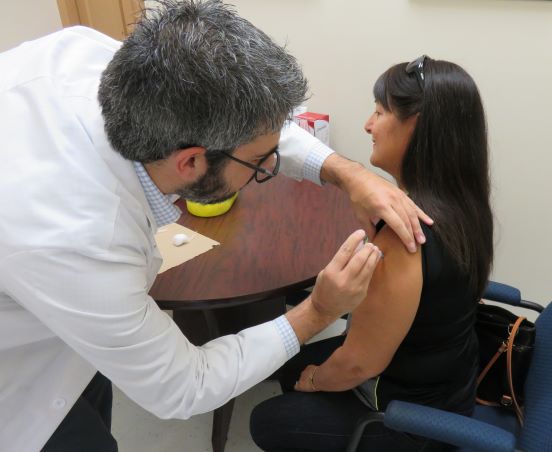
So do your part to protect yourself and others — find a pharmacy or clinic that gives flu shots. Most pharmacies do now, and they’re free there for most people just as they are at your doctor’s office. Roll up your sleeve and take a deep breath… it’s done in seconds and hardly hurts at all.

And, to feel the injection less, here’s what to do:

  • Relax. It hurts a lot more if the muscle is tight.

  • Ask the person injecting to wait until the alcohol evaporates. It only takes a few extra seconds.

  • Don’t move. You want the needle to go straight in and straight out quickly.

  • Distract yourself. Even taking a deep breath can be enough distraction to take attention away from the injection.

  • Apply pressure right away. Your brain will register pressure instead of pain.

    • Often an injector will press lightly on your arm while giving the injection, for the same reason.

    • They will also make sure the injection is well into your muscle – it hurts less there and works better too.

    • The injector will use a cotton ball to apply pressure. You can take over so they can finish up their paperwork.

  • If the area is sore later, apply a cold compress (a refrigerated ice pack or ice cubes wrapped in a cloth). You can also take a dose of Ibuprofen or Acetaminophen (Tylenol) to reduce soreness at the site of the injection, a common side effect.

So, lots you can do to make your flu shot practically painless!