Categories
Uncategorized

Do masks help prevent virus infections?

We are seeing images of masses of people in airports wearing masks to prevent the spread of the novel (new) Coronaviras infection that originated in China just a few weeks ago. But do they help?

The quick answer is, yes, masks do help reduce the spread of respiratory viral illnesses. But what type is best? Are there other things we should be doing too? Or do we really need to worry about all this yet in most parts of the world?

How dangerous is this new virus?

We know that thousands die every year from influenza, the regular yearly flu. Although many of us think of it as “just the flu”, 61,000 Americans died in the 2018-19 flu season among almost 43 million who were infected and 647,000 hospitalized. And that was just in the US. The Health Canada website states that 12,200 are hospitalized each year due to the flu and 3,500 die because of it.

So far, as I post this on the morning of January 31st, 2020, approximately 9,825 cases of the Wuhan Coronavirus have been identified worldwide and 213 have died. You can check current numbers here. While that’s far fewer than the number who died last year from regular influenza, the percentage dying is what’s startling… 2.2% for the Coronavirus, as compared to 0.14% for the flu…over 16 times the rate!

And, unlike the flu, we don’t yet have a vaccine to prevent its spread. With worldwide travel so common now, it’s understandable that authorities are worried and taking action to try to contain the infection.

After our experience with SARS, a similar coronavirus that caused 8,098 cases and 774 deaths, the international community has moved quickly to contain the Wuhan coronavirus. China has essentially quarantined millions of people at the center of the outbreak—a move that is unprecedented.

Because of this, your risk of catching the novel coronavirus is very low presently if you are outside China. But there are measures you can take to reduce your risk of catching either the influenza or coronavirus…

How to you catch coronavirus or flu?

Like the flu, the coronavirus can spread from person to person, generally through fairly close contact. When an infected person coughs or sneezes, tiny droplets containing viruses are sprayed into the air. Just like misty rain, these droplets settle onto nearby surfaces. Depending on how “virulent” or strong the virus is, it can remain infectious for 24-48 hours or even up to 7 days on hard surfaces (length of time varies with the virus and type of surface, although virus’s ability to cause infection generally decreases after 24 hours).

Infectious droplets can potentially be inhaled by another person if they are close enough when someone coughs, sneezes or even when they talk, causing an infection. Once the droplets settle onto nearby surfaces, viruses can also be transmitted by touching a virus-contaminated surface then touching the face with the contaminated hand.

Ways to prevent the spread…

So, the first piece of advice is to wash your hands frequently and to avoid touching your face when in public or anywhere an infected person might have been. Disinfecting surfaces that a sick person may have touched or left droplets on can also reduce the spread of the illness.

Secondly, if you are going to be in close proximity to someone who is infected, for example, caring for a family member who is sick with a respiratory virus, wearing a mask is likely to decrease your chance of becoming ill. If you are going on a long international flight, the need for a mask is more questionable, depending on where others on your flight may have been in the previous 1 to 2 weeks. Carrying a disposable mask and putting it on if someone seated near you is coughing or sneezing is one strategy some travellers are considering, due to the emergence of the new coronavirus. I have not seen studies to prove whether this is a beneficial strategy, as yet, but wearing one creates little discomfort for the wearer and the cost of a regular disposable surgical mask is very low.

If you have cold or flu symptoms, you can reduce the chance of passing it on to someone else by wearing a mask. And, of course, staying home when you’re sick is the most effective way of containing a viral infection.

Masks can serve two functions:

1.)They can prevent inhalation of contaminated droplets in the air and can prevent their release into the air when a sick person coughs or sneezes.

2.) They prevent the person from touching their face with potentially contaminated hands.

Which type of mask is best?

While some masks are more effective at blocking inhalation of tiny particles and droplets, such as the “N95” mask that blocks 95% of inhaled particles, all masks have been shown in studies to lower the risk of transmission of viruses from person to person when in close proximity. But it is always recommended to pair wearing a mask with frequent washing of hands.

Washing hands often for at least 20 seconds or using a sanitizing handwash has also been shown to reduce the risk of contracting a viral infection. Several studies of combining handwashing with wearing a mask, even a simple surgical mask, have shown that the risk of catching influenza from an infected person living in the same household was reduced by 70 to 80%!

Lastly, although perhaps this should be the first piece of advice, be sure to keep all vaccines up to date, especially if travelling. There are few good excuses for not getting the annual flu shot but, obviously with flu-related deaths in the thousands, many don’t think it’s important. But the flu generally peaks in February, so it’s not too late to get it. Reports suggest they may have a vaccine for the Wuhan coronavirus within 5 to 6 months.

Meanwhile, the risk of catching the coronavirus remains low in most countries where few cases have occurred, unless a person is in close direct contact with someone who is actually infected with the virus.

So, thus far, you’re more likely to catch the flu virus than the new coronavirus, unless you’re visiting China where most cases have occurred. But, remember that proper handwashing can help prevent the transmission of any respiratory virus.

How to wash your hands properly

1. Wet your hands with clean, running water (warm or cold).

2. Apply soap and lather hands by rubbing together with the soap.

a. Studies have not found added benefit to using antibacterial soaps, other than in healthcare settings.

3. Scrub hands for at least 20 seconds.

4. Rinse hands well with clean, running water.

a. If using a public washroom, it may be advisable to use a paper towel to turn off the tap, although it has been debated whether significant numbers of germs are transferred between hands and faucets.

5. Dry hands using a clean towel or air dry them.

6. Use a hand sanitizer with at least 60% alcohol when you can’t use soap and water.

a. Apply enough product to the palm of one hand to wet hands thoroughly.

b. Rub the gel over all surfaces of hands and fingers until hands are dry. This should take about 20 seconds.

c. Hand sanitizers may not be as effective when hands are visibly dirty and may not remove harmful chemicals, such as pesticides or heavy metals.

I’ve made it a habit to wash my hands and remove shoes as soon as I enter my home. Now, if I can just learn to keep my hands away from my face and use that hand sanitizer I carry around in my purse more often…

#coronavirus #influenzaprevention #surgicalmask

References and additional reading:

Mapping the Coronavirus Outbreak Across the World—Bloomberg.com

2019 Novel Coronavirus, Wuhan, China—Centers for Disease Control and Prevention (CDC)

Handwashing: Clean hands save lives—CDC

Does wearing a mask prevent the flu?—Healthline

Severe acute respiratory syndrome (SARS)—Wikipedia

How long to six common bacteria and viruses last outside the body? Idealresponse.uk

This is how long cold and flu germs can live on surfaces like doorknobs and subway poles–health.com

Categories
Uncategorized

How to Swallow Pills

Many people have trouble swallowing medication because pills feel different than food when we put them into our mouths. But swallowing is a natural function that we don’t think about most of the time. When we are born, we already know how to swallow! So, this blog is about ideas you can try to make swallowing medication easier.

Why worry?

Part of the problem with swallowing a pill is the worry that it will get “stuck” in your throat. But the average bite of food is much larger than most pills. So, relax. Look at how little that pill is compared to a fork loaded with food…

Use your normal swallowing process

First, it’s a common misunderstanding that “gravity” will help a pill go down, and some people tip their head back when they try to swallow their medication. But tipping the head back actually makes the throat narrower, making it harder to swallow.

Think about when you swallow food. You chew the food and as you swallow it, you are looking down at your plate, planning your next mouthful. In this position your throat is more open, making swallowing easier. Your tongue moves the food to the center of your mouth then pushes it back to where the muscles in the throat take over, pushing it down to your stomach. You certainly don’t need to tip your head back to make a mouthful of food go down easily!

So, with a pill, of course you don’t want to chew it (unless your prescription says to do so!). If your mouth is dry, take a drink of water first. Or, take a drink of water anyway, dry mouth or not, just to “practice” your normal swallowing movements. Place the pill on the front part of your tongue, not at the back where you may be more likely to stimulate the gag reflex. With your chin down, take another large sip of water and pretend the pill is a piece of meat you have already chewed up. Do the same swallowing movement you did with the drink of water you just took.

If the pill does seem to get “stuck”, continuing to drink water usually does the trick to move it along. And eating a bite of solid food afterward, such as a piece of bread, does an even better job of ensuring that pill makes it all the way down into the stomach.

Capsules and coated tablets may easier…

If it’s a powder-filled capsule you’re trying to swallow, it will float up to the back of your throat when your chin is lowered and be the first thing to go down when you swallow the water. Easy peasy! The capsule shell also becomes slippery when it gets wet, making it slide down easily. These are reasons that capsules are easier to swallow than tablets.

Many tablets have a coating that quickly becomes slippery, making them easier to swallow than uncoated ones. You may have noticed an “easy to swallow” version of Tylenol that has a red coating like this.

But uncoated tablets can easily be carried by the water as the tongue naturally pushes it toward the back of the throat. I just think “meat” when I’m swallowing. Meat is usually still a lump even after it’s been chewed.

For some people, taking a small spoonful of a food you don’t need to chew, like apple sauce or yoghurt, can work better than water, since the thickness decreases the feel of the tablet in the mouth. It’s a little inconvenient to carry apple sauce around if you take tablets several times a day, but could be a “stepping stone” to learn to swallow pills more easily. Like everything else, swallowing pills gets easier with practice.

And if none of that works?

If none of this works for you, you could consider crushing the medication. However, it’s very important that you make sure this won’t change how the pill works. Delayed-acting and time-release tablets cannot be crushed, as this will allow all the medication to be absorbed into your system right away. Be sure to ask your pharmacist if it’s ok to do before trying this.

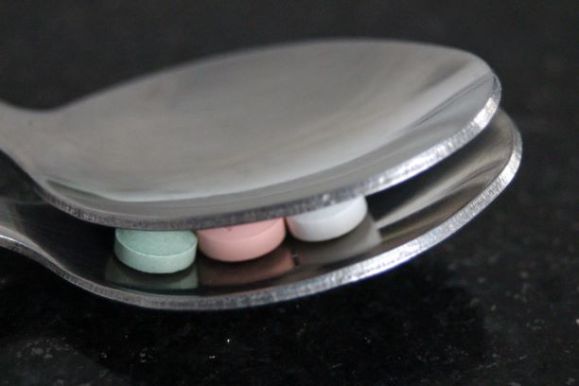
Most pharmacies carry pill crushers that can make this easier, and many of these devices leave the crushed bits in a little container to make it easy to mix with a soft food, like apple sauce, yoghurt or pudding. You also could try crushing the tablet between 2 spoons, as in the photo, if you don’t have a tablet crusher:

Another option for some medications, is to get it in liquid form. Again, this is not for controlled-release medications. If the medication is not commercially available as a liquid, sometimes your pharmacist can prepare a liquid for you from the tablets. I often did this as a compounding pharmacist.

So, if necessary, ask your pharmacist about this possibility. They will likely need to research whether the drug is stable in solution, as some medications can quickly degrade when dissolved in water, and they may want to discuss this change with your doctor. Occasionally, when a drug could not be dissolved in a watery base, I would mix it with an oil, such as canola oil, and flavour it with peppermint oil (for example, aspirin for a child).

So, if you have trouble swallowing pills there are many solutions. I hope something in this article will help you take your medication more easily! And, of course, like everything else, you will get better at taking pills with practice!

#swallowingpills #compounding

Categories
Uncategorized

Olives, almonds, jet-lag and hair


It’s Friday again. Just sitting down to write my weekly blog from sunny Spain, after 2 long days of travel and a jet-lagged day of settling in. At least the trip seemed shorter this time, since I was able to sleep during 2 of the 3 flights!


Here are my “secrets” to help your flight seem shorter and to feel more rested when you arrive:

  1. Get yourself some earplugs or put on a disconnected headset to muffle that crying baby or the chatty people who don’t realize they’re keeping others awake. If you’re a person who falls asleep to music, you could try playing a soothing quiet tune through the headset.
  2. Use a mask to shade your eyes (this one wasn’t my idea… Air France provides these on overnight flights!). Darkness tells your brain it’s time to sleep.
  3. Use a neck pillow to prevent your head from falling to one side when you fall asleep (a sudden shift in head position can easily wake you and a bad head angle is a recipe for a stiff neck!)So, not rocket science, but little things can make a difference in how you feel when you arrive, if you think to prepare ahead!


My other tip is to set your watch to your arrival time zone when you’re halfway through your longest flight. I find it works best if you do this just before or after you take your nap. For me, it seems I can fool myself into changing time zones more easily if there’s sleep involved, since I never know how long I’ve slept until I look at the time! Might not work for you, but it helped me…


And, just to follow up with my “going grey” project— above is my photo of “haircut #2”, taken on our balcony overlooking the Mediterranean. (Love it here!) I’m surprised that I look less grey than I expected, though… I guess it’s like a box of chocolates—you never know what you’ll get! Maybe I didn’t need to go quite as short as I did but it will be an easy “do” to keep up with while we’re visiting Espaňa.


I did have a question from a reader, though…what if you don’t want to cut your hair short to speed up the elimination of the dyed part? Two ideas if that’s you… First, if you’re mostly grey, you could colour the top layer platinum to match the roots, either all of the top or streaks/highlights depending on how grey your roots are. Platinum is a popular colour these days, even among younger women. Quite striking, actually! Leaving the underneath part would create a mixture of colours that would help camouflage the “change line”. This could also slow down the change-over, giving you time to get used to it all. Going natural is a change that some of us want to ease into…


A second idea, for those who have a lot of grey, would be to just “strip” out the colour from the dyed hair so it will blend with mostly white/grey roots as they grow out. I have a good friend who is using this approach, and it looks really nice! In similar fashion, some will colour their hair a light colour that will transition more easily to natural. Whatever you decide to do, a consultation with a talented hair colour specialist is always wise. They would certainly have more ideas and experience with all this than I do…


But I must add that I’ve been admiring the lovely natural-coloured styles that increasing numbers of women are sporting these days. Now that I’m paying more attention, I’m noticing so many women who are enjoying just being themselves when it comes to hair style and colour! Our own “freedom 50+”…


But now, back to my pre-supper appetizer of delicious crunchy almonds and tasty Spanish olives…

Categories
Uncategorized

Olives, almonds, jet-lag and hair…

It’s Friday again. Just sitting down to write my weekly blog from sunny Spain, after 2 long days of travel and a jet-lagged day of settling in. At least the trip seemed shorter this time, since I was able to sleep during 2 of the 3 flights!

Here are my “secrets” to help your flight seem shorter and to feel more rested when you arrive:

1. Get yourself some earplugs or put on a disconnected headset to muffle that crying baby or the chatty people who don’t realize they’re keeping others awake. If you’re a person who falls asleep to music, you could try playing a soothing quiet tune through the headset.

2. Use a mask to shade your eyes (this one wasn’t my idea… Air France provides these on overnight flights!). Darkness tells your brain it’s time to sleep.

3. Use a neck pillow to prevent your head from falling to one side when you fall asleep (a sudden shift in head position can easily wake you and a bad head angle is a recipe for a stiff neck!)

So, not rocket science, but little things can make a difference in how you feel when you arrive, if you think to prepare ahead!

My other tip is to set your watch to your arrival time zone when you’re halfway through your longest flight. I find it works best if you do this just before or after you take your nap. For me, it seems I can fool myself into changing time zones more easily if there’s sleep involved, since I never know how long I’ve slept until I look at the time! Might not work for you, but it helped me…

And, just to follow up with my “going grey”— above is my photo of “haircut #2”, taken on our balcony overlooking the Mediterranean. (Love it here!) I’m surprised that I look less grey than I expected, though… I guess it’s like a box of chocolates—you never know what you’ll get! Maybe I didn’t need to go quite as short as I did but it will be an easy “do” to keep up with while we’re visiting Espaňa.

I did have a question from a reader, though…what if you don’t want to cut your hair short to speed up the elimination of the dyed part? Two ideas if that’s you… First, if you’re mostly grey, you could colour the top layer platinum to match the roots, either all of the top or streaks/highlights depending on how grey your roots are. Platinum is a popular colour these days, even among younger women. Quite striking, actually! Leaving the underneath part would create a mixture of colours that would help camouflage the “change line”. This could also slow down the change-over, giving you time to get used to it all. Going natural is a change that some of us want to ease into…

A second idea, for those who have a lot of grey, would be to just “strip” out the colour from the dyed hair so it will blend with mostly white/grey roots as they grow out. I have a good friend who is using this approach, and it looks really nice! In similar fashion, some will colour their hair a light colour that will transition more easily to natural. Whatever you decide to do, a consultation with a talented hair colour specialist is always wise. They would certainly have more ideas and experience with all this than I do…

But I must add that I’ve been admiring the lovely natural-coloured styles that increasing numbers of women are sporting these days. Now that I’m paying more attention, I’m noticing so many women who are enjoying just being themselves when it comes to hair style and colour! Our own “freedom 50+”…

But now, back to my pre-supper appetizer of delicious crunchy almonds and tasty Spanish olives…

Categories
Health

You are what you eat… body and mind

Benalmadena on the Mediterranean Coast

Last week, I wrote about the importance of when you eat… but what you eat is also important to your health. A ranking of popular diets for 2020 ranked the traditional Mediterranean diet as #1. This rating was based on how nutritious and safe the diet is; how effective it is for weight loss; how easy it is to follow and stick with; and how well it protects against diabetes and heart disease. The Mediterranean diet is also recognized by the Mayo Clinic and World Health Organization as a healthy and sustainable dietary pattern.

Advantages of the Mediterranean diet

The Mediterranean diet is a traditional way of eating that people living in counties in the Mediterranean area have followed for generations, rather than a constructed diet based on manipulating components of food. This diet has attracted attention because of the lower rates of heart disease and cancer in populations who follow it.

While other diets are better at losing weight more quickly, the Mediterranean diet helps maintain a healthy weight without severely limiting or removing entire food groups from your plate. This can make it much easier to follow long-term. Of course, weight loss or gain depends on how much of the recommended food you eat.

This diet includes a wide variety of foods, making it enjoyable and easy to follow, with just a few basic “rules” on what foods to choose most often.

And, with this diet, a glass or two of red wine along with your meal is acceptable and possibly even advantageous but, of course, not necessary if that’s your taste. For me, that’s a plus… a nice glass of red wine makes a meal more special!

What is the Mediterranean diet?

The Mediterranean diet is more of an eating pattern than a structured diet. It is a plant-based diet that emphasizes eating fruit, vegetables, whole grains, beans, nuts, legumes (lentils, peas, chickpeas, beans, soybeans, peanuts), olive oil and plenty of tasty herbs and spices (lessening the need for salt); and seafood at least twice a week; and poultry, eggs, cheese and yoghurt in moderation. Sweets and red meat are saved for special occasions. And a splash of red wine if that’s to your taste—the recommended amount is one glass a day for women and two for men. (I have often questioned why men are thought to be able to cope with twice what women can, given the often-small difference in body weight… but that’s a subject for another blog!)

Here is how the Mayo Clinic website describes the diet:

  • Daily consumption of vegetables, fruits, whole grains and healthy fats (mainly olive oil)
  • Weekly intake of fish, poultry, beans and eggs
  • Moderate portions of dairy products
  • Limited intake of red meat

Find it tough to change the way you eat? McMaster University’s Optimal Aging Portal suggests starting with these 5 steps (Guess what? They recommend the Mediterranean diet too!):

  1. Please pass (up) the salt—reducing sodium (in salt) will help lower blood pressure which, in turn, will decrease your risk of heart disease. Try using herbs and spices for flavour instead. Note that many processed foods are high in salt.
  2. Nothing fishy about this advice—eat more salmon, mackerel, tuna and other fish high in omega-3 fatty acids. Don’t like fish? Try a fish oil supplement instead.
  3. Cut the (saturated) fat—red meat and dairy are generally higher in this type of fat. Reducing these and replacing with healthier unsaturated fats (found in plants and fish) can lower risk of heart disease.
  4. Choose a smaller plate—the size of your plate, food package, or portion you are offered (at home or in a restaurant) can influence how much you eat. Using a smaller plate and avoiding “super size” portions in restaurants can help avoid health risks associated with weight gain.
  5. Go Mediterranean—as discussed above, learn about the Mediterranean diet, where you are encouraged to eat more vegetables, fruit, fish, whole grains and unsaturated fats like olive oil. There is evidence that this diet can improve blood sugar, insulin and blood pressure as well as help you lose weight.

Diet can also affect mental health

What you eat can also influence your mental health. Nutritional psychiatry, the study of how food is connected to mental function and mood, is a new but interesting field that is working to determine the connections between our diet and our mental health.

What you eat directly affects the structure and function of your brain and, ultimately, your mood. For example, we know that the brain chemical, serotonin, affects mood and many drugs work by increasing this neurochemical. It is also linked to diseases like irritable bowel syndrome, cardiovascular disease (heart disease and stroke), and osteoporosis. And it helps regulate sleep and appetite, and inhibits pain. But 90-95% of serotonin is produced in the gut, not the brain!

We also know that what you eat influences the “good” bacteria in your intestines, your microbiome, and these bacteria activate nerve pathways directly between the gut and the brain, along with their many other effects on health that scientists are currently identifying. Studies show that taking probiotic supplements can lower anxiety levels and perception of stress, and improve mental outlook, when compared to those not taking the supplements. Many traditional diets contain fermented foods, which act to improve the microbiome in the same manner as probiotic supplements.

As well, diets high in refined sugars and processed foods, like the typical Western diet, worsen symptoms of mood disorders, such as depression, promote inflammation and oxidative stress causing harm to the brain and other parts of the body.

So, consider trying a traditional diet like the Mediterranean diet for 2 or 3 weeks. Think about adding a few fermented foods—experts suggest 5 servings a week of 3 different kinds—and see how it makes you feel.

The field of nutritional psychiatry is relatively new, but it makes sense that what we eat can affect how we feel as well as our overall health. Remember, you are what you eat!

References:

Best Diets Overall—US News

Nutrition and healthy eating—Mayo Clinic

Adopt a Mediterranean diet now for better health later—Harvard Health Publishing

5 Diet changes supported by evidence—McMaster University’s Optimal Aging Portal

Does diet influence mental health-Assessing the evidence—Medical News Today

Categories
Health

You are what you eat…body and mind

Last week, I wrote about the importance of when you eat… but what you eat is also important to your health. A ranking of popular diets for 2020 ranked the traditional Mediterranean diet as #1. This rating was based on how nutritious and safe the diet is; how effective it is for weight loss; how easy it is to follow and stick with; and how well it protects against diabetes and heart disease. The Mediterranean diet is also recognized by the Mayo Clinic and World Health Organization as a healthy and sustainable dietary pattern.

Advantages of the Mediterranean diet

The Mediterranean diet is a traditional way of eating that people living in counties in the Mediterranean area have followed for generations, rather than a constructed diet based on manipulating components of food. This diet has attracted attention because of the lower rates of heart disease and cancer in populations who follow it.

While other diets are better at losing weight more quickly, the Mediterranean diet helps maintain a healthy weight without severely limiting or removing entire food groups from your plate. This can make it much easier to follow long-term. Of course, weight loss or gain depends on how much of the recommended food you eat.

This diet includes a wide variety of foods, making it enjoyable and easy to follow, with just a few basic “rules” on what foods to choose most often.

And, with this diet, a glass or two of red wine along with your meal is acceptable and possibly even advantageous but, of course, not necessary if that’s your taste. For me, that’s a plus… a nice glass of red wine makes a meal more special!

What is the Mediterranean diet?

The Mediterranean diet is more of an eating pattern than a structured diet. It is a plant-based diet that emphasizes eating fruit, vegetables, whole grains, beans, nuts, legumes (lentils, peas, chickpeas, beans, soybeans, peanuts), olive oil and plenty of tasty herbs and spices (lessening the need for salt); and seafood at least twice a week; and poultry, eggs, cheese and yogurt in moderation. Sweets and red meat are saved for special occasions. And a splash of red wine if that’s to your taste—the recommended amount is one glass a day for women and two for men. (I have often questioned why men are thought to be able to cope with twice what women can, given the often-small difference in body weight… but that’s a subject for another blog!)

Here is how the Mayo Clinic website describes the diet:

· Daily consumption of vegetables, fruits, whole grains and healthy fats (mainly olive oil)

· Weekly intake of fish, poultry, beans and eggs

· Moderate portions of dairy products

· Limited intake of red meat

Find it tough to change the way you eat?

McMaster University’s Optimal Aging Portal suggests starting with these 5 steps (Guess what? They recommend the Mediterranean diet too!):

1. Please pass (up) the salt—reducing sodium (in salt) will help lower blood pressure which, in turn, will decrease your risk of heart disease. Try using herbs and spices for flavour instead. Note that many processed foods are high in salt.

2. Nothing fishy about this advice—eat more salmon, mackerel, tuna and other fish high in omega-3 fatty acids. Don’t like fish? Try a fish oil supplement instead.

3. Cut the (saturated) fat—red meat and dairy are generally higher in this type of fat. Reducing these and replacing with healthier unsaturated fats (found in plants and fish) can lower risk of heart disease.

4. Choose a smaller plate—the size of your plate, food package, or portion you are offered (at home or in a restaurant) can influence how much you eat. Using a smaller plate and avoiding “super size” portions in restaurants can help avoid health risks associated with weight gain.

5. Go Mediterranean—as discussed above, learn about the Mediterranean diet, where you are encouraged to eat more vegetables, fruit, fish, whole grains and unsaturated fats like olive oil. There is evidence that this diet can improve blood sugar, insulin and blood pressure as well as help you lose weight.

Diet can also affect mental health

What you eat can also influence your mental health. Nutritional psychiatry, the study of how food is connected to mental function and mood, is a new but interesting field that is working to determine the connections between our diet and our mental health.

What you eat directly affects the structure and function of your brain and, ultimately, your mood. For example, we know that the brain chemical, serotonin, affects mood and many drugs work by increasing this neurochemical. It is also linked to diseases like irritable bowel syndrome, cardiovascular disease (heart disease and stroke), and osteoporosis. And it helps regulate sleep and appetite, and inhibits pain. But 90-95% of serotonin is produced in the gut, not the brain!

We also know that what you eat influences the “good” bacteria in your intestines, your microbiome, and these bacteria activate nerve pathways directly between the gut and the brain, along with their many other effects on health that scientists are currently identifying. Studies show that taking probiotic supplements can lower anxiety levels and perception of stress, and improve mental outlook, when compared to those not taking the supplements. Many traditional diets contain fermented foods, which act to improve the microbiome in the same manner as probiotic supplements.

As well, diets high in refined sugars and processed foods, like the typical Western diet, worsen symptoms of mood disorders, such as depression, promote inflammation and oxidative stress causing harm to the brain and other parts of the body.

So, consider trying a traditional diet like the Mediterranean diet for 2 or 3 weeks. Think about adding a few fermented foods—experts suggest 5 servings a week of 3 different kinds—and see how it makes you feel.

The field of nutritional psychiatry is relatively new, but it makes sense that what we eat can affect how we feel as well as our overall health. Remember, you are what you eat!

References:

Best Diets Overall—US News

Nutrition and healthy eating—Mayo Clinic

Gut microbes important for serotonin production—Medical News Today

Adopt a Mediterranean diet now for better health later—Harvard Health Publishing

5 Diet changes supported by evidence—McMaster University’s Optimal Aging Portal

Does diet influence mental health? Assessing the evidence–Medical News Today

#Mediterraneandiet #mentalhealth #bestdiet

Categories
Health

The IF diet

When we eat may be more important than what we eat, scientists are saying. Time-restricted eating, limiting the hours when we eat, may be the answer to the many controversial diets that just don’t work. Do you have a few extra pounds you’d like to shed? I do! Read on to learn about the IF diet, a way of eating that doesn’t require counting calories or eliminating food groups, and has health benefits beyond just maintaining a healthy weight.

In lab animals, less energy intake results in increased life span. This has long been known by scientists. Energy intake can be lowered by eating less at each meal or by intermittent fasting, in other words, eating less frequently. It turns out that this good for your brain too.

Certain religions include fasting regimens in their traditions, and many famous historical figures, such as Plato and Ghandi, fasted regularly. Plato claimed that going hungry improved his ability to think. A quote from 3800 BC written on the wall of an Egyptian pyramid says, “Humans live on ¼ of what they eat; their doctors live on the other ¾.” It seems unlikely that humans throughout history ate and snacked throughout the day as most of us do.

Time-restricted eating

Intermittent fasting (IF), also called time-restricted eating, involves withholding food for a period, then eating normally. Effective fasting can last from as little as 14 hours a day, to one or two days a week, to one week a month. All regimens show benefits to health.

Firstly, intermittent fasting helps to control weight. That makes sense as you are likely cutting out snacking that you might normally have done during those hours. Excess weight is a risk for age-related cognitive impairment (possibly including Alzheimer’s disease) as well as cardiovascular disease, diabetes, certain cancers, and more. Many find intermittent fasting to be more effective in controlling weight than many other diets.

Secondly, fasting helps improve brain function. Nerve cells are more active when you’re hungry. Brain cells are challenged by the restriction in calories and react to become more efficient and form protective mechanisms. Fasting stimulates the production of proteins that promote growth and strengthen connections of brain cells. These proteins are called neurotrophic factors. An important one is BDNF (Brain Derived Neurotrophic Factor). Cognitive challenges (like puzzles or learning a new language), and exercise also increase production of these same proteins.

When you exceed 12 hours without ingesting any food, sugar levels become depleted and your body turns to using fat for energy. Ketones are produced when fat is burned for fuel and ketones are good for the brain. For example, a ketogenic diet is used to treat some forms of epilepsy, as ketones suppress seizures.

The BDNF protein increases the numbers of mitochondria (our cells’ energy factories) in the brain. This provides more energy for brain cells, an increased ability to form and maintain connections in the brain (which improves memory and ability to think), and an increased ability to repair damage to the DNA of cells, preventing cell aging.

So, scientists say 3 meals a day plus snacks is not the healthiest eating pattern. Mark Mattson, PhD at the National Institute on Aging at NIH, suggested that the statement: “Breakfast is the most important meal of the day” is not true and may have been a marketing ploy to sell breakfast foods! He has done extensive research into the pros and cons of intermittent fasting and published the results in the Journal of the American Medical Society (JAMA). Here is his list of benefits of intermittent fasting on the body and the brain:

· Blood—decreased insulin, insulin-like growth factor-1 (IGF-1), and leptin; increased ketones, adiponectin and ghrelin (hunger hormones that control appetite and energy balance)

· Liver—increased insulin sensitivity and ketone production; decreased IGF-1

· Intestines—decreased energy uptake, reduced inflammation, reduced cell proliferation

· Brain—improved cognitive function, increased neurotrophic factors, increased stress resistance, reduced inflammation

· Heart—decreased resting heart rate, decreased blood pressure, increased stress resistance

· Fat cells—lipolysis (fat breakdown), decreased leptin, increased adiponectin, decreased inflammation

· Muscle—increased insulin sensitivity, increased efficiency, decreased inflammation

Intermittent fasting promotes fat burning and the production of beneficial ketones. As well, the “housecleaning” system in humans that cleans out dead cells and other toxic and inflammatory substances, called autophagy, only activates when the bowels are not absorbing nutrients. Avoiding food for at least 12 hours is necessary to activate this essential cleaning system.

A word of caution…

If you have any chronic health condition, are elderly or for children, be sure to discuss this diet with your doctor before trying it. It is also recommended to begin slowly, for example, starting with 12 or 13 hours a day and increasing the time without food by one hour at a time to allow your body to adjust. Water, and black coffee or tea are allowed during periods of fasting and it is recommended to stay well hydrated.

Considering the potential health benefits of restricting calorie intake, I plan to shift my breakfast to a noon brunch and make sure I have my supper by 8pm, keeping my meals and snacks to an 8-hour slot each day. This seems to me to be the easiest way to take advantage of the many health benefits of intermittent fasting found by scientists. But some people may prefer to gain the same benefits by eating normally for 5 to 6 days a week and fasting (up to 500 calories per day) on the remaining days. This is sometimes referred to as the “5:2 diet” but, to me, this sounds like it would be much more difficult to adapt to.

With the intermittent diet, it’s not necessary to count calories or restrict any particular type of food, such as fats or carbohydrates. However, it’s always recommended to eat foods in their whole natural state and avoid highly processed foods as much as possible. And, again, talk to your doctor if you have any health concerns. This includes hard-to-control diabetes, children or adolescents, those over 70, pregnancy, chronic heart or kidney disease, low body mass (BMI), frailty or recent hospitalization, or history of an eating disorder.

If you are interested in learning more about the IF (Intermittent Fasting) diet, here are some sources of information: