Categories
Uncategorized

How do you kill coronaviruses?

We received a delivery the other day…brought it into the kitchen where we keep a box cutter, like we always do. My hubby cut open the tape sealing the top and then we looked at each other. Just a minute… Were we doing this right?

We both took a step back. OK, I said, you open the top flaps. The parcel was shipped over a week ago, so it’s unlikely that there could be any live virus inside, even if it was contaminated when it was packed. I’ll remove the contents with my clean hands. You put the empty box in the garage, then we’ll both wash our hands again. I think that works…

This incident got me thinking. As we start to reopen our communities, we need to pay attention to ways we might be bringing the coronavirus into our homes. We already have the habit of removing our shoes at the door and washing our hands with lots of soap for 20 seconds before we touch anything in the house. I know that if I have worn a mask outside, I need to put it into hot soapy water right away. And I know that soap kills the virus, but I needed to know more.

Going shopping?

What about parcels you bring home from the grocery or pharmacy? Do we need to wipe down every item we bought at the store? Since this is a new situation, there isn’t a solid answer to many of our questions. So, here is where I drift into logic… what I plan to do (besides moving my box cutter closer to the door!).

First, knowing how long the virus “lives” on different surfaces helps. Sources I’ve read mentioned that heat and humidity can also affect how long the virus remains able to cause an infection. Here’s some information I found:

  • Hard, smooth surfaces, like stainless steel or plastic—16 hours or up to 3 days
  • Copper is an exception—only about 4 hours
  • Cardboard (an example of a porous, organic surface)—3 to 4 hours most sources; 24 hours quoted in one source
  • Food—no evidence of people catching the virus through the food itself (cooking kills essentially all organisms)

Since many products are packaged in plastic, I plan to wipe everything down unless I know I won’t touch it again for at least 3 days like, say, those extra 3 giant packages of toilet paper that we all need to stockpile, even though it will last for months… 😊 Just kidding (I’m still working on the package I bought last December!), but you get the idea!

I always wash my fruits and vegetables before preparing, but I think I’ll wash them before I put them in the fridge to keep it clean. Although thorough testing hasn’t been done with the current coronavirus yet, there is some suggestion that refrigeration might extend the life of the virus. Rinsing with plain tap water is recommended for fruits and vegetables, as soap and detergents can seep into their porous surfaces and are not intended to be eaten.

After unpacking my groceries, I’ll disinfect the counter where unwashed items had been placed and (of course!) wash my hands. Next thought: what’s a good disinfectant to use?

What solutions should we use to disinfect?

Health Canada has a list of disinfectants that are effective against the coronavirus. Although many are industrial cleaners listed by letter/number code names, there we a few that I recognized:

  • Isopropyl alcohol 70%
  • Household bleach, diluted to 0.12%

– Check the label for bleach strength (can be 2-10%). Dilute as directed for

the strength of your bleach…

— 2%–15ml (3 tsp) per 240ml (1 cup) of water

— 4%–7.5ml (1.5 tsp) per 240ml (1 cup) of water

— 6-7%–5ml (1 tsp) per 240ml (1 cup) of water

— 8-10%–3.5ml (3/4 tsp) per 240ml (1 cup) of water

— Solution is effective for 24 hours, once diluted

— See reference below for more information on using bleach as a

disinfectant

  • Hydrogen Peroxide 0.5%

— Pharmacies sell hydrogen peroxide 3%. This would be diluted: 1
part peroxide with 5 parts of water to make 0.5% (e.g. 1 tablespoon

peroxide mixed with 5 tablespoonsful of water)

  • A few commercial cleaners listed on Health Canada’s website:

— Clorox Kitchen Cleaner and Disinfectant or Clorox Wipes

— Disinfectant Fantastik All Purpose Cleaner

— Eco Multi-Purpose Disinfectant Spray

— Lysol Multi-Surface Disinfectant Spray or Wipes

— I’ve got a package of these at my front door for doorknobs

and small packages going in or out

— 3M Surface Disinfectant Spray

— Many more—check the reference “Hard -surface disinfectants”

below

Temperatures above 56C (132F) will also kill the coronavirus, but these temperatures will cause scalding and burns, so be careful! However, this tells us that cooking destroys the virus and suggests we should do laundry in hot water if we think our clothing is contaminated (although the virus is believed to only live a few hours on cloth). Use extra caution if handling clothing that could still be carrying live viruses.

Items to be careful with when out and about, are those with smooth surfaces, and those touched by a lot of people (like door handles, faucets, computer mice/keyboards, key pads on debit machines/self-checkouts, toilet handles, latex gloves—yours or others). As a rule, indoor surfaces are riskier than outdoor ones, as the UV rays in sunlight can kill viruses. Think about your phone, too, if you use it while out (nice smooth surfaces!). See the references below for a great video on how to clean your phone. And droplets (that could contain viruses) linger for more time in still air than in moving air, for example, wind outside, or air conditioning/fans inside.

What about disposable gloves?

Gloves are good to wear when cleaning (if only to protect your hands!) and should be discarded afterward. Wearing gloves in public to try to protect against the virus can give a false sense of security. Gloves can become contaminated as soon as you touch something and viruses live longer on their smooth surfaces, creating the problem of disposing of them safely. Bare hands, however, can be sanitized by washing or using hand sanitizer.

You don’t catch the virus through the skin on your hands, so gloves don’t really give you any added protection. Gloved hands can still transmit virus if they become contaminated and you touch your face while wearing them. Medical workers have a strict procedure for removing gloves to avoid infecting themselves (turning them inside out by touching only the cuff and disposing of them immediately).

A last word about masks…

I’ve written about masks already, but just a final word about why opinions have changed regarding whether everyone should wear a mask in public until there is no risk of a second wave of COVID-19 infection… As I looked at the evidence for and against wearing a cloth mask in public (since we don’t have enough medical masks) I found a study done in 14 hospitals in Vietnam in 2015 (one of very few that have been done) that concluded cloth masks are completely useless and possibly harmful.

It didn’t take long to discover the study had a couple of serious flaws… Usually a control group is used to create a baseline of what would happen if there was “no intervention” (or no mask in this case). It turns out that over 99% of the “control” group, with which the cloth masks were compared, wore medical masks (which are known to be superior to cloth masks). This made it falsely look like the cloth mask was worse than wearing no mask at all! The other point that wasn’t obvious in the original write-up of the study, was that it was sponsored by the giant mask manufacturer, 3M, increasing the risk of bias in the study… incentive to conclude that everyone should buy masks and never trust a reusable cloth one!

A reanalysis done this year as hospitals were running out of masks, took into account that less than 1% of the control group did not wear medical masks. They suggested that cloth masks may have been as much as 50 to 70% effective in the 2015 study. Other comments also note that no information was given about the cloth masks, such as the material used, number of layers, etc. so a well-made mask made from 2 layers of tightly woven or knitted cotton fabric that fits the face snugly, could make a significant difference, especially if it is designed to hold an additional filter.

So far in North America, New York and Los Angeles county have mandated that everyone wear masks when in public to reduce the chance of viral spread and a second wave of COVID-19 infection. Unlike Asian countries, we’re not used to wearing masks and will need to adapt to the idea. As one writer in the Czech Republic commented: At first, we thought those wearing masks were weird; but within just a few days, those NOT wearing a mask were the ones who were weird… Remember that, because cloth masks are believed to be most effective at preventing you from potentially giving an infection to someone else, masks work best to prevent an epidemic when everyone wears one when they can’t be physically separated, especially since the virus can be spread by those who don’t know they have it.

But enough about the coronavirus for a while…

We’ve been inundated with information about COVID-19 for several weeks now and, although I’m sure there’s still plenty to learn as we move forward, it’s time for a little variety in my blog! I’m looking for new topics to write about. Is there a health issue you’ve been wondering about? Send me a comment or question…

References:

Coronavirus Resource Center—Harvard Health Publishing

Hard-surface disinfectants and hand sanitizers (COVID-19) – Canada.ca l

COVID-19 – Disinfecting with Bleach – Michigan State University Center for Research on Ingredient Safety

Coronavirus: How to clean your smartphone safely—BBC

A cluster randomised trial of cloth masks compared with medical masks in healthcare workers–BMJ Open journal

Comments on cloth mask study–BMJ Open journal

#howtokillthecoronavirus
Categories
Uncategorized

What comes next? Reopening our communities

Like everyone else, I’m getting fatigued with everything COVID-19, while still being fascinated by new information. But this week I started wondering… what comes next? We won’t be couped up in our homes forever (even if it’s starting to feel like it!). So, I thought I’d see what some of the experts are saying…

We’ve been told that life is unlikely to return to normal until we have a vaccine or until enough people have had the virus (and hopefully developed natural immunity) to prevent easy spread. Finding safe and effective treatments will also make a difference in how we need to behave when we leave our homes.

I read this week that the economies of many countries are the worst they’ve been since the crash of 1929. Loosening the widespread restrictions we currently have—closed businesses, restaurants and schools, physical distancing and staying at home—will help our failing economies but we risk a second wave of infection: more people catching the virus, more admitted to hospital and more dying.

It will be a careful balancing act. Experts are recommending a gradual reopening while closely monitoring for any spike in the spread of the virus. Those of us in North America have the advantage of being farther behind in the course of the pandemic and we can benefit from observing the results of actions taken in Asian and European countries where it began earlier.

So, what do experts think we need to do to reopen our countries safely? Here is a step-by-step scenario:

Phase 1—Slowing the spread

We are currently in this stage in North America. We know the extreme measures in place are designed to limit human-to-human contact, the main route of spread. We understand hand washing and sanitizing surfaces are also important to reduce the chance of viral spread through touching contaminated objects.

But we are still learning about the virus. We know it can survive 16 hours (or possibly as long as 3 days) on smooth non-porous surfaces like stainless steel and plastic (depending on the reference you read) but only several hours on porous surfaces like cloth. (Yet another reason to avoid use of plastic!). It is also affected by other factors like temperature and humidity. Experts now tell us that the virus can be passed on to others, not just by coughing and sneezing, but by simply talking and breathing.

Some countries or areas within countries are mandating use of masks in public while others are still recommending them but as a voluntary measure. We are reminded not to use medical masks, however, as supply is short and needed for those caring for sick patients. Although all agree staying at home is the most effective way to decrease virus spread especially since it can be passed on by people without symptoms, as restrictions are lifted, masks may become an important additional part of the virus control strategy.

Phase 2—Gradual reopening

Businesses and schools will gradually be allowed to reopen once 4 things happen:

  • The rate of virus spread is under control
  • There is no risk of overwhelm of health services
  • Authorities can detect local outbreaks quickly
  • Communities are able to adapt to changes necessary to prevent virus spread in workplaces, public areas (like parks) and schools as they reopen

This will not happen everywhere at once, so some communities will reopen before others. If a spike in virus activity occurs, a community may need to close again for a while.

People at highest risk, the elderly and those with chronic diseases, will still need to be protected. Those over 60 and especially over age 80 will need to continue to limit exposure to others, as these populations are at increased risk of harm from the virus. There will still be a need to control the rate of spread to avoid spikes in hospital admissions. Public hygiene will need to be improved, and cleaning of public places will need to become routine. We will be required to continue physical distancing. Public gatherings will be limited initially, and it is likely that people will be asked to wear cloth face coverings when in public to reduce asymptomatic spread, as was announced this week in New York and Los Angeles. Even the Village of Cap-Pelé, where I live, posted advice to wear a mask in public and shared a video of Dr. Jerome Adams, Surgeon General of the US, demonstrating how to make a simple mask without a sewing machine. Click here to view it.

Anyone with COVID-19 symptoms will be asked to stay home and seek testing. Tests will become widespread and routine with point-of-care (rapid, in-house) testing in health care facilities for anyone with symptoms. Contacts of positive cases will be efficiently tracked to reduce the amount of asymptomatic spread.

Phase 3—Lifting physical distancing

Once wide surveillance, safe and effective treatments and an effective vaccine are available, we will be able to lift the requirement for physical distancing.

Phase 4—Preparing for the next pandemic

It’s important that we learn all we can from this pandemic so we can reduce the impact of the next one. We need to maintain effective surveillance systems and supply chains, and enable coordination between health systems. Communicating what has been learned in each country will help us all deal better with the next pandemic and even with the yearly seasonal flu, from which too many die each year.

Watching and learning

This is where a few countries stand, as of April 16, 2020:

  • Greece closed their country early and have had a low number of cases—about 2000 in total, with 102 deaths. Restrictions remain in place there.
  • Sweden has remained mostly open, challenging the scientific mainstream.
  • The Czech Republic, where masks were mandated early, had an easier time than other countries (total 166 deaths to April 16, 2020) and is now easing their lockdown.
  • Spain and Italy both closed in a later stage of their pandemic resulting in a hard hit. This week Spain is reopening manufacturing and construction and Italy is now loosening restrictions somewhat, allowing small stores to open as part of a step by step reopening of the country.
  • Denmark plans to speed up the lifting of restrictions, after their latest numbers were lower than expected.

The actions of each country will contribute information that can be used by others. Hopefully researchers will analyze the many factors that enabled the Coronavirus to spread so quickly and widely in some areas and will determine what strategies combined to best limit it in others.

How will we all be changed?

How much this pandemic affects us over the long term remains to be seen. Will we hesitate to shake hands with a stranger? Will we continue to wash our hands more often and stop touching our faces in public? Will we want to wear a mask when using public transit or travelling by plane?

It’s hard to know right now but, after our harrowing trip back from Spain in mid-March, I expect my travel habits will change. Meanwhile, I’m keeping myself occupied by making cloth masks for family and friends. At least I feel that I’m doing something positive to help others while waiting at home for Phase 2 of this pandemic.

Are you doing anything special to keep busy these days without going near others? Comment below…

References:

National Coronavirus Response — American Enterprise Institute

A look at when and how Canada should reopen after COVID-19 closures — Global News

These countries are reopening after coronavirus – here’s how they’re doing it — CNN.com

COVID-19: As Sweden’s death toll mounts, epidemiologists urge leaders to ignore their own public health agency — The National Post

#afterCOVID19 #reopeningcommunities

Categories
Uncategorized

Haircuts and Isolation

So, I did what they all say you should never do… I cut my own hair! It started off innocently enough—I just thought I’d trim the bangs that were hanging in my eyes… and then the back that was bugging me, flipping up like a ‘do from the 60s… I thought maybe with a mirror…

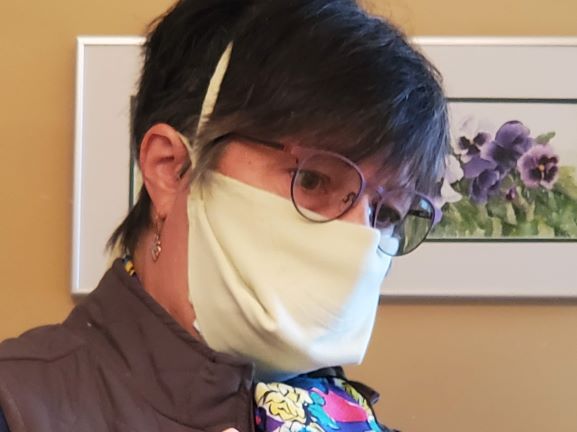
From there, it was all downhill. I’ve been dying to get rid of the last of the hair dye. Just the tips of the sides (where it was actually quite grey) still had some colour. And I had some nice sharp scissors in my hand. Thought I’d just snip off those brown tips. But, of course, you can’t just take a chunk off, even if you have thick hair like I do. The photo above of me modelling my latest mask experiment (a disposable one!) shows the new ‘do… completely dye-free now!

So, I managed to sort of even out the sides. Shall we just say it’s not the best haircut I’ve ever had… Good thing my hair is thick (it hides mistakes a bit better)! Can’t wait for my hairdresser to open up for business again for a proper cut. What’s that expression? Don’t try this at home! Or at the very least, ask someone who can see what they’re doing to do a minor trim, and only if it’s necessary for you to be able to see where you’re going!

But at least I’m not alone… There are lots of funny videos circulating on the ‘net of self-haircuts gone wrong, and white roots emerging beneath colour while none of us can access our usual hair care. My husband has been joking that 90% of blonds will disappear before the COVID isolation is over!

Making masks

I’ve been spending time every day making masks from my fabric stash. We sewers/knitters (especially those with Scottish genes like me!) save everything just in case we might need it some time. Well, the time has arrived and I’m making good use of my stash. I made about 100 masks this week for family, friends and neighbours, refining my patterns to make them faster and easier to make and more comfortable to wear. And I’ve been researching filters to put inside that will increase the effectiveness while still allowing the wearer to breathe easily.

The flat t-shirt pattern I shared last week with 2 layers of paper towel (or, even better, a double layer of blue disposable shop towels) makes a simple and comfortable mask, although a bit fiddley to put on, with strips of t-shirt material for ties. But it’s a mask anyone can make with minimal sewing that could even be done by hand if you don’t have a machine. (See last week’s blog for the pattern and instructions.) http://jeanniebeaudin.wixsite.com/author/post/masks-4-all

But my favourite to wear, is the Olson mask designed by a hospital system in the US when their supplies were running low. They even had N95 filters to insert inside. And they also have a child version of this pattern now. The original pattern is wider than needed so the sides can be folded over a thin hair elastic (which I didn’t have at home). So, I modified it by taking an inch off the sides and sewing on strips of t-shirt fabric for ties or strips of matching fabric cut on the bias so it would stretch (essentially homemade bias tape, for those of you who sew) and sewed a 4.5 to 5 inch piece on for ear loops. As you can imagine, this mask is more complex to make but it fits nicely and is easy to put on with the ear loops. It also has a pocket to put a filter into and, going forward, I think this is a good idea even if the filter is just a double layer of paper towel or coffee filter. Adding a filter makes the mask more effective.

About mid-week, as the pile of masks grew and I ran out of people to give them to, I brought a stack to our doctor’s office here. There is a large nursing home next to them and I suggested that they pass them on to the workers there or whoever they felt needed them most.

A disposable no-sew version

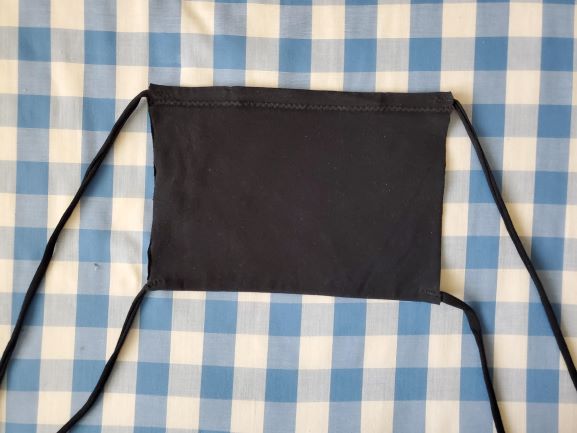
If you don’t sew, there is also a simple disposable mask made from blue shop towels, ordinary elastics, a paper clip (or 2 to 3 twist ties), tape and a stapler (shown above). Here’s a video of how to do it. I didn’t have elastics so I substituted a 30 cm (12 inch) piece of yarn (blue to match!) with a slip knot so it can be pulled snug around the face. (Put a simple knot at the end of one string, and tie another simple knot with the other end around the first string. Use this loop in place of the elastic in the video. Pull on the 2 ends to tighten once you have the mask on.)

The best way to avoid the coronavirus is still to stay home. But if you need go out for an essential errand, health organizations are recommending that you wear a mask, although governments haven’t mandated that we wear them yet in North America. The more of us who wear them, though, the less the virus will spread and the safer we all will be.

But what about gloves?

Disposable gloves, however, are much less effective because we don’t catch the virus through our skin. Gloves can pick up the virus, however, and transmit it to the face just as an unprotected hand can. And since the surface is smooth, we know that the coronavirus stays viable (”alive”) longer on a glove than it would on your hand! About the only benefit of disposable gloves I can think of, is to protect your hands from harsh sanitizers when in a situation where you can’t wash with soap and water but need to clean your hands a lot, such as on a long trip…and none of us are doing that these days! Any outings we have in potentially crowded places should be as short as possible. Get what you need, get back home, and don’t touch your face (and as little else as possible) until you wash your hands!!

So, if you’re like me, this isolation is starting to get stale, but we still need to stay home and avoid others as much as possible. We try to get out in our yard for a little fresh air every day, and I’ve been keeping busy with projects, like the masks, and learning new things. My current learning project is how to do audio…so stay tuned for the podcast version of this blog (if I can figure it all out…)!

Resources:

Homemade mask from blue shop towel

Olson Mask (fitted with filter pocket) (see link to download about halfway down the page)

Olson Mask in child sizes (see link to download about halfway down the page)

Masks 4 All (with t-shirt mask pattern)—Jeannie’s blog last week

Categories
Uncategorized

Masks 4 All?

We are learning new information on COVID-19 every day. As much as we are saddened, stressed and fatigued with news of the virus, we do need to pay attention to the news because what we need to do—how we need to change our behaviour—is constantly changing.

The consensus on whether the public should wear masks is changing too. Various countries have taken a different approach to masks and researchers are noticing that masks for all is one of the strategies that successful countries, with the flattest curves on graphs of both cases and deaths, included masks along with physical distancing, washing hands, disinfecting surfaces regularly and staying home as much as possible.

The reasons given for not advising the public to wear masks when outside their homes include:

1. They have not been proven to be effective

2. They may encourage people to touch their faces to adjust the mask

3. Non-healthcare people don’t know how to put on and remove a mask properly

4. Masks need to be saved for healthcare workers, as there are not enough available for everyone (at least in North America)

In my opinion, reason #4 should be listed first…

There is no question that high-level masks should be reserved for those working directly with people who are infected. The N95 mask is designed to filter out 95% of particles from air the wearer is inhaling. This includes bacteria, viruses and fine mist that is generated during certain medical procedures. But simple, inexpensive, homemade cloth masks may be all the is needed by the general public.

The key function of masks worn by the public is to prevent people from exhaling bacteria and viruses when they talk or cough. It is known that some people have few or no symptoms of COVID-19 but can still unknowingly spread the disease. When you wear a mask to the grocery store or pharmacy, you are mainly protecting others, more than yourself. Wearing a mask doesn’t mean you don’t still have to wash your hands and avoid touching your face…it’s an extra measure of safety that is added onto what we are already doing to help protect others. Any of us could have the coronavirus but not realize we do because we do not have any symptoms. Because of the way they work, homemade cloth masks work best when everyone wears one.

Reason #1: not proven to be effective

So, are masks worn by the public effective? As medical policy makers have been saying, there is no proof they are…until now. Research in Asian countries and in Czechoslovakia, where rates of coronavirus spread are impressively low, is suggesting that their policy of masks for all is making a difference. Countries, like South Korea, Japan and Hong Kong where wearing a mask in public when you are sick is a custom, are among those with the lowest curves showing numbers of cases. As China opens up businesses and people there return to work, we will see a further test of masks combined with other strategies as the world watches whether a second wave of coronavirus can be prevented there.

Meanwhile, growing evidence of virus spread by people without symptoms is prompting the World Health Organization and governments to reconsider their policies stating that masks do not need to be worn by the public. Masks are recommended to be worn by those with symptoms that suggest COVID-19 infection, but it is beginning to seem likely that it is also being spread unknowingly by people with the virus who do not have a cough, sore throat or fever.

Reason #2: “may” encourage people to touch their faces

My first question is: do healthcare workers touch their faces more when wearing a mask or to they adapt to it quickly when told they must not do this? This, again, has not been proven to be a problem when wearing a mask and, in fact, I’ve read the opposite expert opinion elsewhere: that a mask stops a person from touching their face…it physically block you from doing this. The jury is certainly out on this one… Let’s just say that the rule of avoiding touching the face is still an important one and must be remembered whether you wear a mask or not.

Reason #3: lack of education about how to use a mask

A significant cause of infections of healthcare workers is improper removal of contaminate protective clothing. Remember that the purpose of Personal Protective Equipment (PPE) in hospitals is to create a layer that blocks viruses from reaching the worker. In the process, the outside of the equipment (including the mask) is very likely to be contaminated. The worker must learn to remove the equipment without touching the outside as this would expose them to viruses and bacteria.

But is this also an issue for people who wear a mask in public? The main purpose (as stated earlier) is to prevent the public from expelling droplets that may contain viruses when they talk or cough. This makes removal technique much less important than for those who are surrounded by viruses as they work with sick patients every day. But, just like learning to wash our hands properly, members of the public can learn to take precautions when removing their masks.

When removing your mask, it is best to handle it only by the straps or elastic, avoid touching the outside or inside and put it directly into hot soapy water (soap kills the coronavirus) or a mild bleach solution (1 part bleach to 9 parts water). Leaving it in a laundry basket can create risk of exposure for the person doing the laundry later, although generally viruses do not live more than a few hours on porous surfaces like cloth or paper. You could also put your masks into a laundry bag or pillowcase to enclose them until wash day. After removing your mask, you should wash your hands…but if you’ve just returned from an “outdoor adventure” (like shopping 😊) you should be washing your hands anyway.

The mask also needs to be put on properly for best effectiveness…it should fit as snugly as possible to maximize the filtering effect, including squeezing the metal clip or wire that is (hopefully) inserted in the edge positioned over the nose. The mask must be kept over both the nose and mouth to be effective, and we’ve all seen photos of people who have only covered their mouth with the mask or (heaven forbid!) dropped it below their chin to talk.

Remember that it is also possible to catch viruses through the eyes (although less common than through the mouth and nose), so wearing glasses to protect the eyes is also a good idea.

Reason #4: not enough masks to go around

We know that there are problems providing enough masks for our front-line healthcare workers who really need them. If everyone starts competing for the limited supply currently available, the problem will become worse. We cannot allow that to happen.

The earliest masks were a piece of fabric tied across the face, first used during the bubonic plague. Even these simple masks were reported to result in fewer infections in those that wore them. In areas of the US hardest hit, seamstresses and quilters have started making masks from cloth and many have posted patterns on the internet to encourage others. I saw a photo of homemade masks left hanging outside in Czechoslovakia for anyone needing one to freely help themselves.

The initial thought was that, even though these homemade masks are untested, it was better to have an untested one than nothing at all. But there have been preliminary tests that show this: a cloth mask does not filter as well as an N95 mask, but it does make a difference. Patterns that allow a filter to be inserted may provide even better protection. Paper towel is suggested as a simple filter that adds to the effectiveness while still allowing you to breathe easily. A double layer is more effective. And stay tuned as researchers look at what materials work best. We may need to use these for 12 to 18 months, until a vaccine is available.

So, I made 27 masks this week. I distributed some of these to my friends, family and neighbours along with the pattern so they can make more. A double layer of cotton t-shirt fabric or tightly woven cotton are suggested as effective fabrics and the stretch allows a comfortable and snug fit without using darts or tucks, keeping the construction simple and quick. Five to six adult- and 2 child-sized masks can be made from one large adult cotton t-shirt. The sewing so limited the mask could be sewed by hand if you don’t have a sewing machine. I will post the pattern and instructions for use below. This design fits best if the top straps pass over the ears and the bottom straps are pulled up and fastened at the top of the head. Note that woven cotton, cut on the bias (diagonal) provides some stretch.

I plan to make as many as I can—although I may be limited by my t-shirt supply (any donations welcome!)—and I want to encourage others to wear them and make them too! Will you join me in the movement to slow the spread of COVID-19 by helping to make “masks 4 all”?

Slogan for the mask campaign in Czechoslovakia:

“My mask protects you. Your mask protects me.”

References:

WHO considers changing guidance on wearing face masks- The Guardian

CSC considering recommending general public wear face coverings in public—The Washington Post

Alternative fitted face mask pattern–Unity Point Health (made with t-shirt fabric or woven cotton)

Jeannie Beaudin’s Simple Mask Pattern (with filter pocket)

Made from a t-shirt, preferably 100% cotton, heavyweight

Sides are left open so a paper towel (folded in half) can be inserted as a filter for extra protection. One large short sleeve t-shirt makes 5 or 6 adult and 2 child size masks.

Cut across the t-shirt, 13 inches up from the hem. Turn inside out and cut away seams from the sides. Save to use as ties. Cut 9-inch strips, so you have 9 x 13 rectangles with one 9-inch edge already hemmed (from the bottom of the shirt). This edge will form the top of the mask.

You will be able to get 2 from the bottom front, 2 from the bottom back plus 1 to 2 from the upper section , depending on the size of the t-shirt. Sleeves can be made into child-size masks or ties if necessary.

Insert wire of some kind into the pocket formed by the t-shirt hem. Four-inch pieces of pipe cleaner, or 2 to 3 twist ties can be used. Center the wire then stitch across the pocket on each side of it to keep it centered.

Fold up the bottom so it just overlaps the hem stitching. Zigzag along the overlap or hand sew with hem stitch if you don’t have a machine.

The ones from the upper back won’t have a pre-hemmed edge. Fold this 9 x 13-inch rectangle in half. Stitch a ¼-inch seam across the 9-inch side. Place your wire on top of the seam allowance, and stitch in place with a wide zigzag stitch that jumps over the wire or hand-stitch in place. Turn right side out and press lightly.

Cut strips ½ to 1 inch wide from leftover fabric for ties. There will likely be enough in the lengthwise fabric since most t-shirts are more than 18 inches wide, but they can also be cut crossways from the upper part of the t-shirt or the sleeves. If you want to be “fancy” you can pull lengthwise on the strips so they curl, then stitch with a zigzag stitch to keep them folded in half.

Stitch securely to each corner of the mask. Can tuck the end of the strap between the layers before stitching.

Child mask is made the same way from the sleeve fabric or other leftover sections. Trim to width needed to reach from front of one ear to the other. Depth can be adjusted to reach from bridge of nose to under the chin when folded in half.

To wear:

Fold a piece of paper towel in half and insert into the mask through the side opening. One piece of multi-size towel works perfectly. Place the wire edge over the bridge of your nose. Pass the upper ties over your ears and tie snugly behind the head. Pull the lower ties up and tie near the crown of your head. Tuck the sides in under the ties that are pulled upward, making a neat little pocket. Squeeze the wire so it fits snugly over your nose (this will keep your breath from escaping and fogging your glasses!). Wear glasses for extra protection for your eyes!

To remove:

Try to hold the mask by the ties when you remove it (the front could be germy…). Remove the paper towel from the pocket through one of the side openings and discard immediately. Drop the mask into hot soapy water, swish/ soak for 5-10 mins so mask is well exposed to soap (soap kills viruses!), rinse, wring, roll in a towel to absorb excess moisture and hang to dry. Wash hands!

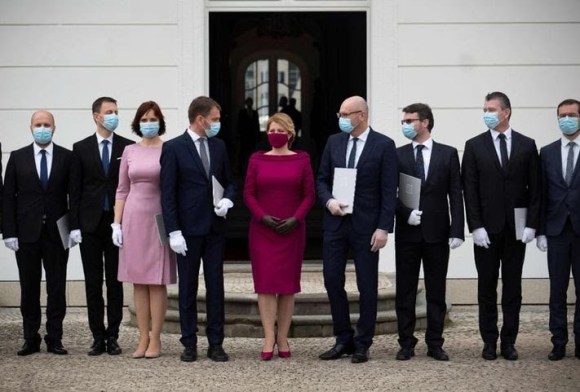
P.S. Won’t we all be stylish this spring! You could make lots of different colours to match your favourite outfits this summer!! …Just like the Prime Minister of Czechoslovakia 😊

#Masks4all #shouldwewearamask #howtomakeafacemask