Categories
Uncategorized

Einstein and Feynman’s advice for learning…

I came across an article that really resonated with me on a site called Mind Café…about 2 secrets to learning faster and remembering more of what you learn, as suggested by Albert Einstein and Richard Feynman, 2 famous physicists. Let me summarize it for you…

The first tip, from Albert Einstein, is to enjoy what you are learning… my take on that is to learn about subjects you are interested in. For example, I’ve been studying Spanish. I love to go to Spain, and it’s been helping me to understand signs and menus there. I’m still trying to learn to speak better, and that’s my current challenge.

Of course, sometimes you need to learn something that is, shall we say, less than exciting to advance in your job or to continue to do the job you’re already doing correctly. But, at the very least, you can set yourself challenges and take satisfaction on the achievement when you finish.

Increasingly, learning is being presented in an entertaining way. “Gamification” of learning, where lessons are turned into a game, is designed to hold your attention on the material, make it more fun and challenging, and give you a series of rewards throughout the program to give a feeling of achievement. Some learning games even create a competition between users to inspire them to study harder and longer!

The second secret, from Richard Feynman, is to teach others what you are learning. In addition to repeating the material as you do this, you also need to understand a concept well to explain it to another person. Even being able to summarize the essentials of what you are learning, requires you to have a good understanding of what you’ve been reading or studying. Feynman explained that the hallmark of true genius is the ability to explain a complex subject very simply… simple enough for an 8-year-old to understand! He was noted for being able to do this with quantum physics.

Using the material you have learned is known to be a good way to remember more of it, especially for adults. And teaching it to someone else is an effective way to use your new knowledge. Often the person you are teaching will have questions that will make you think more deeply about what you have learned, solidifying the new memories you have formed.

I think these two tips, enjoying what you learn and teaching or explaining it to others, resonated with me because (without realizing it) this is what I’ve been doing since I retired. I use a game called Duolingo every day to learn Spanish, and I write this blog to tell others about what I’ve been reading and learning! With my blog, not only do I constantly read so I will have something interesting to write about, I learn more about writing through this weekly practice I really enjoy. Interaction with readers is the icing on the cake. It’s so nice to hear from people and know that some actually read or listen to my articles!

Life-long learning is something that was not only encouraged but required when I was a practicing pharmacist. I still review educational programs for Canadian pharmacists, so I guess I never stopped my pharmacy learning. The practice of pharmacy constantly changes—new drugs, new regulations and, these days, new diseases to learn about. With the current pandemic evolving, there is new information almost every day, requiring us to change our behaviour. Even the experts are learning constantly about this virus. While this learning may not be enjoyable, I think we all realize how important it is for us to get it right. For some, it could be illness or death, for those around us if not for ourselves.

Lastly, learning something new keeps your mind sharp and your brain functioning, helping you to age well. And it helps to make you a more interesting person to socialize with too! You’ll always have lots to talk about when you keep learning new things.

So, leave a note below in the comments about something you’ve enjoyed reading or learning recently. It will help you remember and learn better, and maybe you’ll interest other readers in your favourite topic!

Reference:

2 Secrets to Learning Anything Faster: Lessons From Albert Einstein and Richard Feynman — Mind Cafe

#agingwell #lifelonglearning

Categories
Uncategorized

COVID is in the air…

A new study has found that “Airborne transmission of COVID-19 represents the dominant route for infection” and “wearing of face masks in public corresponds to the most effective means to prevent interhuman transmission”.

These are conclusions from a study done by the PNAS (The Proceedings of the National Academy of Sciences of the USA), published June 16th. The combination of airborne transmission plus asymptomatic carriers is a recipe for an epidemic that is difficult to control. And that’s what we’re seeing.

Asymptomatic spread

We now know that there is a high rate of viral spread through asymptomatic carriers—people with no symptoms. Estimates vary from 25% to over 50% of cases originating from those who never get symptoms or have not yet started to show symptoms like fever and cough.

Airborne transmission

And, while 2 meters (6 feet) is known to greatly reduce virus transmission, other factors like air currents, temperature and humidity, can affect the length of time viral droplets and mists remain in the air and are able to infect those who inhale them. This makes it possible to transmit the virus in some situations even when physical distancing is maintained, and hands are washed properly. And we’ve all been in situations when you can’t keep even 1 meter (3 feet) distance.

Enter the mask…

This new study calculates that thousands of cases have been prevented in cities and countries where governments have mandated masks must be worn in public places. By examining changes in the rates of new infections after masks were mandated to be worn by everyone in public, the researchers estimate that over 78,000 infections were prevented by masks in Italy and over 66,000 in New York City from April 17th to May 9th.

The study looked at rates of new infection in various countries, and how the rates changed as they implemented various measures, as a way to scientifically determine the effectiveness of different strategies. While some countries, like China, mandated lock-downs, hand hygiene and wearing masks all at the same time, other countries made these changes separately, allowing researchers to determine the effect of each measure.

By analyzing the changes in the curve of disease cases when each new strategy was started in Wuhan, China, Italy and New York City between January 23rd and May 9th, they were able to illustrate the impact of each measure. The study showed that, while physical distancing made a small difference, the change was greater when masks were mandated to be worn by everyone when in public.

The reduction in new cases of COVID-19 when masks were mandated is clearly visible on graphs—with a “flattening of the curve” easily seen. This contrasts with the rest of the world where physical distancing, quarantine and isolation continued to be used alone. Here is one of the graphs… the circled dots show when masks were mandated to be worn in public in Italy and New York City:

You can see that the curve of the pink line representing NYC doesn’t change significantly as it crosses the 2 lighter blue lines representing social distancing and stay-at-home orders, but it drops noticeably after the circled dot marking the mandating of masks in public.

Researchers concluded that “wearing of face masks in public corresponds to the most effective means to prevent interhuman transmission, and this inexpensive practice, in conjunction with simultaneous social distancing, quarantine and contact tracing, represents the most likely fighting opportunity to stop the COVID-19 pandemic.” They also stated, “Other mitigation measures…are insufficient by themselves in protecting the public.”

Virus behaviour

We now know the main way of passing the coronavirus is breathing in air after an infected person has exhaled. Because of the high rate of asymptomatic transmission, chances are, this person wouldn’t even know they were infected. Washing your hands won’t prevent you from inhaling infected droplets. But masks can. This virus likes to hang out in the nose (as compared to SARS and MERS that preferred to stay in the lungs) so it is more likely to be breathed or coughed out that those previous similar infections. Shouting, singing, and even talking loudly can send a mist of tiny viral droplets into the air, some as an aerosol that can linger for much longer than suspected initially. Hand washing can protect you from virus in larger droplets that have settled on surfaces, and physical distancing reduces the number of particles that reach you, but masks are needed to prevent those who are sick but not diagnosed from unknowingly creating a contaminated aerosol mist that others can inhale.

World Health Organization (WHO)

However, the World Health Organization (WHO) insists that “masks alone are not a replacement for physical distancing, hand hygiene, and other public health measures.” But, they say, cloth masks may provide a “modest reduction in transmission” by:

· “reducing the risk of asymptomatic carriers spreading the virus”

· “reminding the population that the pandemic is ongoing and everyone can play a role in stopping it” as well as

· Stimulating the economy by “encouraging the public to create their own masks.”

They also suggest there are disadvantages to cloth masks worn by the public:

· Touching the mask too often (usually due to a poor fit)

· Potential to cause headaches, breathing difficulties or skin irritations and

· The possibility of creating a “false sense of security” as they are not 100% protective

Note that these disadvantages are not supported by objective research. I find it odd that a high level of proof is required to recommend a measure, but they readily share disadvantages with no objective studies. I can’t help wondering why they are so hesitant to recommend a safe measure like masks, especially now that plenty of supporting science is emerging for this strategy. You can read or listen to more about reasons to wear or not wear a mask in my blog “Masks 4 All” (Blog or audio track).

And this week (to add to the confusion) the WHO stated there was no evidence of asymptomatic virus spread, despite many studies that found this is a major problem with COVID-19. They later explained that they were referring to non-symptomatic people who never showed symptoms but had had a positive test, not those who were pre-symptomatic and developed symptoms within a day or two. Pre-symptomatic people are known to be highly infectious. There are plenty of examples of “super spread” events involving infected individuals who progressed to symptoms soon afterward.

This certainly demonstrates the importance of clear communication. As one friend said, whatever they tell us today will probably change by next week. Confusing messages create mistrust of advice from authorities and result in fewer people following recommendations to limit viral spread. We are seeing this especially in increased numbers of infections in young people in their teens and 20s.

Meanwhile, the WHO reported the highest number of new cases yet on June 8th, bringing the global total to 8 million, and they stated that the pandemic is worsening. We need to continue physical distancing, hand washing, and staying at home as much as possible. And there’s enough evidence now to know that adding a mask whenever we cannot stay away from others will further reduce new cases. It’s so easy to become complacent… but we’re not out of the woods yet. In fact, you could say we’re still in the middle of the forest!

In Canada…

In Canada, British Columbia and New Brunswick (my province!) are leading the way with good control and low numbers of cases. Experts attribute this to:

· strong leadership with clear communication and quick decision-making,

· better data transparency with open reporting of cases and

· a high level of cooperation by the public. New Brunswick’s mainly rural population is also believed to be a helpful factor.

So, why do I keep talking about masks?

I feel compelled to keep talking about masks when I read they work but still see how few people in my community wear them. While reports suggest there are very few cases in our area, it’s only a matter of time until one arrives here, as happened recently in northern NB, and without masks the virus can quickly spread until it’s detected and those affected are traced and isolated. It’s even more important in urban areas with higher population density.

Governments are too often slow to respond, but the evidence is clear now. If at least 80% of people wear masks when in public places, the pandemic can be controlled. If you can’t wear a mask for health reasons, it’s OK as long as the people around you wear one. If you dislike wearing a mask or can’t wear one, minimize your time in public places—and just stay home. That works too! But, most of us need to do our part and find some type of face covering we are comfortable wearing, if we want to stop the spread of COVID-19.

So, what’s your favourite type of mask? Are you able to adjust it properly so it feels comfortable? I keep searching for the perfect design…

References:

Identifying airborne transmission as the dominant route for the spread of COVID-19 – PNAS

A modelling framework to assess the likely effectiveness of facemasks in combination with ‘lock-down’ in managing the COVID-19 pandemic – Proceedings of the Royal Society

Geography, leadership and sheer luck: Why BC and NB flattened the curve so quickly – CTV News

#domaskswork #howdoesCOVIDspread

Categories
Uncategorized

Masks and Condoms…More in common than you think!

Oooh… really?

I have a riddle for you this week. How are face masks and condoms alike?

Answer: Most people would rather not use either of them! But…

Masks and condoms both protect the person wearing them, they reduce the chance of passing a disease to the person you are with (even if you don’t know you don’t have one), they are a minor inconvenience and they’re inexpensive. They both have also become more popular because of dangerous diseases—COVID-19 for masks, and HIV/AIDS for condoms. And neither works perfectly…but they’re better than using nothing at all! But some people still don’t want to use them, even though they know they really should!

People all over the world are wearing masks in public now as part of the strategy to slow the spread of the coronavirus and save lives. But some North Americans are refusing to use this minor inconvenience even though there is plenty of evidence now that face coverings of any kind can make a difference. Are people just too uncomfortable? Embarrassed? Don’t believe the experts? I was curious so, of course, like any typical baby boomer, I started reading… and I learned there are many different reasons people will refuse to wear a mask.

Culture

First, wearing a mask isn’t part of our culture here in North America (except among health care workers) and people often feel uncomfortable with change. Other parts of the world, like Asia, had already started using masks in public when previous viruses that didn’t reach here caused deaths. They also used them to protect themselves from high levels of pollution in dense cities. Apparently, wearing a mask when you’re ill there is so imbedded into the culture, it is considered very rude and inconsiderate to cough or sneeze into your hand or sleeve—you are expected to wear a mask if you are sick, even with a cold. So, the culture was already different in Asian countries. However, masks were accepted quickly in Europe and Scandinavia when they were threatened by COVID-19, so that’s only a small part of the explanation.

Vanity

Our face is what we show the world—part of what makes us attractive to others and recognized by friends. Women wear makeup to enhance their looks. Men show their character through grooming, facial hair, and a healthy smile.

One article I read, even suggested some people feel wearing a mask makes them appear weak and overly worried about an invisible threat. Healthy, strong people usually only get a mild case, so wearing a mask must suggest you aren’t healthy and strong, right?

But, because we now know that the virus is easily spread by those with no symptoms, we all need to think about the people we could unknowingly pass the virus along to. How could you not feel guilty if you caused someone else to suffer and possibly die? Young, healthy people wear masks to protect others more than themselves… caring for others isn’t a weakness.

Communication

A large part of communication is visual. The expression on a face tells a lot of what a person is thinking. A smile brightens someone’s day. Some people worry about that loss of communication, and it’s important. But they say the eyes are the window to the soul…perhaps we can learn to read expressions in the eyes better, just like those who are blind become more sensitive to sounds. And, like the blind, we can learn to be more sensitive to the tone of voice that speaker is using.

But another option to improve visual communication and facial recognition, is the face shield. Although not considered quite as effective as a well-made mask, shields still make a difference in reducing dispersion of droplets so use will reduce the spread of the coronavirus. There is also an option for children, who might have difficulty with a mask, with the shield attached to a sun hat. Note that masks are not recommended for children under age 2.

Physical discomfort

Many people find wearing a mask just plain uncomfortable. It can be stuffy and hot, feeling your breath in your own face. The elastics can make your ears sore, the fabric can make your nose itchy…

The key here is to have a mask that fits properly. You want it snug but not so tight it pulls your ears forward. It should have enough room for your nose and be made of a material that is smooth enough not to irritate your face. It needs to fit closely enough that air doesn’t pass around the edges and be “breathable” enough that you can breathe easily through the fabric. And, especially as summer arrives, you want it to be absorbent so it will stay cooler on your face. I hope manufacturers and researchers are working on this! Since it is likely to be over a year until we have a vaccine for everyone, we need good quality reusable masks and information on the best materials to use if making them yourself.

Confusion

Another problem in convincing people to wear masks in North America, is the confusion over whether we really need to wear one in public. Initially, authorities told us masks were not necessary and might even increase our risk but, with research, this has been shown to be incorrect. Recommendations have gradually changed from “don’t wear a mask” to “they might help” to “you should/must wear a mask when you cannot stay more than 2 meters (6 feet) away from others”. The initial recommendations were based on a lack of information (because the virus is so new) and the worry that the public would buy all the available masks, leaving none for front line health care workers who needed them more. Enter, the homemade or store-bought reusable cloth mask…problem solved!

We know that staying at least 1 meter (3 feet) apart lowers the risk of catching the virus and that 2 meters (6 feet) is better, and that a mask isn’t needed if you can maintain that physical distance. But there are lots of places that this is just impossible…like at the Costco! There are just so many aisles and corners, and people going everywhere, that you never know when you’ll end up too close to someone you don’t know. And some services, like the post office, paying for purchases, or getting your hair done, require a small distance between people to complete the service. Wearing a mask in some cases is necessary for the worker and the client to stay safe. Essentially, masks allow more people to go back to work with much lower risk to their health and for the safety of those they serve.

Political

It’s hard to imagine, but the health-related issue of wearing a mask has become a political issue in some areas. Some people tolerate change better than others, and I suspect that the wholesale changes we’ve endured with self-isolation, quarantines, and physical distancing are taking their toll on the mental health of many. Demanding that they also cover their face has just been too much for some, adding to the mental stress that’s already sky-rocketed over the past few months. Refusing to wear a mask when required is a way of rebelling, of demanding a return to a normalcy we can’t safely have right now. Life is hard for so many in 2020. It will be difficult to find a cure for all of what’s happening, but we have to keep moving ahead, one step at a time.

And me? Do I wear a mask?

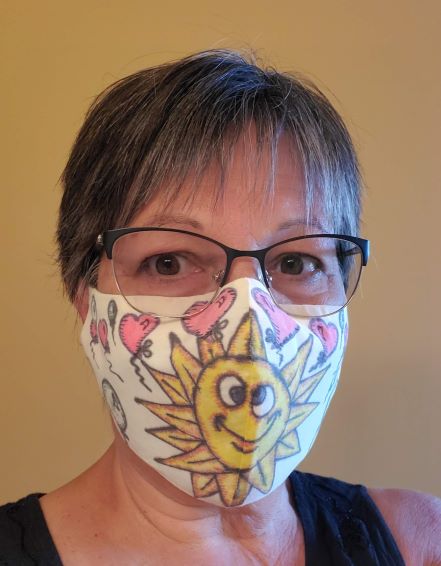
I’m what you’d call an “early adopter” … I started wearing a mask in mid-March when I arrived home from a winter vacation a month earlier than planned. My husband and I were in Spain as the country was shutting down due to the virus and we were lucky to get a flight home as quickly as we did. We tried to buy masks to protect ourselves on the 3 flights and 4 airports we had to pass through, but there were none left for sale anywhere. I started making masks for myself, friends and family as soon as I arrived home, knowing what was coming.

I also accepted covering part of my face more readily than many would because of my past experiences. As a hospital pharmacist, I prepared sterile medicines and was required to wear a surgical mask (sometimes for hours at a time) to protect the products I was making. We all breathe out little droplets containing bacteria when we talk and exhale and just a single droplet falling on the medicine meant it would no longer be sterile. Later, as a compounding pharmacist, I worked with potent drugs in powder form. I needed to upgrade to an N-95 mask then to filter the air I was breathing, so I wouldn’t inhale powders that escaped into the air. So, I was used to the concepts of protecting myself and others by wearing a mask.

Of course, some people cannot tolerate wearing a mask—for example, those with breathing problems like asthma or emphysema, those with mental health problems, or children under 2 years. But, as with vaccines, if those who can wear a mask do it, those who can’t will be protected. Recent modelling suggests that, if 80% of people wore a cloth mask in public, the spread of the virus could be stopped. Over 90 countries now require masks to be worn in public places and countries that adopted this policy early along with other measures all have had less than 1000 deaths due to COVID-19.

But we all need to realize that most of us only need to wear a mask for short periods of time—only when we are not sure we can stay at least 2 meters away from others. I keep one in my pocket or purse whenever I go out so I can slip it on when needed. Here in New Brunswick, Canada, we are told we must put one on when entering a public place, but we can remove it if we see that we will be able to keep our distance from others once inside.

I have never had to wear mine for more than an hour at a time. It is different for workers, though, and they should have several washable masks, so they can change to a fresh one every few hours. They would also benefit from breaks during the day in a place where it’s safe to remove the mask for a while. But, like health care workers, it’s something you just get used to because it’s necessary.

And what about you?

Have you started wearing a mask when you can’t keep the required physical distance from others? Are there other reasons not to wear a mask that I haven’t discussed? Please send me a comment!

References:

The psychology behind why some people won’t wear masks—CNN https://www.cnn.com/2020/05/06/health/why-people-dont-wear-masks-wellness-trnd/index.html

A Doctor Explains Why 45% of All Americans Refuse to Wear a Protective Mask—Forbes https://www.forbes.com/sites/johnbbrandon/2020/05/06/a-doctor-explains-why-45-of-all-americans-refuse-to-wear-a-protective-mask/#2a188b29213d

Why are people refusing to wear masks amid coronavirus threat?—KSAT.com https://www.ksat.com/news/local/2020/05/27/why-are-people-refusing-to-wear-masks-amid-coronavirus-threat/

Refusing to Wear a Mask Is a Uniquely American Pathology—SLATE https://slate.com/news-and-politics/2020/05/masks-coronavirus-america.html

Over 100 health leaders to governors: Require masks to help contain the coronavirus—USA Today https://www.usatoday.com/story/opinion/2020/05/14/require-masks-stop-coronavirus-spread-over-100-health-leaders-column/5182076002/

#whywearamask #howeffectiveareclothmasks

Categories
Uncategorized

Could screen time be good for you?Health Technology During COVID…

Working virtually—from home—has become a reality for an estimated one-third of workers, but what about health care? There are many forms of technology that can protect and improve our health…like apps and online sites designed to measure health information and motivate us to increase healthy activities and habits. And to avoid spread of the coronavirus, many doctors have been seeing patients virtually…by phone or video. Turns out it’s a convenient and efficient way to care for patients that may be the way of the future, even after we have a vaccine.

Virtual consultations

I first started thinking about how technology could help us be healthier when I was contacted by a Canadian health care company, Maple, who wanted to advertise on my blog. You may have noticed that I don’t advertise, mainly because I don’t want anything I say to be influenced or censored or even to appear to be biased in any way. But I found the concept of being able to contact a doctor through an app to be interesting. With this company, you can speak to a doctor within 24 hours, specialists as well as general practitioners are available, and the cost is $49 to $99 per consultation, depending on the time of day and day of the week. They also coordinate virtual staffing of a small hospital that lost its only doctor. I understand there are similar companies in other countries as well. Of course, in Canada, we have universal medical coverage, making this a less attractive option for the general public.

But then I realized my province offers virtual consultations with all our doctors, a new service that began being covered with the outbreak of COVID-19. And so do all other provinces and territories in Canada, with most advising doctors to provide telemedicine or virtual care when possible. Seems not that long ago, doctors were refusing to handle prescription renewals by phone because there was no compensation for the time required to complete this (often time consuming) task. Patients love the convenience and are happy to avoid the waiting room, especially with the current increased risk of disease. Doctors comment that they can see more patients in less time. I guess it takes an emergency to advance the system quickly.

But we’ve had an “811” line for several years, staffed by nurses, to give advice for health problems that aren’t a “911” emergency. It’s free for all, covered by Medicare, and has been working well to reduce the load on emergency departments, where people often end up when they aren’t sure what is wrong. So, I guess we’ve had virtual care for a while but, with the current health crisis, it’s been greatly expanded.

Technology at home

The internet is a wealth of information, although some sources are better than others. It’s amazing what we can do on our phones and laptops now to improve or monitor our health. I have vetted the following sites/apps as best I can, but please check with your doctor before acting on any information contained in these online/virtual sources. To evaluate any online information source, look at who developed or posted it, when it was last updated, and whether they are selling you something… and ask your doctor, nurse practitioner or pharmacist to verify it is an accurate source of information.

So, the following is a list of apps and online information sites that I’ve found, several of which I use myself and others that look interesting. I hope you will find some of these useful:

  • Fitness trackers – There are many of these available, from simple pedometers to track your steps and distance walked or biked each day. It’s fun and motivating to see how far you’ve walked at the end of the day, week or month and to compare how you’re doing over time. I especially like to use one of these when on vacation to see how far we walked each day.
  • Exercise apps and websites – If you want to exercise at home, there are lots of sources of online sessions you can access for free with different levels of intensity or experience. Some will even send you reminders to exercise. Many require little or no equipment and often only limited space is needed.
  • Nutrition apps – While it’s time consuming and unnecessary for most of us to track everything we eat every day, it might be something you want to do for a while if on a special diet. Many have nutrition information built in to help track calories, carbohydrates, salt or specific nutrients in foods (for example, calcium might be of interest to someone with bone loss). Some are geared to specific diets, like Keto or Vegetarian. I noticed one (Veganized) that even tracks nutrients to ensure a balanced diet, as well as enabling meal planning and shopping lists. Others simply give a breakdown of nutrients in a measured amount of food for information purposes, like carbohydrates for those on a keto diet, without tracking everything you eat.
  • Mental health – Meditation guides, mood journals, sleep aids are designed to help you learn to meditate or relax to enable falling sleep. Two popular ones are Calm and Headspace, if you are interested in learning to meditate. Sleepwell.NS’s website: www.mysleepwell.ca is a site I often recommend to those who have problems sleeping and want to avoid medication.
  • Brain training – Like every part of the body, exercising the brain helps to keep it functioning well. While I use blogging to keep my brain active, some like to play brain games to stay sharp and have a little fun. Some people even find these relaxing and de-stressing after a busy day. From word games (Scrabble online, Wordscapes), logic puzzles (Sudoku, logic puzzles), and memory games to more specific exercises for those with brain injury, there are plenty to choose from, many for free. I like to play solitaire to pass the time and challenge my brain a little—once, as I was getting of a flight, a man who had been sitting a couple of rows back asked me if I won my game! My mom did the newspaper puzzles every day for years, and most of these (Cryptoquotes, crosswords) are available online now, with new ones each day. Just search “brain games” in Google Play or the App Store to find something you’d enjoy.
  • Disease monitoring — There are many apps for diseases like diabetes that require constant monitoring. Most blood glucose meters have an app from their manufacturer that stores the readings and helps interpret this information, and some will even automatically detect the results of tests you do. Your doctor can provide the monitoring information you need to set it up, for example, high and low blood sugar level limits for a diabetes program. He’ll also likely be interested in the reports it produces!
  • COVID-19 — There are even apps to track the coronavirus and keep us informed about our level of risk. The Canada COVID-19 app provides alerts for your area of Canada, a symptom tracker, daily updated stats, a self-check assessment, what to do if you get sick and more. And there are others, some designed to simply provide information or to track cases. Be sure to check on the privacy disclosure of how any data they collect is being used.
  • — If you are a health care worker, the Open WHO app from the World Health Organization provides courses to educate workers, decision makers and the public on various health emergencies and procedures, including COVID-19. Note: Choose your preferred language, as courses and information are provided in several languages.
  • — Some countries are using tracking apps to enable contact tracing—a potentially life-saving type of app that all countries may need to consider in anticipation of a second wave of infection.
  • Communication — And, of course, who hasn’t heard of Zoom? Our family has long been Skype users…there’s something special about being about to see as well as talk to someone. They say that communication is 70% non-verbal, so that’s probably why. I can tell you that my Mom always preferred Skype to a telephone call, even when she was in her 80s and 90s! Making video calls is even easier now with many choices of programs. Besides Skype and Zoom, there are Whereby.com, WhatsApp, Messenger and, I’m sure, others that allow you to communicate with messages, voice and video. Nothing like being able to talk face-to-face with someone you love when you’re isolated and can’t visit!

Our smart phones really are “smart” enough to help us stay healthy if we use them fully. Have you been using any helpful apps I haven’t mentioned in the past couple of months? Please let me know so I can add them to the list!

Reference:

Telemedicine and virtual care guidelines—Royal College of Physicians and Surgeons of Canada