Categories
Uncategorized

Ecotherapy: the Park Prescription

When you were a kid, did your Mom just tell you to “Go outside and play” like mine did? Turns out, she wasn’t just getting you out of her hair. She was doing something that was good for your health, something more than encouraging you to get some exercise. And now, doctors are doing the same, even for us grownups. Some are now writing prescriptions instructing their patients to spend a specific amount of time outdoors, in nature, each week.

Ecotherapy

It turns out that there are many heath benefits to spending time, not just outdoors, but in a natural setting. Ecotherapy is a newer scientific field that studies the effects of natural settings on our health. Studies comparing brain activity of healthy people after a 90 minute walk in nature, as compared to a similar walk in an urban setting, have shown reduced stress, anxiety and depression. They also found decreased repetitive thoughts, lower blood pressure and decreased levels of the stress hormone, cortisol, that raises blood pressure and cholesterol, causes inflammation and has other detrimental effects when it is elevated too long.

Benefits were noted after about 20 minutes, so each session in natural surroundings is recommended to be at least this long.

What are the benefits?

Exercise

First, there’s the most obvious: exercise. Many of us do something active while we’re outside and away from our entertaining screens. I’m sure you already know the benefits of exercise in improving health and reducing risk of many diseases from heart disease and cancer to the risk of falling, with a long list between these two, not to mention maintaining healthy bones and muscles.

Exercise is important for all ages and levels of fitness. I remember seeing an elderly woman in Spain, walking on the Paseo Maritimo with her walker, enjoying the sunshine and view of the Mediterranean in spite of her level of disability. Even a small amount of movement can maintain or improve your capacity for exercise and ability to function.

Mental health

You might be less aware of the mental health benefits of being outdoors, even if you’re just relaxing on a park bench. Appreciating nature’s beauty distracts us from our worries and even improves depression and anxiety. It’s just plain good for your mental health. I’ve found that a walk on the beach near my home, regardless of the weather, always makes me feel better when I’m upset about something. It even helps make a good mood better than ever!

Interestingly, even bringing the sounds of outdoors to those who cannot get outside is reported to make a difference in brain activity, directing attention outward, distracting focus from worrying about problems. Looking at pictures of nature, especially a favourite spot or a place you’d like to visit, is also helpful in distracting from inward-directed focus that occurs during anxiety, post-traumatic stress disorder and depression.

Immune system

But you may not realize that, when you’re outside in a natural setting, you also expose yourself to a variety of healthy microbes that are different from what are in your home, just by breathing. Some call this “forest bathing” but healthy microbiota exist in any park or garden with plants and trees, not just in large forests. Perhaps a better term is “nature bathing”, immersing yourself in nature.

Spending time outside in various natural settings increases the variety of microbes in our bodies, along with the exposure we choose when eating various fermented foods that contain microbes, like certain cheeses (cheddar, gouda, and mozzarella), yoghurt, kefir, miso, and fermented vegetables or pickles made without vinegar. Microbes we inhale eventually are swallowed and added to the mix. Scientists now recognize that the digestive system is much more than just a way to get nutrients into our bodies. The types and balance of bacteria, fungi and viruses living there (collectively called the microbiome) produce nutrients for us, influence our immune systems and even communicate with our brains.

And we can’t forget about COVID…

These days we have even more reason to spend time outdoors. We’ve learned that improved ventilation and maintaining space from others are important factors in reducing spread of viruses and being outside in fresh air provides ideal ventilation and plenty of space to spread out while still enjoying the company of others. Of course, it will still be a while until crowded venues, like outdoor concerts, are recommended but we’re seeing higher numbers allowed for outdoor activities than for indoor ones because of the infinite “air exchange” nature provides, the natural movement of air that carries away those nasty viruses, if any happen to be present.

So, don’t be surprised if the first prescription your doctor gives for a milder health complaint is a “Park Prescription” with instructions to spend a couple of hours a week at your local park or even just 20 minutes 3 times a week. In fact, the benefits of a Park Prescription could be expected to add to any other treatment you may need to use. If you have other health conditions, your doctor may also have additional advice or cautions as you start your “prescription”.

This is a world-wide movement inspired by Healthy Parks Healthy People, an initiative of the National Park Service in the UK and being promoted in Canada by Park Prescriptions, A Prescription for Nature.

You can read more about it below, but why wait for your doctor to tell you to get outside and enjoy nature? After over a year of COVID restrictions we all have at least a little COVID fatigue… the “COVID-osis” I wrote about a couple of weeks ago. Isn’t it great to know that just going outside and absorbing a little nature can get us on the road to a cure!

Note: The above photo is of a little creek flowing into the Saint John River (in the background), on a walking trail near the Princess Margaret Bridge in Fredericton.

#mentalhealth #forestbathing #NaturePrescription

References:

Health benefits of nature—Healthy by nature

PaRX– A Prescription for Nature

11 Probiotic Foods That Are Super Healthy—Healthline

Healthy Parks Healthy People—National Park Service

Sour mood getting you down? Get back to nature—Harvard Health Publishing

Spending time in nature helps mental health—CBC News

Categories
Uncategorized

Seasonal time change-Love it or hate it?

This year I voted for the first time ever in a TV News poll. The question was: should we continue to change clocks in this spring and fall? I voted no!

Why vote no?

Changing our clocks often creates confusion. Not all countries change at the same time and some areas don’t change at all now. It doesn’t take much imagination to understand the confusion this must create for travellers, airlines, distance meetings on the Internet, and showing up for church on time on that first Sunday.

For example, I always assumed that all countries changed their clocks at the same time. How else could international travellers and transportation systems manage during that week? We jokingly chastised a friend for arriving an hour late at our meeting place while staying in France, presuming she’d forgotten to change her clock. Later we realized Canada changes a week before Europe does and, of course, we were following Canadian news. I had wondered why my phone hadn’t changed the hour automatically… turns out it was smarter than we were!

But time change can also affect health and how well you sleep while your body adjusts its daily cycles by that hour. Animals, plants, and even microbes have these daily cycles as well as humans. They are part of the biological clock which controls cycles of various lengths, some of which are longer than a day, like women’s menstrual cycles. The daily cycles are called circadian rhythms, from the Latin term “cerca diem” which means “around a day”.

Each of us has our own ”chronotype”, or individualized daily rhythm. Some of us are “early birds”, others are “night owls”, and these tendencies often run in families. But our rhythms are also affected by factors outside the body, especially light, including artificial light from our home lighting and devices. Getting more or less sleep than usual, changing time zones, and working a night shift can affect circadian rhythms. Hormone changes like menopause and the menstrual cycle can also have an influence. And aging can change your circadian rhythms too—our chronotype is often different in later life than it was when we were teenagers, sliding us more toward the “early bird” type, quite different from the teenage “night owls” who love to sleep in.

Your body has its own clock… located in the brain

Biological rhythms are controlled by a cluster of neurons (nerve cells) called the SCN (superchiasmatic nucleus) located in the hypothalamus section of the brain. It’s located behind the eyes, it’s very sensitive to light, and it receives direct nerve input from the eyes.

The SCN sends signals throughout the body to regulate many activities. It cues systems like digestion to produce digestive enzymes at mealtimes, and the endocrine system to produce hormones that wake us and help us go to sleep. The sleep/wake cycle is one of the most well-known circadian rhythms. Those who are completely blind and keep their eyes closed during the day, can reduce the amount of light falling on the back of the eyes enough to disrupt their day/night cycle. I had a young client who was blind that used a drowsy-causing antihistamine to help correct his sleep/wake cycle because of this many years ago.

Circadian rhythms can also affect metabolism and weight gain by regulating blood sugar and cholesterol production. They can control how sharply your brain focuses and can affect risk of mental health problems like depression, bipolar disorder, and dementia. The immune system is also influenced, impacting DNA repair and our natural systems of cancer prevention.

What can time change do?

Arbitrarily changing the time with the season means all these automatic functions need to shift by an hour. We know that travel across several time zones requires a major shift of circadian rhythm, with the well-known fatigue we call “jet lag”. But even 1 hour can leave us tired and not functioning our best for a few days while we adjust to the sudden change, rather than experiencing the gradual change of the seasons.

Circadian disruptions, even of only 1 hour, have been shown to result in serious sleeping problems – struggling to fall asleep, waking during the night, and being unable to sleep as long as you want in the morning. Disruptions are also suggested as potentially contributing to obstructive sleep apnea, where breathing stops briefly, disrupting sleep and decreasing oxygen levels.

Timing of drug administration in relation to circadian rhythms may influence drug effectiveness too. Chronobiology, the study of the effect of the circadian rhythm on our biology, is part of a current area of research into personalization of medicine along with other factors that affect an individual’s response to medication.

What can you do to help stabilize your circadian rhythm?

Going to bed and getting up at the same time each day helps to keep the circadian rhythm on an even keel. Using less bright lighting after sundown, and especially reducing blue light that the SCN is most sensitive to, can reduce the effect on your circadian rhythm and your sleep. Most devices have a dimmer for the screen and some now have built-in filters for blue light, the colour of light that seems to affect the SCN most.

Why do we change the clocks anyway?

Originally clocks were changed to provide more daylight hours for farmers and the “war effort”, while keeping sunrise earlier during shorter winter days. But is this still needed with mechanization of farming and the peace time we now enjoy? Or is it just a habit or tradition? Several jurisdictions have already fixed their clocks and more are considering it.

Why did I vote to freeze clocks?

I voted we should stay permanently with Daylight Savings Time in that CTV opinion poll, mainly because of the unnecessary confusion created by the shift and the lack of a good reason to continue the tradition. But this year I noticed it took me longer to adapt to the change. It’s Thursday as I write this and last night was my first good night’s sleep this week. It’s taken me four days to adapt my internal clock to the 1 hour shift last Sunday. So negative health effects are another reason to stop seasonal time adjustments. I was happy to see that the majority in the poll voted to stay in Daylight Savings Time permanently too!

So, how did you make out this week? Did you find yourself a little draggy in the morning? Any trouble falling or staying asleep? I’m curious… Shall we do our own little poll? Are you in favour of eliminating the twice yearly time change? Vote below!

References:

What to know about circadian rhythm—Medical News Today https://www.medicalnewstoday.com/articles/circadian-rhythms?utm_source=Sailthru%20Email&utm_medium=Email&utm_campaign=MNT%20Daily%20News&utm_content=2021-01-12&utm_country=&utm_hcp=&apid=30707099

Circadian Rhythm—Sleep Foundation https://www.sleepfoundation.org/circadian-rhythm

Circadian Rhythms—NIH National Institute of General Medical Sciences https://www.nigms.nih.gov/education/fact-sheets/Pages/circadian-rhythms.aspx

Get in Touch With Your CircadianRhythm—WebMD https://www.webmd.com/sleep-disorders/find-circadian-rhythm#1

#sleepbetter #circadianrhythm #seasonaltimechange

Categories
Uncategorized

Neti pots: salt, steroids, baby shampoo?

People have used saline rinses for the nose and mouth for centuries, and doctors still recommend them for minor infections and pain. Rinsing helps to wash away bacteria and viruses and inactivates some of them, giving our immune system a better chance to overcome the invaders. But what’s the best solution to use?

Chronic sinus problems…

When I first went to my doctor with a sinus problem that wouldn’t go away, she suggested trying a neti pot rinse with saline 3 times a day as a first treatment. While it helped clear away some of the excess mucous that was clogging my breathing, the relief was very temporary. I progressed to steroid nasal sprays that, again, gave only short-lived improvement and subsequently to an Ear, Nose and Throat specialist who gave me more steroids in a higher dose, this time in a form designed for inhalation but mixed with saline and used with a neti pot. You may remember the blog I wrote about the vertigo and tinnitus that developed after just three weeks on that regimen. On hindsight, it may have been because I used it at bedtime, thinking I would sleep better if I could breathe through my nose. Some of the solution probably stayed in my sinuses longer that it should have because I was laying down, increasing my exposure to the drug and worsening the side effects.

Through all this, I couldn’t help thinking that there must be bacteria or yeast that were the underlying problem but weren’t being addressed. My sinus problems had started right after a nasty chest infection–why would parents bring their terribly sick, coughing child into the pharmacy, infecting others, while waiting for his prescription to be filled?? We know now that masks are an excellent tool for preventing spread of infections–we should continue using them when we are ill even after the pandemic is under control. Sorry for the rant…

It took 2 courses of different antibiotics to clear my chest infection and I suspected it was a resistant organism that was at the root of my chronic sinusitis. However, I was told that we couldn’t do a culture of the sinuses to see what was going on. It was frustrating to be treating only symptoms and not the cause. Especially after my reaction to high dose nasal steroids, I didn’t relish using them for the rest of my life and worried I might eventually lose my hearing (a year later, I still have tinnitus in one ear…)

Adding baby shampoo…

So, it goes without saying that I read everything I come across about the nose and sinuses. And, a few weeks ago, I found an article about using baby shampoo in a neti pot for chronic sinusitis. Baby shampoo? Yes, but well diluted, of course, down to 1%, or one ml in 100 ml of saline. Normal saline, a solution of salt in water that is the same saltiness as tears and other body solutions, is used rather than plain water, as it is much less irritating to the sensitive lining of the nose. The writer described getting significant relief from his chronic sinusitis of many years, when nothing else had helped, by using soapy water as a nasal rinse.

Of course, I dug further into the science. Shampoos and other soaps contain surfactants, chemicals that break up surface tension, allowing oil and water to mix, and (as we all know in these days of COVID) they actually kill many infectious organisms. Some bacteria produce a “biofilm”, a film that protects them against our immune systems’ advances, making them more resistant. The surfactants in shampoo help to break up these films, allowing the immune system to do its thing more effectively. Baby shampoo is gentler than many other soaps, being designed for babies, so is chosen because it will cause less irritation in the sensitive lining of the nose.

I couldn’t wait to try it… in fact, I tried some liquid hand soap I had on hand but it was quite irritating. I don’t recommend this! But the baby shampoo didn’t irritate my nose, although I read some people do complain of this. Reducing to 0.5% might solve the problem if you experience irritation, but it might not work as well.

However, this has been a game-changer for me! I no longer have to take decongestants or steroid spray every day. In fact, I can’t remember the last time I used either. And, once the congestion was under control, I found I didn’t need to use the 1% shampoo in saline rinse every day. However, it’s safe to use daily if needed. I find that using a nasal rinse with 1% baby shampoo 2 or 3 times a week keeps everything under control for me.

So, here’s how I do it:

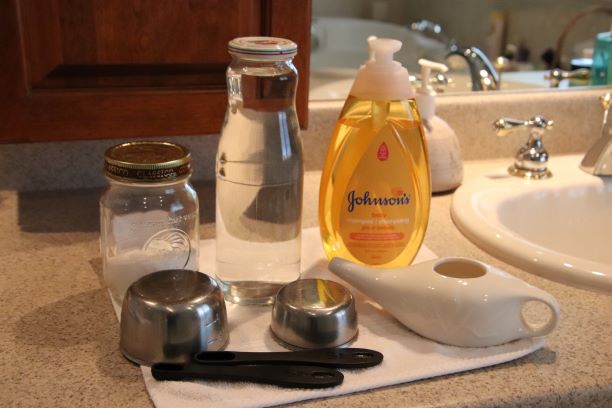
  • I use 2 measuring cups (1 cup and ½ cup), measuring spoons (1/2 and 1/4 tsp), non-iodized salt, baking soda, and baby shampoo (preferably unscented). I find the shampoo bottle with pump attached is really convenient.
  • I boil tap water and let it cool, but you can also use distilled water. Boiling kills any organisms that might be in the water and evaporates chlorine that is usually added to city water supplies. I do a kettle full, pour it into a glass jar while still hot, and store it in in my washroom with the rest of my equipment.
  • Mix up some salt and baking soda–I mix 1 tablespoonful of baking soda with 1 cup of sea salt. They recommend avoiding iodized salt, as the iodine can be irritating. Note that proportions of salt and baking soda vary in different recipes, up to half and half, but I find the mixture above works fine.
  • To prepare the solution, I use 2.5ml (1/2 tsp) of the salt mixture in 250ml (1 cup) of water and stir well until dissolved. Some recommend warming the water to body temperature, but I find room temperature is fine (and simpler!)
  • I pour half the solution into a 125 ml (1/2 cup) measuring cup, then add 1.25 ml (1/4 tsp) of baby shampoo to the remaining ½ cup and stir well. It takes a couple of minutes of stirring for the shampoo to mix in thoroughly.
  • I do a rinse with the soap solution first, then usually do a few other things, like rinsing off the equipment I’ve used and brushing my teeth (letting my sinuses “soak”, so to speak), then I rinse the soapy solution out of my nose with the remaining non-soapy saline solution.
  • Make sure your equipment is thoroughly cleaned after each use. I rinse everything with hot tap water immediately after using then let air dry, and I spray with alcohol then let dry after every 2 or 3 uses. You can also just put the equipment in the dishwasher to clean everything well.
  • And here is a video of how to actually do the neti pot rinse.

What about COVID-19? Can nasal rinses help?

Of course, in these days of the coronavirus pandemic, many are wondering whether nasal rinses can prevent or treat COVID-19. While it is unlikely that it could be a cure, studies have shown that saline rinses can reduce viral shedding in ordinary coronavirus infections like the common cold, making the infection less likely to spread to others. Adding a surfactant, like baby shampoo, would be expected to have a better chance to neutralize the coronavirus as it is an enveloped virus (surfactants can disrupt virus coatings, as they do when we wash our hands properly). Studies on the effects of nasal rinses on COVID-19 are ongoing (so no conclusions yet), but it’s interesting that we do know the spread of influenza and common colds could be reduced somewhat, along with congestion symptoms, by using a nasal rinse with baby shampoo when infected. So, while it’s not likely to be a cure, using nasal rinses when infected may be able to reduce the risk of spreading the novel coronavirus.

Of course, wearing a mask is almost certainly far superior at preventing infection than trying to rinse the virus away could be. Once the virus has entered the nasal passages, rinsing could only be expected to temporarily reduce the virus count, even if effective, so we want to prevent it from getting into our bodies through proper use of masks and physical distancing from others.

Sore throats and minor mouth infections

Saline solution (without shampoo!) can also be used as a gargle for minor sore throat or sore mouth (such as a canker sore). It is less important to use purified water and normal saline, as the lining of the mouth is not as sensitive as the nose. I like to use lots of salt and warm tap water so it will dissolve faster when using as a gargle or mouth rinse.

My hubby swears by using salt for a sore throat or mouth sores (something he’s done since he was a child), and he’s right—it really works quite well to relieve soreness and speed healing. Of course, if the pain is severe or you don’t get relief from milder pain within a couple of days, see your doctor. You may have a more serious infection. Although the solution is safe, it is recommended not to swallow it, especially if you have high blood pressure, as salt can increase pressure in some people.

So, have you tried saline rinses or gargles? Is it a family tradition? I’m wondering how many know about and use this simple at-home treatment…

References:

Impact of Nasal Saline Irrigations on Viral Load in Patients With COVID-19—U.S. National Library of Medicine https://clinicaltrials.gov/ct2/show/NCT04347538

No, Mouthwashes and Nasal Rinses Aren’t Cures for COVID-19—Healthline https://www.healthline.com/health-news/no-mouthwash-and-nasal-rinses-arent-cures-for-covid-19?c=197157373360

Baby shampoo nasal irrigations for the symptomatic post-functional endoscopic sinus surgery patient—American Journal of Rhinology http://www.neilmed.com/articles/babyshampoo.pdf

What to know about gargling with salt water—Medical News Today A guide to salt water gargles: Sore throat, other conditions, and recipe (medicalnewstoday.com)

#netipot #sinusrinse

Categories
Uncategorized

Neuropathic pain… oh my nerves!

Neuropathic pain is pain caused by nerves that aren’t working as they should. Put simply, nerves are long thin cells that carry messages of body sensations to the brain, and commands for movement back to the body. The brain is made up of a complex network of nerves that interpret messages and communicate with each other, allowing us to think and feel. When nerves become damaged, messages can become disrupted or nerves can simply start firing on their own, creating false messages such as pain when there isn’t a problem. We call this neuropathic pain, pain that is caused by the nerves themselves malfunctioning.

In contrast, “nociceptive” pain is caused by an injury, physical pressure or inflammation in some part of the body. The nerves are working properly when they send pain messages to the brain telling you there is something wrong. Your nerves can also trigger a sub-conscious reflex movement that reduces damage, like pulling your hand back from a hot surface even before you realize you’ve burned your finger.

What does it feel like?

Neuropathic pain, pain caused by the nerves themselves, can be mild or severe, permanent or temporary. It can feel like burning, throbbing, electrical-like sensations, tingling “pins and needles”, increased sensitivity, itching or just numbness. Basically, whatever the nerve is supposed to do can either be blocked or “overdone”, depending on whether the damaged nerve stops transmitting signals or starts firing randomly because of damage or pressure. Sensations can be changed when sensory nerves are damaged or squeezed and, when motor nerves are affected, the ability to move can be blocked (for example, paralysis with a stroke) or uncontrolled (as when muscles twitch).

What causes it?

Neuropathies can often be hard to diagnose and treat, and there is a wide range of causes for damage to nerves. Some of these include:

  • Diabetes—High sugar in the blood causes damage to tiny nerves in the hand, feet and eyes, leading to numbness and loss of vision over time, especially when blood sugar levels are not well controlled.
  • Cancer and cancer treatments—A growing tumour can press on nearby nerves inhibiting their function or causing pain. Cancer drugs, with their toxicity spilling over onto our own cells, can cause damage to nerve cells too. Numb fingers are common with some chemo treatments, but these nerves usually repair themselves after treatments are finished when dosages are carefully monitored.
  • Neurological diseases—Some diseases cause symptoms by having an effect on nerves, like multiple sclerosis, a disease where the myelin “insulation” around nerves becomes damaged, resulting in nerves firing randomly or signals being unable to travel through the nerve.
  • Stroke—A stroke results from blood not reaching part of the brain, either because of a blood clot or because a blood vessel has burst. Without blood and the oxygen and nutrients it carries, nerve cells in the brain die and cease their function. Interestingly, sometimes other nerves can take over the function, allowing a significant amount of recovery. This is called “plasticity”… the ability of tissues to grow and change (somewhat like molding plastic!)
  • Shingles—After you have chicken pox, the herpes zoster virus doesn’t totally disappear. It stays dormant in nerve cells, waiting for its chance to come back as shingles, a nasty painful/itchy rash with fluid-filled bubbles on the surface of the skin. While it’s reactivated, the virus can cause damage to the nerve it’s growing in, sometimes resulting in ongoing pain signals being generated even after the virus infection is subdued and the rash is healed. This is known as “post herpetic neuralgia”, and can last weeks, months or even years. Treating the virus infection quickly with an anti-viral medication will reduce the nerve damage and chance of developing long-term problems. It is recommended to start treatment within 72 hours but the sooner, the better.
  • Phantom limb pain—It’s hard to imagine, but almost 80% of people with amputations can have pain or itching that their brain is telling them is occurring in the limb that is no longer there. These sensations are likely initiated in a nerve that has been cut or damaged in the surgery sending signals that the brain interprets as coming from the absent limb. It must be so frustrating to have an itch that you can’t scratch!
  • Nutrient deficiencies—Lack of a nutrient essential for nerve health, for example vitamin B12, can also be a cause of malfunction of peripheral nerves, those in the extremities. Interestingly, metformin, a commonly used medication for diabetes, can reduce absorption of B12, leading to a deficiency in significant numbers of patients, and increasing risk of numbness in the hands and feet that is often blamed on the diabetes itself.

And there are many other diseases that can cause misfiring of nerves. I occasionally get a burning sensation on the outside of one foot—it took me quite a while to figure out it was a compression neuropathy, caused by a muscle spasm in my calf pressing on the nerve to my foot. I get quick relief from this foot pain by massaging my calf. Who would have thought! Unfortunately, in some people the source and exact location of the problem are never identified.

Focal neuropathies are those focused in one spot of a single nerve, making them easier to treat once diagnosed. Peripheral neuropathies, for example diabetic neuropathy, can be widespread since the cause (high sugar in the blood) originates in the blood that circulates throughout the body.

Treatment

Of course, addressing the cause (like taking an anti-viral for shingles, keeping diabetes under control, or using massage as I do for my foot pain) is an ideal treatment if this is possible. Otherwise, using medication that modifies how nerves fire, like anticonvulsants, antidepressants or drugs that block certain pain receptors within the body, can be helpful to reduce discomfort. There are also drugs that can activate calming pain-blocking pathways, like the GABA pathway and alpha adrenergic pathway in the body.

Commonly used neuropathic pain medications include anticonvulsants like gabapentin/pregabalin, and carbamazepine (Tegretol), and tricyclic antidepressants like amitriptyline or desipramine. Magnesium supplements (especially if the diet is lacking in magnesium) are sometimes helpful, as well as substance P blockers like capsaicin (a non-prescription cream) or loperamide (an antidiarrheal medication that can also be made into a cream by a pharmacist). In difficult to treat neuropathies, pain receptor blocking drugs like ketamine (yes, the date-rape drug!) may be tried.

As a compounding pharmacist, I have often made some of these into a penetrating gel when the location of the damage was known and this avoids side effects commonly noted when taking it by mouth. Because the medication is delivered directly to where the problem is, much less is needed and side effects like drowsiness and stomach upset are essentially eliminated. This allows us to combine several drugs that work to block pain in different ways into one product. One favourite that often works well is a combination of ketamine (an NMDA blocker), gabapentin (an anticonvulsant AMPA blocker) and clonidine (an alpha-adrenergic blocker).

Sometimes the pain and sensitivity were so great, the person couldn’t tolerate rubbing a pain cream onto the skin. In these cases, we would supply a lidocaine spray in a water base (avoiding alcohol that could cause painful coolness as it evaporated) to numb the skin before using the pain gel.

It has been very gratifying, as a compounding pharmacist, to be able to help people who were not getting pain relief from the standard medication. It was at a pain conference that I learned how muscle spasms, where muscles become thickened and shortened, could cause pain in a different part of the body by pressing on nerves or pulling on tendons that attach muscles to bone. This results in pain being sensed in a different location than the origin of the problem, making it more difficult to diagnose the source.

If you suffer from neuropathic pain in spite of treatment with standard medication, I highly recommend asking a local compounding pharmacist trained in pain management to work with your doctor. Together the 3 of you can work to find alternative solutions to calm your pain.

#NeuropathicPain

References:

Types and causes of neuropathic pain—Medical News Today

Algorithm for Chronic Neuropathy—Professional Compounding Centers of America (PCCA)