Categories
Uncategorized

May is Cancer Research Month…

Finding cures, debunking myths, searching for causes
Cancer research is gradually turning cancer into a chronic disease for many and a cure for significant numbers. Cancer is a generic term for a collection of diseases that can affect any part of the body. While there are similarities in these diseases, there are differences that require tailored approaches. The causes vary with various types of cancer.

Similarities

All cancer involves uncontrolled growth of cells in the body, caused by damage to the growth control mechanism in the cell. Most of the time, damage is repaired by our immune system or the cell just dies, preventing cancer from developing. Too high a rate of damage (for example, caused by daily cigarette smoking) or too little repair (for example, increases in rates of cancer as we age and our immune systems become less efficient) can increase the chance of a damaged cell growing and dividing unchecked.

Differences

Some cancers are easier to detect, either because of where they are located (e.g. on the skin) or because we have a test that will detect changes early (e.g. mammograms for breast cancer, PSA blood tests for prostate cancer). Like any disease, cancer is easier to treat successfully when detected early, while the growth is small and hasn’t spread.

Cancer myths debunked

Myth—Cancer is a death sentence

In increasing numbers, cancer is becoming a chronic disease or is cured completely. We all know someone who had cancer 10 or more years ago and is doing well. I have a friend whose cancer was 25 years ago and has had no sign of recurrence.

The 5-year survival rate for all cancers combined is now about 67%; those for breast, prostate and thyroid cancers are 90% or better. Researchers are constantly finding better treatments and methods to detect cancers early when they are more easily treated. Survival rates have increased by 1.5% on average each year since 2001.

Of course, ideally we want researchers to find the causes of cancers and to recognize pre-cancerous changes so we don’t need to suffer through treatments and worry. Cell changes in the cervix, and bowel polyps are now recognized as potentially pre-cancerous changes that are searched out and treated before cancer can develop.

Myth—Cancer is contagious

Cancer cannot spread from on person to another. However, a few cancers are caused by an infection that can be passed to another person. Two examples are cervical cancer, caused by human papillomavirus (HPV), and liver cancer, that can be caused by hepatitis B and C viruses. We now have vaccines to prevent these infections which are reducing the cancers they cause.

Myth—Cell phones cause cancer

Somehow the rumour that 5G cell signals cause cancer has been spreading through the internet. While we do know that exposure to ionizing radiation (e.g. X-rays) can cause cancer, cell phones emit radio waves, a type of non-ionizing radiation that has never been found to cause cancer.

Myth—Artificial sweeteners cause cancer

Although older sweeteners, like cyclamate combined with saccharin, were found to cause bladder cancer in lab animals, currently used sweeteners, like stevia and the sugar-alcohols (e.g. erythritol, sorbitol), have been well tested and were found to be safe. Aspartame has also been tested in over a half million human subjects and no links were found to various cancers, like lymphoma, leukemia or brain cancer.

I’ve found that aspartame and some of the other artificial sweeteners tend to have an unpleasant aftertaste, however, especially when too much as been added. Of course, we know that too much added sugar is bad for our health. Excess artificial sweetness may fit into the same category by keeping up our cravings for the sweet taste. But it’s surprising how quickly our taste will adjust to less added sweetness, as it does for decreased salt. Since cutting back on sugar and salt, I find many commercial baked goods too sweet or salty for my taste preference now. I commonly reduce sugar in recipes by 1/3 to 1/2.

Myth—Herbal medicines can cure or treat cancer

While some natural medicines or treatments like acupuncture and massage may help with side effects or the stress of cancer or its treatment, none has been shown to cure or treat cancer.

Remember that herbal medications are medicines still in their natural form, and can have side effects or drug interactions you need to watch out for. For example, kava kava may cause liver damage and St. John’s wort can increase the effects and side effects of some antidepressants, since it works by a similar mechanism. Be sure to discuss any use of herbal medicines with your doctor or pharmacist.

Myth—Most cancers run in families

While an estimated 3 to 10% of cancers are the result of inheriting a faulty gene from a parent that increases cancer risk, most cancers are not inherited. Most cancers are believedthoroughtly to be caused by damage to one or more genes that starts in a single cell during a person’s lifetime.

A newer alternative explanation for cancer, being investigated, is that damage occurs to the energy-producing mechanism of the cell (the mitochondria), providing the cell with unending energy to grow and divide faster and longer than normal cells that die off after a finite number of cell divisions. Interesting research… hopefully it will result in new ways to treat or prevent cancers.

But even inheriting a bad gene doesn’t necessarily mean you will get the associated cancer. Genes need to be “expressed” or turned on to have an action, in this case, increasing a person’s chance of developing cancer. Epigenetics is the study of the factors that turn particular genes on and off, and these factors can be controlled and changed. This research is also working toward new treatments and prevention strategies for cancer.

Myth—There is no cure for cancer

Many cancers today can be cured, especially if detected early. Testicular and thyroid cancers have a 60% cure rate. Breast, prostate and bladder cancers are cured around 50% of the time. These percentages increase each year, as cancer researchers do their work.

Cancer prevention

Many cancers are preventable. For example, according to the WHO report on Cancer in 2020, 2.4 million deaths occur every year due to use of tobacco products. Other known risk factors are heavy alcohol consumption, excess body weight, physical inactivity, and poor nutrition.

There are also known environmental factors, like exposure to certain pesticides and herbicides, asbestos, second-hand tobacco smoke, radiation and excess exposure to the sun’s ultraviolet rays that cause cancers. Too few of the chemicals we use have been thoroughly tested for carcinogenic (cancer-causing) activity.

And there are many chemicals produced inside our bodies that cause or stimulate cancer growth too, like oxygen radicals, excess hormones and other substances that induce inflammation or stimulate growth of malignant cells.

I keep watching for research into causes for cancer, so we can all take steps to avoid this terrible group of diseases, but it’s also important to take advantage of screening strategies for early detection that scientists have developed. Researchers tell us that about half of all cancers could be prevented.

More resources need to be directed toward cancer causes and prevention. While cures are increasing, overall rates of cancer are increasing too. And even when the science is there (for example, smoking has been known to cause cancer since the 1950’s) it can take decades for change. We need better systems to turn scientific discoveries into action and results. This is called “knowledge translation”… on average, it takes 17 years for a scientific discovery to be implemented as regular practice or policy. COVID research has been a refreshing and inspiring exception, thank goodness! It’s been inspiring and informative to watch the science evolve and be implemented in such a short time.

During the month of May, Cancer Research Month, please pause a moment to thank and support the researchers who continually strive to eliminate cancer by researching treatments, causes and prevention strategies.

References:

Medical myths: All about cancer – Medical News Today

Colon polyps – Mayo Clinic

Cancer-causing substances in the environment—National Cancer Institute

Tobacco use causes almost one third of cancer deaths in the WHO European Region – World Health Organization

A Call For More Research On Cancer’s Environmental Triggers—NPR

#CancerResearch #CancerResearchMonth
Categories
Uncategorized

What’s the best mask to protect against variants?

We know now the main way the novel coronavirus that causes COVID-19 spreads is through the air in droplets an infected person breathes out. And we know that clouds of the tiniest of these droplets, called an aerosol, can linger in the air for up to an hour. This is why, until everyone is vaccinated everywhere in the world, masks are our best defense against the pandemic along with physical distancing and washing our hands.

So, sure, we’re all tired of wearing masks, just like we’re tired of staying home and wish we could visit friends and relatives on the other side of those closed borders. But images of ICUs and descriptions of “long COVID” help us to be patient… and reports of how contagious some of the variants can be are convincing of the danger that is still out there. We all want to avoid that.

So what’s the best mask available to us?

3 basic types of masks

There are 3 main types of masks: the N-95, disposable medical masks, and cloth masks. Keep in mind that any mask is better than none, but they are only as effective as the fit around your face. All air must be breathed through the mask in order to be filtered. Any air that escapes around the mask because of gaps in the fit can carry virus into the person’s airway or, in the case of someone who is infected, out into the air for someone else to breathe in.

I discovered that the Centers for Disease Control and Prevention (CDC) in the USA did some research on masks in January of this year. They found that there’s more than one way to get a high level of protection from the masks that are available to us.

The N95 mask

N95 masks, also referred to as respirators, are the gold standard and are strongly recommended for healthcare workers who are working closely with patients who have (or are suspected of having) the novel coronavirus. At the beginning of the pandemic, there was such concern that the public would buy up all available masks, along with no studies to prove they helped (since the virus was so new), that authorities told the public not to use masks at all.

However, it’s been over a year now… enough time to learn that the virus travels through the air and to manufacture all the masks the public might want to buy. I see N95s at my local Costco, always in stock, these days. But is it the best mask to wear when you go shopping or enter a public place?

It might not be. But you should be aware that an N95 mask is harder to breathe through because of its higher filtration. It also only works to filter 95% of particles you breathe in if it is fitted tightly to the face. When fitted properly, it will leave a reddened line or dent in the face where it seals after just a few hours of wear. You may need to adjust the ear loops by tying a knot in them to make sure the mask is pressed securely against your face. Many of us would be uncomfortable wearing one for any length of time unless we were required to do so for our work. You do get used to them after a while…

Medical procedure (surgical) masks

The flat, pleated medical procedure masks, also called surgical masks, are made with 3 layers of good quality filtering material but, because of their design, they typically don’t create a good seal around the face. This allows air to leak around the mask, reducing its filtering ability. The CDC’s study showed we could expect about 56% blockage of particles from a medical mask alone that is worn properly.

Knotting ear loops

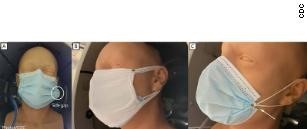
Another method of improving the fit of a medical mask they tested, was to tie a knot in the ear loop close to the fabric then tuck in the sides. This pulls the medical mask more into the shape of the N95 mask, greatly reducing gaps on the sides and around the nose. One study found this alone improved filtration to at least 77% of particles.

Cloth masks

Homemade cloth masks were the first alternative suggested to medical masks that were difficult to find a year ago. The initial recommendation was to make one from 2 layers of tightly woven cotton fabric or heavy t-shirt material but, with research, that was upgraded to recommending 3 layers of different fabrics, ideally one of them being non-woven material. There are lots of patterns for sewn or folded masks (that don’t require sewing) on the internet and, of course, you can buy cloth masks anywhere now. I wish I’d known that I could have cut up a t-shirt for some protection on our trip home from Spain in March 2020! The CDC study found approximately 51% reduction in inhaled particles using a 3-layer cotton cloth mask, and this would very with the materials used.

One advantage of cloth masks is that they are washable, so you don’t have to worry about supply. Plus you can individualize them, adjusting the loops and shape if needed, so they fit your face snugly. You can even have fun with designs and colours—I love the “matching” look 🙂 and comical ones. However, the filtering capacity varies widely depending on the fabric used. When I sewed masks, I put a pocket for a filter on the inside so users could increase the filtration according to changing recommendations. Blue shop towels were one recommendation for a non-woven filter, and I used these in my masks until the most recent recommendation – double masking.

Double masking

I started noticing people on TV wearing two masks in late January. It turns out that this technique is based on the research by the CDC mentioned above. The fabric medical masks are made from filters well – the problem is leakage around the edges of the mask where gaps often occur because of the curves of the face. Woven cotton, especially when cut on the bias (diagonal), and knitted fabrics have some stretch and can mold to the face better than medical mask material.

As well, when a mask is sewn, it can be sized and shaped to fit over the nose and chin and tucks can be added wherever they are needed to fit the shape of the individual’s face. When I was sewing masks for family and friends last year, I was surprised that a mask that fit most faces would gap badly on others or just be so large it would slide off and not filter at all. Faces come in all sizes and shapes! I ended up making 3 different sizes for adults and added extra tucks for my hubby’s masks.

So the CDC looked at 2 options: placing a well-fitting cloth mask over a medical procedure mask and tying the ear loops to improve the fit. Both approaches significantly improved the filtration ability of the medical mask.

Combining 2 methods

They tested combinations of either 2 masks used together, or a medical mask tied and tucked as described (and shown in the photo above). Here are some numbers from their studies:

  • Doubled or tied mask with a simulated cough (exhalation) and unmasked reciever – 85.4% reduction in particles exhaled
  • Inhaling with doubled or tied mask, with an unmasked source – 82.2% reduction in particles inhaled
  • With both the source and receiver with doubled mask – cumulative reduction in exposure of 96.4%
  • With both the source and receiver using a tied mask – cumulative reduction of 95.9%

The study also commented on mask fitters (small, shaped devices worn over a medical mask to seal it to the face), and covering a medical mask with a stretchy, close-fitting fabric, like a length of pantyhose fabric or a “gator” necesita scarf. Both these techniques were found in two other studies to give similar results to double masking. Mask fitters are also referred to as a mask seal or brace, and are worn on top of a face covering to improve fit. You can buy these already made or make your own. Here are some videos and instructions. The last example, on slide 35, is the simplest to make and, if making for yourself, you can just knot the elastic to fit rather than using slide clamps, if you don’t have access to these.

Can you just layer 2 medical masks?

No. The CDC notes that layering 2 medical procedure masks does not give similar results, as this does not improve the fit. They also recommend choosing cloth masks with a nose wire to ensure a good fit over the nose.

So, you might want to consider using an N95 mask, now that they are more readily available, if someone in your household has COVID or if you are in some other higher-risk situation. However, using a medical mask with either a well-fitting cloth mask over it, tying the ear loops to improve the fit, or using a mask fitter will work very well in most situations you will encounter in public. Now that variants are spreading, it’s worthwhile to take that extra step to ensure good filtration and good fit for whatever mask you choose to use.

One last bit of COVID news…

As you know, I’m always reading quirky heath news. Here’s an interesting one for you. Flushing a toilet or urinal creates aerosols… and we know that those with COVID excrete the virus (they can actually detect whether anyone using the “facilities” in a building has it by doing a single test of its wastewater). So, the advice, if you need to use a public restroom, is to flush then get the heck out of there quickly. I’ll probably wear a mask in public washrooms from now on, even when COVID is long over with…

References:

More scientists now believe COVID-19 spreads primarily through the air — CTV News

Maximizing Fit for Cloth and Medical Procedure Masks to Improve Performance and Reduce SARS-CoV-2 Transmission and Exposure, 2021 – Centers for Disease Control and Prevention (CDC)

Double masking can block 92% of infectious particles, CDC says – CNN Health

What you need to know about face masks as protection against coronavirus – CNN

How to make a Badger Seal – University of Wisconsin-Madison

Don’t linger after you flush — CTV News

Categories
Uncategorized

How to criticize…

I’ve been a reviewer of educational programs for pharmacists for over 20 years and, somewhere along the way, I learned tips on how to critique a person’s writing. I think this advice can apply to any time we want to share an opinion on work someone has done or even on an opinion they’ve expressed, so I thought I’d pass it along. Too often, conflicting opinions are expressed rudely, especially on the internet where people feel anonymous. It makes me cringe, knowing there’s a human somewhere on the other side of the screen…

Expressing opinions

The way you express your opinion can either begin a stimulating discussion where both parties can learn something (even if it’s only what others think) or it can shut down the conversation and belittle the other person. And isn’t it conversation, learning and new ideas that make life interesting?

In conversation, it helps to acknowledge the other person’s opinion before expressing your own—perhaps by saying something like: “That’s an interesting take on the situation” or ” Now, that seems different from my experience”. You get the idea. We all have different points of view and experiences, and these colour how we judge events. We believe what we do for a reason. Acknowledging and trying to understand others’ opinions broadens our understanding of the experience, event or whatever is being discussed.

Churchill famously often used to begin with “I may be wrong, but…”, allowing him to more easily change his mind when he learned additional facts that warranted it. None of us can claim to know everything. We form our opinions on what we know, and it’s just smart to keep the door open to changing your mind after you’ve learned more.

On the internet, it’s much easier for some to become the bully when they don’t know the person who wrote the post. These are the ones we call trolls, although I expect they don’t see themselves that way. We need to remember there is a real person, a human with feelings, behind that text.

Helpful tips

So, the tips I was taught to follow, when doing a formal review of an educational program, besides following these thoughts, were to start the critique by pointing out what was good about the program, offer constructive criticism of what I felt could be improved, and to finish with something positive. You can almost always find something complimentary to say about a piece of writing or a passionate opinion (if only the commitment to an idea).

It was also recommended to make positive suggestions for improvement, rather than just criticize what was said. Offering an additional credible source of information to support your suggestion carries more weight than just you saying it. I often add a link to a recognized website with authority on the subject to support my suggestions.

In conversation with a person who believes facts we know are incorrect according to current science, for example, in the debates over vaccines and masks, pointing out that they are incorrect won’t help change their mind. First, it is recommended to try to understand why they believe what they do. People who are fearful, may want to deny that the pandemic is real to reduce their fear; someone whose child has had a bad reaction could understandably believe that all vaccines are dangerous. Simply commanding a person to “Take your medicine” without understanding why they are hesitant, answering their questions and gaining their trust, rarely results in increased compliance to taking medication. I learned this and more in a 10-hour program on how to counsel patients effectively.

Sadly, on the internet where it’s difficult to build real relationships and many feel they are almost anonymous, there are too many people who feel justified in creaming someone because they have a different opinion. I see this all too often on a Pharmacy website I follow. It surprises me that nice polite Canadians can sometimes be so mean to their colleagues. Fortunately, they’ve not done it to me yet (I write articles for the site from time to time), but I have experienced this on FaceBook. I just keep being nice and point out where my facts came from (I don’t just make stuff up!!).

And after you’ve been trolled?

So, here’s a suggestion for when you run into someone who hasn’t learned to be kind when they have a critique of your work or have a different opinion than you. Keep a little file, folder or book with complementary comments and praise you’ve received, cards you’ve received that say what a great friend you’ve been, thank you’s for something kind you’ve done.

Either ignore or respond to the critique in a calm, polite way, depending on the comment and venue then, later, browse through the wonderful feedback you’ve received in the past to remind yourself that not everyone is a troll.

Over the years, I’ve received many cards and thank-you notes from happy clients and I still have them—they’re shown in the photos above and below. It raises my spirits to look through them from time to time…

Thank-you’s for some pet medicines I made over the years…

#VaccineDebate #InternetTrolls

Categories
Uncategorized

Why do we get “addicted” to coffee?

Have you ever wondered why we crave caffeine or nicotine when we consume them regularly? Or why, after a while, all we’re doing is satisfying the craving? And why we don’t feel so good without our drug of choice after we’ve adapted to it? It’s all about what happens when these substances attach to receptors on the surfaces of cells in our bodies…

Many drugs work by attaching to a receptor on the surface of a cell—we can think of receptors as tiny “locks” throughout our bodies, each one with its specific shape, waiting for the substance (its “key”) to come along, attach, and turn the receptor on. This creates an action inside the cell, like caffeine giving us energy, or nicotine relaxing us. When the effect is pleasant, or helps us feel better, sometimes we keep consuming these “keys”, like caffeine, nicotine, alcohol or even narcotics, trying to keep the effect going.

However, your body always tries to keep things on an even keel. We call this “homeostasis”. So, if you keep lots of your drug of choice in your system, eventually your cells make more receptors for the drug. This results in you just feeling your ordinary self when the substance is in your system. This is known as “developing tolerance” to the drug.

Of course, it’s a bit more complicated than this, with other substances often attaching to the same receptor, creating competition and sometimes providing different actions, but you get the idea. It depends on which key gets into the lock and whether it turns it on.

But if you don’t consume a favourite drug you use daily, after a little while you’ll have lots of empty receptors looking for the “keys” they’re used to having. This can cause you to feel not-so-great. With caffeine, you may have a headache and feel sluggish; with nicotine you may become irritable, feel anxious, or have insomnia.

You start to crave the drug because you know it will make you feel better but, really, once you’ve developed tolerance to the drug, all it will do is make you feel like your regular self. That’s why people will sometimes gradually increase the amount of drug they use, as they try to get the same drug effect that they used to experience.

This lock-and-key concept applies to many substances, from hormones to some medications you take. Even drugs like Tylenol and Advil can eventually cause headaches if taken daily, then suddenly stopped. We call this “medication induced headache” and it happens because your body has adapted to having the medication there all the time.

Without the substance around for a period of time, cells gradually return to making fewer receptors again and the cravings will stop. Some receptors, like those for opiates and nicotine, take longer to return to normal numbers, making these drugs harder to quit. Caffeine receptors seem to return to normal amounts in 3 or 4 days when you quit coffee, and cravings and withdrawal are much less of a problem if you taper your coffee intake gradually.

This week I came across the cutest explanation of how all this works by David B. Clear (a scientist/blogger/cartoonist who lives an idyllic life on an island in the Mediterranean). He uses caffeine as an example. Since I’ve had an extra-busy week, I’m just going to share it with you. He’s also much funnier than I am and even uses cartoons to explain how caffeine works and why we crave it so much. I don’t know about you, but making coffee is the first thing I do when my feet hit the floor in the morning! I’ve always thought it was the taste I was craving… but I very likely have lots of extra caffeine receptors waving around in my brain!

Anyway, here’s the link… hope you enjoy this fun science-y explanation of how caffeine works and why we crave it!

https://medium.com/i-wanna-know/how-caffeine-works-26f7bf813b94

#caffeine #coffeeaddiction #caffeinewithdrawal

Categories
Uncategorized

Can Adults Have ADHD?

ADHD or Attention Deficit/Hyperactivity Disorder, is a neurodevelopmental (or brain development) condition that is quite common in children. Five to ten percent of school-aged children in the US (depending on the source you read) are reported to have been diagnosed with it. But can adults have the condition too?

What is ADHD?

There is no single laboratory test to diagnose ADHD. It’s diagnosed by analyzing symptoms and problems the person has, such as:

  • Lack of attention and focus, daydreaming
  • Hyperactivity, always fidgeting or moving
  • Being impulsive
  • Difficulty controlling emotions
  • Self-focused behaviour: interrupting others, trouble waiting their turn
  • Poor organization and time management skills
  • Forgetfulness
  • Problems finishing a task
  • Difficulty following instructions

While all children show these traits at times, children with ADHD do this more regularly and the behaviours can affect success in school and interactions with other children. The diagnosis of ADHD is a process with several steps. The doctor will want to make sure it isn’t another problem with similar symptoms, like a sleep disorder, anxiety, depression, or a learning disability. They may want to talk to teachers, parents and others who care for the child to assess behaviour in different situations. Sometimes, if it is felt that medication would be beneficial, a trial will be done to assess how well a particular medication works before starting a regular prescription. Regular drug holidays are recommended to ensure it is still needed.

There are 3 types of ADHD: predominantly inattentive, predominantly hyperactive-impulsive, and a combination of the two. Symptoms can change over time, as the person ages and, while males are more often active, females tend to be the inattentive type that is less often diagnosed.

And, yes, the condition can continue into adulthood. However, adults are less likely to be diagnosed and the symptoms can be different.

Symptoms in adults

While many of the symptoms of ADHD in adults are similar to those in children, adults often exhibit restlessness and inattention, rather than overt hyperactivity. Fidgeting can continue for adults, as well as impulsivity.

As adults, those with ADHD can still tend to get distracted easily and misplace things. They might lose their temper quickly, be more irritable and impatient than others, and interrupt other people who are speaking. They may also have more difficulty than most in following instructions. Adults with ADHD could find dealing with stress to be a challenge. At work, they may miss deadlines and have difficulty staying seated, succeeding better at a job where they can move around.

But many adults have learned adaptations to control their symptoms and to turn what can be a problem in childhood into an advantage as an adult. A job that requires lots of energy might be perfect for someone with ADHD. Having an ADHD mind that likes to think “out of the box” can be an advantage for work that requires innovation and creativity. Smartphones are an ideal tool to keep on schedule and ensure important tasks are not forgotten.

Some years ago, my husband and I were watching a program on TV about adult ADHD. At the end of the documentary, we looked at each other with the same thought: my hubby had ADHD. But he has turned it into an advantage. He’s always had plenty of energy to keep up with the middle school students he taught and innovative ideas to make their curriculum interesting. Understandably, his most disliked part of the job was sitting in staff meetings. I think his favourite invention is the sticky note and he’s used them well for years to keep organized and remember tasks that needed to be done—a great adaptation strategy.

My friends have always been jealous of me with my “hyperactive hubby”… He always been energetic and looking for projects to do around the house. I’d come up with an idea for a home improvement and, next thing I’d know, it was done!

What’s the cause?

The cause of ADHD is generally thought to be genetic—it tends to run in families—or a result of how the brain developed, perhaps influenced by something like nutrition or smoking/alcohol use during pregnancy. But there has been some suggestion it could be due to (or worsened) by pesticides or food additives and colouring agents—chemicals in our food. Some parents report improvement in their child’s symptoms by changing to whole, unprocessed food in the diet. As this is a healthy change, it’s worth trying.

Research has not shown ADHD to be caused by too much sugar in the diet, watching TV or playing video games excessively, poverty or poor parenting. However, these factors could potentially worsen ADHD symptoms.

But there are medications to control symptoms and increase the person’s ability to succeed in a setting that requires sitting still and paying attention, like school. Unfortunately, most schools are not geared to teaching children who don’t fit “in the box” of sitting at desks in rows in a classroom, making it more difficult for a very active child to be successful and harder for the teacher to cope.

However, learning coping strategies to compensate for negative symptoms, while choosing activities and careers that take advantage of the positive aspects of ADHD can help a person succeed and thrive because of their differences. Coping strategies should be part of any treatment that is considered necessary.

One positive characteristic of some with ADHD is the ability to change. My hubby actually loves new situations and thrives in new challenges. In these days of rapid change, this can be a distinct advantage. Albert Einstein is quoted as saying: “The measure of intelligence is the ability to change” and, although politicians are often criticized for changing their minds, Churchill is reported to have said “Those who never change their minds, never change anything.”

We all need to use whatever traits we have to our best advantage. And we need to work to develop schools and workplaces that compensate for behaviours that can be less successful while developing each person’s strengths. It’s important to recognize ADHD, in adults as well as children, to help them achieve the success they deserve in today’s world.

#ADHD #AttentionDeficit

References:

Attention-Deficit/Hyperactivity Disorder (ADHD) – Centers for Disease Control and Prevention (CDC)

What to know about untreated ADHD in adults – Medical News Today

14 Signs of Attention Deficit Hyperactivity Disorder (ADHD) – Healthline

Causes of and Risk Factors for ADHD—Healthline