Categories
Uncategorized

Vaginal dryness… a fixable problem

Some time ago, I was chatting with a friend who had had ovarian cancer and the topic of vaginal dryness popped up. She was suffering terribly and knew that she shouldn’t use any hormone treatments because of her hormone-related cancer, but no-one had mentioned anything she could try that was safe for her to use. I was surprised to find out no-one had told her there were non-hormonal treatments she could use that would help.

Treatments for vaginal dryness are common knowledge for pharmacists and many other health professionals, and sometimes we forget that our knowledge is specialized. It’s easy to wrongly assume that everyone knows about lubricants and moisturizers. But I learned from my friend that this isn’t always the case. I was glad I was able to help her, and thought I’d put the information out there for anyone else who might need it!

What causes vaginal dryness?

The cells that line the vagina grow in response to the hormone estrogen, making the vagina walls thicker and more elastic. These cells also produce moisture called mucus, much like the inside of our nose and other “inside linings” in various parts of the body. When estrogen levels drop, though, these cells slow down their growth and mucus production, resulting in a thinner lining and less mucus to lubricate and keep the area moist as it should be.

This moisture is moderately acidic and this helps prevent infections. It also helps sperm survive and travel through the woman’s genital system, making mucus production important for those who are trying to become pregnant.

Low estrogen levels, like women often experience after menopause, are a common reason for vaginal dryness, but they aren’t the only reason. Women can notice more dryness any time estrogen levels are falling, such as during breastfeeding, after childbirth, with heavy cigarette smoking (another reason to quit!), during depression or excessive stress, with immune system disorders (such as Sjogren syndrome), during some cancer treatments (for example, hormone blocking therapy, chemotherapy or radiation to the pelvis), and after surgical removal of the ovaries.

Some women will even notice less mucus being produced during parts of their normal cycle, as estrogen cycles through its normal ups and downs. Estrogen is highest at the time of ovulation, roughly at day 14 of a normal cycle (although this varies from woman to woman) and lowest when her period begins.

Women can use this mucus production to predict how high their estrogen is, and when they have ovulated. After the menstrual period, estrogen and mucus production gradually increase. The highest or “peak” production of mucus occurs when a woman is ovulating, and the mucus changes in colour from clear, slippery in texture, and “stretchy”; to creamy, yellowish/white and non-stretchy immediately after ovulation occurs. (“Stretchy” refers to the ability of estrogen mucus to form strings when stretched between 2 pieces of toilet paper.)

Being dehydrated or taking medications that cause mouth dryness, like decongestants and some antidepressants, can also cause the vagina to be dryer. These “anticholinergic” medications that reduce secretions throughout the body as a side effect, provide a helpful action for a stuffy, runny nose in the case of decongestants. Drinking extra water throughout the day can help reduce this drying side effect when it is bothersome.

What does vaginal dryness feel like?

Women will commonly notice pain or discomfort during sexual intercourse because of a lack of lubrication. This can lead to a loss of interest in sex, since it is no longer pleasant and sometimes downright painful. Some women will notice light bleeding after intercourse, due to small tears in the vaginal lining caused by friction.

In worse cases of vaginal dryness, women will notice ongoing soreness and/or irritation. They may also experience vaginal itching, stinging or burning. Just the friction of clothing against the area can even become uncomfortable.

How is it treated?

There are several different types of products that can be helpful for vaginal dryness. I think of these as “steps” to progress through, depending on how bothersome the dryness has become:

  • Vaginal lubricants (e.g. KY Jelly®, Taro Gel®, other generic brands)—I refer to these as the “lowest level” of treatment. Think of lubricants as a replacement for the mucus that is missing. Lubricants can give immediate relief, but the effect doesn’t last. They are useful before or during intercourse and can be inserted or applied to the outer area of the vagina or applied to the man’s penis before entry. Water based products (essentially water with a gelling agent or silicone added) are both effective and recommended over oil-based products like Vaseline®, mineral oil, or other oils. Note that oils can break down latex products like condoms, increasing the risk of breaking.
  • Longer-lasting lubricants (e.g. Replens®)—I think of these as the next step in vaginal dryness treatment, and would be recommended for women with ongoing symptoms. When inserted, these products adhere to the walls of the vagina for several days. They are recommended to be used every 3 to 4 days for continuous relief of symptoms.
  • Vaginal moisturizers (e.g. RepaGyn® vaginal suppositories)—When you need more than just lubrication, a moisturizing product may work better. Moisturizers contain ingredients that “plump up” the cells of the vaginal lining, helping to heal and thicken the lining while providing moisture. RepaGyn® has been demonstrated to promote healing after gynecological procedures including chemotherapy and radiation. Its effect is similar to estrogen therapy, but without hormones. RepaGyn® comes as a suppository, inserted 2 or 3 times a week, making it less messy and more convenient to use than gels.
  • Hormone treatments (Estrogen creams, suppositories, rings, patches, tablets)—These are usually reserved for women who don’t find sufficient relief from non-prescription treatments, or who have additional bothersome hormone-related symptoms such as urine leakage, hot flashes, night sweats, etc. Since these symptoms are often caused by menopausal hormone changes, women may benefit from replacing hormones, either vaginally or systemically (by mouth or through the skin as a patch or gel). Of course, these are considered inappropriate for any woman who has had a hormone-dependent cancer, due to increased risk of a return of the cancer. Your doctor would assess your risk factors vs benefits from this therapy before prescribing. If estrogen is only needed for vaginal problems, generally a very low dose is used, and the treatment is inserted into the vagina or applied directly to the area.

Effective treatments are available in any pharmacy without a prescription. So don’t be shy—it’s OK to ask to speak to your pharmacist in a private area about your health problems. And talk to your partner about any dryness, even temporary, so they will understand and help too.

However, if you aren’t getting relief from non-prescription treatments you’ve tried, ask your doctor or other health practitioner for advice. He/she can prescribe higher-level hormone treatments if needed. Remember vaginal dryness is a fixable problem…

References:

Vaginal dryness—Mayo Clinic

RepaGyn information brochure

Replens information

#VaginalDryness

Categories
Uncategorized

Do we still need to wear masks? …and other COVID “trivia” questions

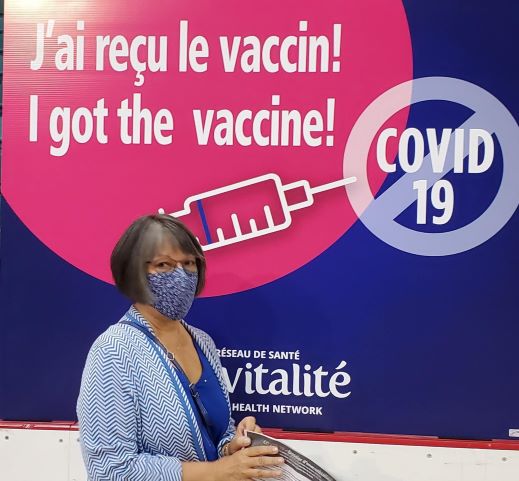
First, I want to tell you I received my 2nd shot this week… I’ve finally joined the list of those fully vaccinated (well, I will once a couple of weeks have passed for the vaccine to do its magic). It feels good to be better protected and helping to make our world safer!

COVID-19 still has a fascination for many of us—it’s still often the first item on the news each day, especially here in Eastern Canada where provincial borders have been closed for months except for essential travel. I don’t know about you, but I can’t resist reading the latest study or statistics on the coronavirus. I expect we’ll be learning about it for many years to come.

So, this week I thought I’d write about some of the COVID (not-so-trivial) trivia I’ve been reading in the medical news, as researchers work to solve the mysteries and questions about the coronavirus and how it behaves.

Can we stop wearing masks once fully vaccinated?

Dr. Theresa Tam, Canada’s chief public health officer, gave the perfect answer to this question we all want answered: “It depends…”. Here’s how she explained it: Vaccines are never 100% effective, so you need to consider how much risk you can tolerate and how risky your surroundings are when deciding whether to wear a mask. You should think about:

Personal risk:

  • Are you vaccinated? One shot or two?
  • Do you have any underlying health conditions that could add to your risk if you do get sick?
  • Are you taking any medications that suppress your immune system? (steroids, organ rejection drugs, certain arthritis/psoriasis/inflammatory bowel disease medications, etc.)

Environmental risk:

  • Are you indoors or out? (Outside is safer)
  • What is the infection rate in the area?
  • Are the people you are with vaccinated?
  • Can you physically distance from others?

As you can see, having a strong ability to fight off any potential coronavirus infection plus a low to non-existent risk of close contact with anyone with the virus means the event is much safer and a mask might be unnecessary. Those who are less healthy will want to keep using a mask in crowded places, like a grocery store, and we all would be wise to use one if there are any cases in the general area. I plan to continue using one for a while yet.

Officials are warning that, as we open up our communities, there is a good chance cases will increase again as people travel more. Our province waited until 75% of adults were partially vaccinated and 20% were fully vaccinated before beginning to reopen, and changes will be gradual to minimize the potential of a 4th wave of infections until 75% are fully vaccinated (hopefully by mid-summer!).

Can dogs and cats catch COVID-19?

Yes! A small study found that 1/3 of cats and 1/4 of dogs, whose owners were infected with COVID-19, also tested positive for the coronavirus. Animals were at less risk if they spent more time outdoors and away from their owners, but they only displayed mild symptoms or none at all. There have been no reported cases of humans catching the coronavirus from their pets, including from virus being transported on their fur, and risk is considered low.

Should you get vaccinated if you have long COVID?

Yes! Those with “long COVID”—lingering symptoms like fatigue and loss of taste and smell that persist for weeks to months after recovery from an acute infection—will sometimes notice an improvement in symptoms after receiving immunization. Researchers suspect that the response to the vaccine enables the immune system to eliminate lingering low levels of virus that may be causing ongoing symptoms.

How much does the first shot help?

Studies find varying levels of response to the first injection of COVID-19 vaccine, depending on the person’s immune system response and the virus variants in the area, but a recent study found 81% response to the first shot and 91% to the second. Another study predicted a 40 to 50% reduction in ability to transmit the coronavirus after a single shot. Because of a worldwide shortage in vaccine, several countries have decided to delay the second shot by up to 4 months with the goal of reducing total deaths from the virus. Interestingly, older people have been noted to mount three and a half times larger response when the second dose is delayed to 12 weeks after the first. This suggests we should get an excellent response when boosters are needed.

What can we do to fly more safely?

Here are some suggestions I found to help keep you safer if you’re thinking of taking a flight:

  • Avoid non-essential air travel unless fully vaccinated (2 weeks after 2nd shot), as currently advised.
  • Check conditions (infection rate) at your destination.
  • Wear a mask in taxis, airports and planes. Consider double-masking and ensure mask fits properly (no gaps). Remember children cannot yet be vaccinated and a recent survey suggests that as many as 20% of unvaccinated adults stated they would lie if necessary to gain access to “vaccinated only” venues… 😮
  • Roll down windows in taxis going to and from airports to improve air circulation.
  • Bring snacks/lunches. Service is limited on many flights. If possible, eat before boarding the plane to avoid the need to remove your mask. If it’s necessary to eat on the plane, having your own food make it faster for you to eat, meaning your mask will be off for less time.
  • Note that large aircraft all have HEPA (high-efficiency) air filter systems, but smaller, older aircraft may not. Exercise extra caution when taking smaller, regional flights.

Are rashes a symptom of COVID?

Yes, weird skin rashes are now recognized as another symptom of COVID-19, along with fever, dry cough, loss of taste and smell, headaches, muscle and joint pain, nasal congestion, and fatigue.

Chilblain-like red/purple, swollen, or blistered skin on toes (mainly in children and young adults) were recognized first and nicknamed “COVID-toes”, but now they realize these can occur in fingers as well as toes. Sometimes this is the only symptom that is noted. Other types of rashes are now known to occur also. These include:

  • Macropapular rash (flat and raised areas of discoloured skin) found on the trunk of 47% of patients, usually those middle-aged to elderly.
  • Hives (aka uticaria—raised areas of itchy skin), in 26% of patients, although sometimes these occur as a side-effect of medications used to treat COVID-19.
  • Vesicular lesions (fluid-filled sacs under the skin, similar to chicken pox) that appear about 2 weeks after infection in about 9% of cases.

It’s affected us all…

During the past year and a half, we’ve all suffered at least a little from “COVIDosos”—my made-up name for the effect the virus has on us even if we didn’t catch it. We’ve gone through difficult changes like learning to physical distance and getting used to wearing masks, and we’ve experienced stress and worry, as the virus waves crashed over us.

Closed gyms, cancelled activities, and spending more time at home to avoid potential exposure to the virus have made it more difficult to stay in shape. And closed borders, quarantines and cancelled trips have left us missing family and friends. Thank goodness for video chats! But I’m excited to be starting to get back to normal, or at least the “new normal”, whatever that turns out to be.

I sometimes think how strange our great-grandchildren will think this time must have been. I had started an art/travel journal in January 2020, when we arrived in Spain for a 3-month winter escape. When the pandemic hit, it became my COVID journal, as we watched Spain begin to close down, travelled through airports on the way home and then self-isolated for 2 weeks at home. I still write in it from time to time. Sometimes I wonder if journals such as mine will survive and possibly be of interest to a future generation one day…

#COVIDfacts #DoWeStillNeedMasks #CanPetsCatchCOVID #HowToFlySafely

References:

COVID-19 and pets: Can dogs and cats get coronavirus? https://www.mayoclinic.org/diseases-conditions/coronavirus/expert-answers/can-pets-get-coronavirus/faq-20486391

How to fly safely this summer—CNN Travel http://www.cnn.com/travel/article/flying-safely-summer-2021-wellness/index.html

In Surprise Twist, COVID-19 Can Cause Weird Skin Rashes. Here’s What to Look Out For—Science Alert https://www.sciencealert.com/in-surprise-twist-covid-19-can-cause-weird-skin-rashes-here-s-what-we-know

Delaying 2nd Pfizer vaccine dose may protect better against COVID-10: study—Global News https://globalnews.ca/news/7861754/pfizer-vaccine-second-dose-delay/

Categories
Uncategorized

Every body is beautiful

How do you feel about your body? Critical or comfortable? Ashamed, accepting, proud? Do you love your body, accept what you’ve got, or are you downright self-conscious? A show on CBC Radio today got me thinking about this subject that’s been in the back of my mind for a while…

Who decides what’s beautiful anyway?

For far too long beauty has been dictated to us by magazines and movies—the goal for us all has been to be a youthful size 2 or buff and muscular, straight from the gym. And, when we don’t achieve these impossible goals, we criticize ourselves and sometimes feel ashamed of our bodies and our lack of willpower.

Even the medical BMI (Body Mass Index) that health professionals use to gauge our ideal weight is skewed to thinness. Although extreme excess weight can have health consequences, analyses show that those in the “overweight” BMI category statistically live longer, on average, than those in the normal and underweight groups. In the interest of helping us to be healthier, doctors will often recommend losing those “extra pounds” whether they have anything to do with the reason for our visit or not, leading some to dread or even avoid medical visits.

It’s all hard on the self-esteem, isn’t it! I think it’s time to work on normalizing our opinions of our human selves… time to be proud of who we are and comfortable with how we look. Our focus should be on being healthy and enjoying life, whatever size or shape we are. Curves are good! We’re made to be “curvy”.

Not just weight…

There are other worries people have about how they look, too. Scars, birth marks, and skin conditions can all take their emotional toll on those affected if they let them. But it can help to realize that most of the worry is your own. If other people have a problem with your outer appearance or your skin condition, it’s really their problem, right? And people really don’t notice, especially when they know you.

So, I’m not just writing this article for those who have some characteristic that they worry makes them stand out from the crowd in some way. I want to convince those in the crowd not to judge individuals based on some fabricated ideal of “perfection” that none of us achieve more than temporarily in our lives, if at all.

Accepting and ignoring physical so-called flaws in others, and looking instead for their positive qualities, can help build their self-esteem while helping us be less critical of ourselves. Skin markings or colour, skin conditions, type of clothing or extra pounds do not determine who a person is, and we can train ourselves not to make unwarranted judgements based on physical characteristics.

So, love and accept yourself and those around you. Have a goal of enjoying life and making others lives better. Remember that your thoughts are just “suggestions”, not necessarily truths or paths you must follow. You can pause, and create new thoughts or suggestions to block ongoing critical thoughts of others. Being healthy, sexy, energetic, and beautiful is not exclusive to those who are young, slim and muscular.

Life is too short to waste it craving for impossible physical perfection. Look for the best in others and you may find it easier to love the skin you’re in. And I think it works the other way too—if you love and accept your own imperfect self, you may find it easier to accept others as they are, as well.

If you’d like to listen to this thought-provoking CBC show, here’s the link:

How to embrace the body you’re in—Now or Never, CBC Radio One https://www.cbc.ca/radio/nowornever

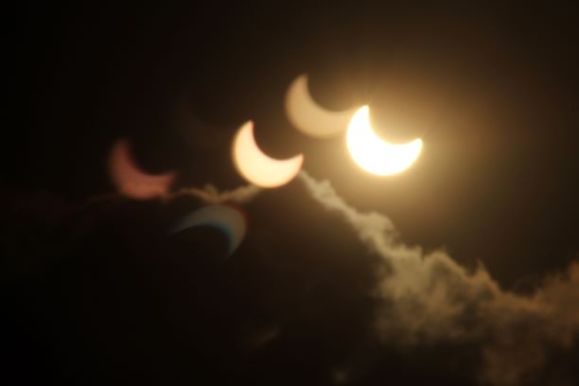
Photo: Partial eclipse of the sun, June 10th, 6:15am, Cap-Pele, NB, jcb

#bodyimage

Categories
Uncategorized

I’m celebrating this week!

Celebrating blogs and books…

It’s a celebration week! It’s been five years since I started this blog… five years and 225 articles! And I’ve learned a lot about writing as well as health along the way. My style has changed from quite “clinical” in early blogs (just the facts, ma’am!) to a much more personal and, I hope, more entertaining style.

My goals have been to keep being curious about health, to continue to read and learn as I did in my years as an active pharmacist… and to get you curious and interested in learning how to be healthier–and live longer and better–too. I hope you’ve enjoyed the journey as much as I have.

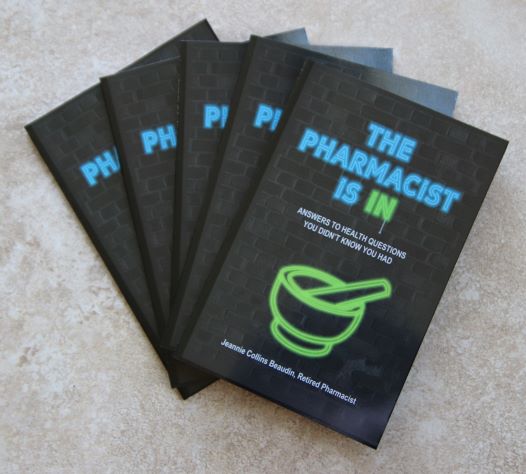
To celebrate my milestone, I ordered some author paperback copies of my newest book, The Pharmacist is IN; Answers to Health Questions You Didn’t Know You Had, just for fun. There’s something about holding a book in your hands, isn’t there? Especially one that you’ve written yourself! If you didn’t get a chance to look it up when it was first published as an e-book in May, the book is a sampling of my blogs, gathered together in an interesting way, to be sold inexpensively (or given away!) to “showcase” and introduce people to my blog, while getting them to focus more their health.

Not on Amazon this time…

Unfortunately, unbeknownst to me, Amazon has changed its rules regarding books made from previously published blogs. “Blogged” books aren’t allowed on their platform now, although I’ve bought books there made this way in the past and thoroughly enjoyed them (even knowing I could have found the same material in bits and pieces for free by spending time searching for it).

Strangely, my book shows up in an Amazon search, but only as an “out of stock” paperback. However, it’s available as an e-book at many other online retailers. The paperback version is also available to local bookstores, to order in through their regular wholesalers, on request. I was disappointed that there don’t seem to be other online stores that do “print on demand” (printing and shipping single copies for individual customers). If you know of one, please let me know–many of my readers prefer print books!

So, to celebrate my 5 years as a (somewhat) serious writer, I’ve put the e-book version on sale (for free!) for anyone who is interested for a few weeks. Here is the link to all stores where it’s available as an e-book: https://books2read.com/u/bwoB1Z (Note: all links work except the Amazon one, so you can go to Kobo, Apple, Google Play Books, Barnes and Noble or others—all have my book for $0.00 for the next few weeks). Feel free to share the link with anyone who might be interested (or who you think ought to be thinking more about their health 😊)

Have you tried audiobooks?

I also decided to create an audiobook and it’s available now too through all major online bookstores (except Amazon!). I did this for 2 reasons: it helps me edit better when I read the material out loud, and my children (and, I’m learning, many others!) love the audiobook format because they can listen on their smart phone, usually with headphones, while doing other things like walking the dog, driving to work or doing the laundry!

The audiobook publishing company I use also provides 100 codes I can give away to provide free copies. So, if you’d like to listen instead of read, or are just interested in trying out the format, email me and I’ll send you a code for a free copy!

The audiobook, like the e-book, can be loaded onto any smart phone, tablet or computer and, I understand, the program to listen is built into the code link (I’m new to this…let me know if you have any problems and I’ll find the answers!). The free app to read the e-book format can be downloaded by clicking a link on the page (usually at the bottom) of any of the online stores, so they make it easy to try out e-books and audiobooks!

I have both the Kobo and Kindle (Amazon) apps on my phone and tablet. Of course, reading on a tablet is more like reading a book because of the size of the screen, but I like having a few books on my phone too, in case I end up sitting in a waiting room somewhere, with nothing to do. I also have a storage card in my phone for extra space to download lots of books, although it’s not necessary. I find the apps very easy to use, and both of the apps I have work in a similar manner.

Extra benefits of e-books…

The great thing with e-books is, when you’ve finished reading a book, you can have another one ready to go. And, when you go on vacation, it’s much easier to pack all those juicy beach reads! There are tons of books that are free or very inexpensive in e-book form. I subscribe to two services, Kindle Buffet (all the books you can eat!) and The Fussy Librarian, that send a selection in book categories of your choice every day.

And library books too!

You can also access library e-books, through a program called Libby, using your local library card number. Hoopla is another library service that works similarly–my first book, Can I Speak to the Hormone Lady? Managing Menopause and Hormone Imbalances, is available there and The Pharmacist is IN has been submitted to Hoopla, too, and should be available soon. I’ve been a library user since I was a child and love to support libraries!

Lastly, I’ll let you in on a little secret—online companies monitor how many times a book is looked up, downloaded and commented on (or “reviewed”) and they use this information to decide how often they will show the book to people who are browsing their site. So, if you find my compilation of blogs interesting, I hope you will leave a little comment to help others find it.

And THANK YOU in advance! Every little bit helps…

Here are the links to get the e-book or audiobook for free:

The Pharmacist is IN e-book https://books2read.com/u/bwoB1Z

My email to request a code for a free copy of the audiobook: Jeannie.Beaudin@gmail.com

#FreeAudioBook #FreeBook #HealthyLifestyle