Hearing loss – causes and effects

Well, I have to say I’m feeling a little “older” than I was a few weeks ago. I was diagnosed with hearing loss, something my hubby suspected (and encouraged me to investigate) as I was asking him to repeat things quite often. I even misinterpreted words occasionally because I had missed a consonant in the word, like “s” or “t”. I learned this happens when you aren’t hearing higher frequency sounds, usually consonants, as well as you should. I remembered my aunt (the one I’m named after!) laughing about this happening to her… and that’s how she knew she wasn’t hearing properly.
It’s an adjustment…
I do have a bit of a problem with calling them “hearing aids” though – it makes me feel like I’m old(er) and I have a disability, but I guess I do. I know I shouldn’t feel this way really, but I’ve decided to call them my “headset”. A name can make a difference sometimes, and it makes me feel better and a little less self-conscious. However, after only a couple of weeks I can see that they’re making a difference for me. I’m hearing sounds that I haven’t heard for a while, at least since my most recent ear infection in January/February this year. Things like running water, the sound of my feet on the ceramic floor, paper rattling, “swishy” sounds. Even my own voice sounds different to me!
To make the adjustment easier, my audiologist set the volume a little quieter to let me get used to hearing all of those sounds again without becoming overwhelmed. He will increase the volume gradually over a few weeks until I can hear everything around me. It was a good strategy, and I’ve adjusted to them easily.
But my hearing aids really do function as a “headset”. They connect to my phone and function as earphones/air pods. No more chasing around for earphones when I want to do my Spanish lessons on my phone! Modern technology is wonderful.
Tinnitus can mean there’s a problem starting
Another thing I learned at my visit with the audiologist was that ringing in the ears, or “tinnitus”, can indicate a loss of hearing. My tinnitus, that I’ve written about previously in a blog about vertigo, started when I was given an untested “off label” treatment for chronic sinusitis. I developed terrible vertigo with this treatment and after I stopped it, I was left with tinnitus.
This winter I had another bout of stubborn sinus congestion and, since I was flying to Spain for the winter, I went to see a doctor about it. I was terrified that I’d have ear pain due to not being able to adjust to the changing pressure in the airplane… it’s happened to me before and I wouldn’t wish that painful misery on anyone.
The doctor accurately suspected that I had caught one of several viruses that were circulating last winter and prescribed a steroid nasal spray for me. These are known to open the Eustachian tube that connects the inner ear to the nasal cavity, allowing pressure to equalize between the ear and the outside, preventing pressure and pain from building in the ear.
With my previous negative experience with steroids, I asked him if I should be concerned about this happening again. He said “Either use the spray or cancel your trip” and then abruptly left the room. Not a great “bedside manner”, I thought. Both of us were wearing masks, and that is a nightmare for anyone with hearing loss. I suspect my repeated requests for him to repeat what he was saying must have ticked him off… But the spray, along with decongestants, worked well to prevent ear pain during my 3 flights.
After 2 months of continuing sinus and ear problems, I finally took an antibiotic for what was was looking like a secondary bacterial infection by then and started improving in the first 24 hours. Antibiotics don’t work for virus infections, but while you’re “down and out” with a virus, bacteria can take advantage of the situation and move in. Any viral infection that lasts longer than 2 or 3 weeks should be investigated as a possible secondary bacterial infection.
Sometimes you’re the last to notice…
We humans tend to adjust to our circumstances rather well. The hearing loss I experienced during my ear infection improved afterward, but not completely. Of course, I thought I was fine. It was my hubby who really noticed that I was missing a lot. I suppose I’ll never know whether it was the infection or the medication I used for it that caused my hearing loss. Hearing loss has been reported with steroids but is less common than with some other medications. But the audiologist says my loss is permanent. 🙁
So now I have my new “headset” that I wear every day, that costs me what seems like a small fortune. But hearing better is worth it. I knew from trying out different standard headsets for my phone, that the quality of the speaker makes a huge difference to what you hear, so I opted for the highest quality. A new option is to rent the headset rather than buying it outright and they sweeten the deal by covering all your visits/repairs that might otherwise have a charge. My hubby says we can always cut back somewhere else if needed…
A recent study also suggests that untreated hearing loss may increase the risk of developing dementia. And people will sometimes avoid social situations because they can’t hear what others are saying, leading to increased isolation and potential related mental health problems. So, in addition to day-to-day advantages, correcting hearing loss can make a difference in long term health, too.
What causes hearing loss?
Hearing loss can be Conductive, caused by problems in the outer or middle ear that inhibit sound waves from reaching the hearing mechanism. Or they can be Sensorineural, caused by a problem in the inner ear where the sound waves are translated into nerve impulses that our brain can read. This also includes any problems with the nerves carrying these impulses to the brain, or in the brain where they are translated into sounds we understand, but this is less common.
A Conductive problem could be as simple as excess ear wax blocking the ear canal, acting like an earplug. Removal can do wonders. However, it can also involve a problem with the ear drum or the tiny bones in the middle ear that carry the vibrations to the inner ear. Fluid behind the ear drum can also deaden sound waves. An audiologist does tests to determine where the problem originates.
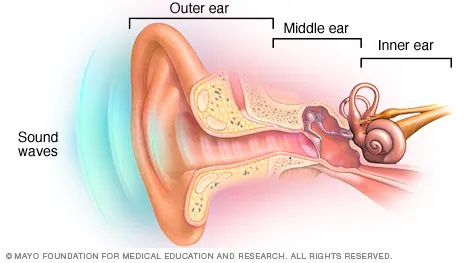
Sensorineural hearing loss involves a malfunction of the inner ear, usually in the cochlea, the organ that translates vibrations from sound into nerve impulses that the brain can read and understand. The cochlea is the spiral shaped organ in the inner ear that you can see in the image above. It has tiny hairs inside that move at certain sound frequencies and tell the brain what frequency of sound we are hearing, high or low. For me, the tiny hairs that sense high frequencies are damaged, and this is also common in the slow onset hearing loss that occurs with aging or listening to too many loud sounds over one’s lifetime.
Certain drugs can also be “ototoxic”, or poisonous to your hearing. Higher doses and longer exposure increase the risk of hearing damage from these, and often a different drug can be prescribed if a problem develops. The most common ototoxic medications include certain antibiotics (aminoglycoside antibiotics, like gentamycin, neomycin and others), some chemotherapies (like carboplatin and cisplatin), some diuretics (fluid pills such as furosemide), quinine (used to treat malaria and leg cramps), and high doses of aspirin or other anti-inflammatory medications. Environmental contaminants like mercury, tin, lead, and carbon monoxide can also damage hearing.
Better to prevent…
Hearing loss is often permanent, so better to prevent it than try to compensate after it’s lost. Avoid excessively loud sounds from music or machinery. Take caution not to set earphones to a high volume and wear protective earplugs whenever you are exposed to loud sounds. Note that they make special ones that allow you to hear the full range of music at concerts while reducing the volume to protect your hearing. But just mowing lawns or using motorized equipment can reduce your hearing over time. Even driving a motorcycle with “loud pipes” can mean you’ll need an expensive headset like mine in the future.
If you get an ear infection, seek medical help as soon as possible. While many ear infections will resolve on their own, some can create an opportunity for bacteria to take hold. An infection that lasts longer than 2 weeks is reason for further investigation. Remember that tinnitus can be a sign of the beginning of hearing loss and don’t ignore it. Ask for a hearing test and investigate causes.
If you (or someone else) notices you might not be hearing as well as you should, check with your doctor or an audiologist. Ask your pharmacist to check whether any of your medications could be ototoxic and pass this information along to your doctor.
Know that genetics can also play a role, making you more susceptible to hearing loss. My mom developed noticeable deafness whenever she had an ear infection and eventually the losses added up. I guess I followed in her footsteps!
Image credits: Drawing by author; diagram shared from Mayo Clinic website
References:
Hearing Loss-Symptoms and Causes – Mayo Clinic https://www.mayoclinic.org/diseases-conditions/hearing-loss/symptoms-causes/syc-20373072
Ototoxicity – Cleveland Clinic https://my.clevelandclinic.org/health/diseases/24769-ototoxicity
Hearing Aids a ‘Powerful’ Tool for Reducing Dementia Risk — Medscape

 Jeannie Beaudin, Artist and Author