
Categories
Uncategorized

New Year’s resolutions??

Did you make a New Year’s resolution? Is it something you really want? Well, now is time to start doing the work it takes to make it happen!

You know, most people don’t fulfill their resolutions… One-quarter give up after only a week, one-third after a month. After 6 months less than half are still trying and, after all is said and done, only 8% are successful.

Why does this happen? Well, life gets in the way…we get busy, make excuses, fall behind, lose motivation and get frustrated.

But, if your resolutions are truly important to you, do it right! Don’t leave worthwhile changes to chance or rely on an approach that is almost guaranteed to fail.

Making successful change involves 3 steps: setting your goals, determining exactly what you have to do to get there, and checking back to make sure you’re on track. And I guess there’s a 4th step – congratulating yourself when you succeed!

So, let’s see what this looks like…

First…setting the goals. Large companies and institutions use a system called SMART goal setting, and you can use this too. What are SMART goals, you ask?? They are detailed goals that are Specific, Measurable, Achievable/Actionable, Relevant and Timed. And they write them down and keep them front and center to make sure they aren’t forgotten.

Be Specific – Know exactly what you want to achieve. Many resolutions are vague, such as enjoy life more, or spend more time with family. Make yours specific…use numbers, pin down details of what you want to achieve.

Make it Measurable – Include parameters you can measure so you know exactly what you are aiming for.

Achievable and Actionable – Make sure what you want to do is actually achievable…don’t set yourself up for failure! Be realistic about your goals. Include details about what actions you need to take to be successful. Learn from earlier attempts, if you’ve tried and failed to reach this goal in the past.

Be Relevant – Choose goals that you really want to achieve. Change is almost always difficult…you have to really want it!

Timed – Set a realistic time frame…next month? By the end of the year? Don’t make the time too long and definitely don’t leave your goals open-ended, to be accomplished “some day”. Interim deadlines are often a good strategy too, and can keep you moving along with your plan.

Next, you need to determine the details of exactly what you will do to achieve your goals within the time you have given yourself. Write the steps down; set a time frame for each. Large organizations call this a strategic plan (and actually pay thousands of dollars to develop these!), but yours doesn’t need to be overly complicated. Just be sure that, like your goals, your action plan is doable, specific and timed. And remember, with some goals there are proven plans already out there… for example, for quitting smoking or losing weight (2 of the most popular New Years resolutions!).

Thirdly, keep this written plan somewhere where you won’t just forget about it. You may want to post your plan where you will see it every day, or make your update part of your Saturday morning coffee routine. Depending on your time frame, the first of every month can be often enough to make sure you are still on track. But be specific about this, and mark it on your calendar!

Remember that vague resolutions are often just unattainable dreams…written, focused goals with well-planned, practical steps to get there will greatly increase the likelihood of achieving the significant improvements in your life that you desire. And be sure to celebrate your success and reward yourself for a job well done when you achieve your New Years resolutions for 2017!

My resolution for 2017 is to self-publish the book on hormones I have been working on for the past year. I want to achieve this by June 2017 and have enrolled in an online course to learn exactly what I need to do to publish and market my book effectively. My first step is to build a mailing list so I can effectively tell people when my book is available. Please help me by subscribing to my blog, if you haven’t already, so your name will be added to my list! Thank you for your support…

#Resolution #SMARTgoals
Categories
Uncategorized

The Politics of Food

What do food and politics have in common? More than you might think…

I recently watched a documentary about food and the obesity epidemic entitled “Fed Up”, available on Netflix and iTunes. Although I probably should have already realized this, I was surprised to learn about some of the ways big business can influence decisions about processing and marketing of food.

A little history…The US McGovern Committee was formed in the late 60’s to investigate the causes of hunger in US, and this mandate eventually expanded to include examination of environmental conditions that affected nutrition and investigation into dietary causes of chronic diseases, such as heart disease, certain cancers, stroke, high blood pressure, obesity, diabetes and arteriosclerosis.

Their 1977 report, “Dietary Goals for the United States”, more commonly known as the McGovern Report, looked at overeating as well as hunger. It suggested that Americans should eat less fat, less cholesterol, less refined and processed sugars, and more complex carbohydrates and fiber. “Complex carbohydrates” indicated fruit, vegetables and whole grains. In other words, they recommended eating more fruits, vegetables and whole grains and less high-fat meat, sweetened foods, eggs and dairy products.

The cattle, dairy, egg and sugar industries reacted strongly to the “eat less” recommendation. Even the American Medical Association opposed the report, saying people should see their doctors for individual recommendations, rather than having a national guide. In response to heavy pressure, the report was watered down, allowing higher sugar, salt, cholesterol and meat intake recommendations. References to processed sugars were removed from some parts of the report.

In 2002, the World Health Organization (WHO) and UN Food and Agriculture Organization (FAO) jointly issued a document labeled “TRS 916” suggesting sugar is a major, if not the major, cause of chronic metabolic disease and obesity. It recommended that less than 10% of calories should be consumed in the form of free sugars: those added to food or in the form of refined sugar, syrup, honey or fruit juices.

According to the documentary, “Fed Up”, the American government resisted publication of the report, concerned it would harm the sugar industry in US. Reportedly they threatened to withdraw funding to the WHO if the recommended limit for added sugar wasn’t increased to 25%. The final report downplays added sugar and, in fact, appears to leave sugar out of much of the discussion altogether.

The result of all this was an increased focus on fat content of food and little or no attention to sugar. The food industry responded by creating “low fat” products, and many were labeled as being healthier choices. Sales of these specialty foods soared.

However, when fat is removed from food, much of the flavour is removed also. To improve the taste of low-fat and fat-free foods, sugar was added, and between 1977 and 2000 sugar consumption in US doubled.

Sugar has been described as a “chronic dose-dependent liver toxin”, and is considered 8 times more addictive than cocaine, according to one source. Eighty percent of processed foods have some form of added sugar, and white flour starchy foods are almost immediately changed into sugar in our digestive systems.

A few other interesting points:

  • Fibre slows the absorption of sugar, so whole fruits with their natural fibre, have much slower absorption of the sugar they contain than fruit juices with little or no fibre.

  • Artificial sugar substitutes have been found to trigger release of insulin, a mechanism believed to be connected to the sweet taste, and this triggers increased hunger.

  • Government regulations allow food that is actually hazardous to health over the long term to be marketed as a healthy option. “Healthier low fat” products with high amounts of unhealthy sugar are really not healthier for us.

  • Large food companies are often controlling food choices for children in school cafeterias. The rate of childhood obesity and related chronic diseases, like diabetes and heart disease, in children is rising at an alarming rate.

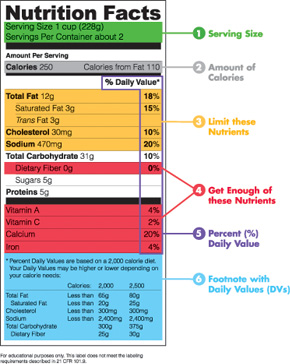
  • It is not required to indicate the percent of daily recommended intake on the nutrition label, drawing less attention to products with excessive amounts of added sugar. Note the image above, downloaded from the internet, and how it simply skips over providing information on sugar…

Even though most of these food lobbies operate in US, we in Canada are highly influenced by American products and advertising. Governments should be taking actions to protect the health of their populations, but powerful lobbies backed by industry money are influencing important decisions about food content, labeling and marketing.

So, take time to check product labels. Be aware that sugar comes in many forms and includes names such as cane extract, corn syrup, concentrated fruit juice, dextrose, diglycerides, disaccharides, Florida crystals, fructooligosaccharides, galactose, glucitol, glucoamine, hexitol, inversol, isomalt, maltose, mannitol, nectars, pentose, sorbitol, sorghum, xylitol, zylose….and more. Ingredients are listed in order of highest to lowest weight so a product with a sweetener as one of the first 5 ingredients likely has a large quantity of sugar.

The solution is education about healthy food choices. Choose whole foods rather than processed, and prepare meals at home as much as possible. And avoid foods with unfamiliar ingredients and added sugar.

Categories
Uncategorized

Erectile dysfunction

It has been suggested that approximately 40% of men experience erectile dysfunction (ED) at least occasionally. The cause can be functional or psychological, and these two types are treated differently.

Proper erectile function involves the brain, hormones, muscles, nerves and blood vessels. It is easy to see that problems could originate at many different levels.

Fatigue, stress, relationship issues, performance anxiety, or alcohol consumption can contribute to erectile problems., especially those of a temporary nature. A diagnosis of erectile dysfunction is only made if the problem lasts more than a few weeks or months. Common underlying causes include: heart disease, diabetes, poor physical health, obesity, multiple sclerosis, smoking Parkinson’s disease, enlarged prostate for prostate surgery. Basically, any disease that damages the nerves or blood vessels can affect erectile function. Treating the underlying cause, when one is identified, can often correct the problem. Dysfunction can also be associated with bicycling, and this is believed to be due to compression of nerves and blood vessels in the groin area.

If normal nighttime or early morning erections occur, this supports a diagnosis of a psychological cause, although there still may be a physiological (or physical) cause. Patients with psychological dysfunction often have a high response to a placebo (or sham medication) – nice to think that the problem might be fixed by simply taking a sugar pill, if you believe it will work!

Standard Treatments

The first line medical therapy is the”PDE5 inhibitor” class of drugs (Viagra, Cialis and others). These drugs block the breakdown of nitric oxide, a substance that dilates blood vessels, resulting in increased blood flow to the penis. Penile injection of vasodilators plus prostaglandin can be highly effective when these drugs fail, or in situations where nerve supply to the area has been damaged (such as in paraplegia).

Penile vacuum pumps (think of the first Austin Myers movie, where he claims “That’s not mine!”) can also be effective when used just before sexual activity. The specially designed pump draws blood into the penis creating an erection, and a special rubber band maintains it for a period of time. These pumps can be obtained through your urologist or can be ordered for you by a pharmacist.

Penile implants or blood vessel surgery are also available and may help in some cases but are more invasive and higher risk.

Natural treatments

  • Panic ginseng (also known as red ginseng) 600 to 1000 mg three times a day appears to show the most benefit in studies. Ginseng has been noted to raise blood pressure, however, so caution is advised in patients whose blood pressure is elevated.

  • Rhodiola 150 to 200 mg daily showed evidence in one study and has a long history of use in Russia.

  • DHEA, a hormone in the androgen class, is more likely to be helpful if the patient is low in hormone production. Although it is non-RX in US, it requires a prescription in Canada, and would need to be obtained from a compounding pharmacy.

  • L-arginine 3500 to 5000mg (or 3.5 – 5g) taken one hour before needed or in a lower dose taken daily, helps increase production of nitric oxide which relaxes blood vessels (note: Viagra-type drugs reduce breakdown of nitric oxide). L-arginine is reported to work better when combined with pycnogenol, a proprietary extract of pine bark. Tea, grapes,wine, juice and berries contain small amounts of proanthocyanidins similar to those in pycnogenol. L-arginine is an amino acid found in high protein foods, such as turkey (especially the breast meat [16g per breast], pork [14g per rib] and chicken [9g per breast]. So, it sounds like a glass of wine with a nice meal of turkey, chicken or pork just might be helpful for ED!

  • Acupuncture was found to benefit 20 to 40% of patients in one study. A series of regular treatments would be required to see benefit.

  • Zinc supplements are reported to help but only if low in zinc.

  • Yohimbe supplements have shown improvement especially in cases where erectile dysfunction is a side effect of medications (such as SSRI antidepressants, like paroxetine or sertraline). Note that yohimbe can increase blood pressure, heart rate and anxiety. Check with your doctor before taking.

  • L-citrulline supplements help the body make more l-arginine that, in turn, is metabolized into the vasodilator, nitric oxide. Note that L-citrulline can decrease blood pressure.

A number of “herbal Viagra” treatments marketed in North America have been found to contain unlabeled Viagra-like ingredients. US FDA warns that these contaminants are particularly common in products claiming to be ”as effective as Viagra”. Because of their range of side effects, this class of drug requires prescription and should only be used under a doctor’s supervision. In particular, heart patients who take nitrates are not recommended to use these, as the combination can cause dangerously low blood pressure. One way to detect these products would be to look where it was manufactured. Products made in North America are highly regulated and would be unlikely to contain dangerous contaminants.

And, a fun fact to finish off – In 16th and 17th century France, impotence was actually considered a crime and legal grounds for a divorce. Isn’t it fortunate that we have advanced since then!

References: Healthline.com; Wikipedia; WebMD.com

Categories
Uncategorized

SPICE UP YOUR HEALTH

Hippocrates said “Let food be thy medicine” in 431 BC. Although we have much more potent medicines these days, there is still some truth to this. You are what you eat… and what you eat can have an influence on your health.

Volumes have been written about food and health – I’d like to take a quick look at reported medicinal uses of spices and flavourings that are probably already in your cupboard. Although these uses are interesting, keep in mind they may not always be the best choice, especially if your condition is looking serious.

Cinnamon – Cinnamon has been used historically as a digestive aid: for indigestion, gas, nausea and even diarrhea and it is possibly effective, at least for gas and spasms of the digestive system. It has also been shown to lower blood sugar by 18-29% but the dose to achieve this is 1-6 g daily, quite a bit! Perhaps this is a good reason to add cinnamon to sticky buns… although it would make more sense to stir cinnamon instead of sugar into your morning oatmeal if you wanted to lower blood sugar.

Cinnamon is considered safe when consumed in the amounts commonly found in food. In theory, it might interfere with antacids and other acid lowering therapy, since it may increase stomach acid.

Garlic – Garlic is known to have mild antibacterial, antiviral and anti-inflammatory action; hence, it has a historic use for colds, coughs, diarrhea and arthritis pain. It has some evidence of effectiveness for lowering high blood pressure and cholesterol modestly, but the dose to achieve this is quite high: 4 grams daily (up to 7 cloves of fresh garlic, depending on size), or 600-900 milligrams of powder.

Garlic decreases the “stickiness” of platelets, the first step of blood clotting, so it has a “blood thinning” effect that can reduce blood clots and heart disease risk. Although it is considered safe in amounts usually used in food, the 4 gram dose would likely add to the effect of other medications that reduce blood clotting, and could also cause increased bleeding risk after surgery. Definitely ask your doctor before taking these high amounts if you are taking warfarin or other potent prevention for blood clots.

Garlic has been shown to lower blood pressure a modest 2-7% and a dose of 900mg of powder appeared to slow development of atherosclerosis in one 4 year study. An observational study suggested increased amounts of garlic in the diet were associated with decreased risk of colorectal, stomach and prostate cancers but, of course, as we discussed last week, association doesn’t prove cause!

On the skin, garlic oil has been used in small amounts for fungal skin infections. However, in my opinion, it might be preferable to use a standard anti-fungal cream rather than impose the odor of garlic on your family and co-workers! It was not found effective for Helicobacter Pylori, the stomach bacteria infection that causes ulcers.

Taken in high treatment doses, garlic can cause breath and body odor; stomach upset, burning or irritation; as well as reducing clotting of the blood as discussed above. Asthma and allergic reactions have also been reported, as has dermatitis (skin reactions).

There is some concern that high amounts of garlic might interfere with anti-rejection drugs, birth control pills (by increasing hormone clearance), oral anti-fungal drugs, some chemotherapy and the calcium channel blocker class of heart/blood pressure medications (diltiazem, verapamil). Ask your pharmacist to check a herbal reference if you take prescription medications before taking large amounts of garlic.

Ginger – Ginger is known to prevent nausea and is even marketed as “Natural Source Gravol” in pharmacies. It has been shown to be effective and safe, but there is a controversy over its safety in pregnancy – it has never been demonstrated to cause harm to the fetus, in spite of widespread use for many years, but proper safety studies in pregnancy have not been done. Best to consult your doctor if pregnant and follow his/her advice.

Ginger has also been used for its anti-inflammatory properties, and was found to relieve arthritis pain as well as ibuprofen on one study. However, more studies of this use should be conducted.

Oregano – Oregano is active against a number of bacteria and yeast, including E. coli, Staph. aureus, Salmonella and Candida, among others. Oregano oil also inhibits the growth of intestinal parasites and can be effective in eradicating Blastocystis, Entamoeba and Endolimax infections when taken as 200mg of emulsified oil 3 times daily for 6 weeks.

A word of caution – when taken by mouth, oregano oil can cause stomach upset and irritation, or allergic reactions.

Sage – Sage is possibly effective for reducing gas, bloating, stomach upset, excessive perspiration and for inflammation of the mouth and throat. It is safe when used in amount normally added to food, but can be toxic if used long-term in high amounts.

For treatment, sage is often used by making a tea with 1-2 grams of leaves in 150ml boiling water for 5-10 minutes and consuming or gargling 3 times daily. Although up to 4-6 grams have been used to make tea, these amounts are considered unsafe to ingest long-term. Sage essential oil can also be diluted 2-3 drops in 100ml water, and used as a gargle or mouth rinse for inflamed membranes.

Treatment amounts of sage may interfere with blood sugar control if swallowed and should be avoided in seizure disorders, due to the potential for causing seizures.

Turmeric – Turmeric root contains curcumin, the substance that gives curry its yellow colour. Curcumin has anti-oxidant and anti-inflammatory effects, as well as bile-stimulating and liver-protecting actions. A small British study found 2 grams of turmeric compared with 800 mg of ibuprofen for arthritis pain and ability to climb stairs.

Like ginger and garlic, turmeric can also reduce blood clotting (although possibly less), and should be used with caution at treatment doses if taking other blood thinners. However, it is considered safe when used in amounts normally in food.

Any time you plan to use a natural medicine, it is advisable to speak to your doctor or pharmacist to make sure it is safe for you to use and that your condition is not more serious than you think. Essentially all pharmacists have quality references for herbal medicines (and spices that can be used as medicines!) and can help you sort out fact from medical fiction and hearsay uses that might cause harm. Always ask your pharmacist about natural medicines you use, especially if you are taking prescription medications.

Reference: Natural Medicines Comprehensive Database