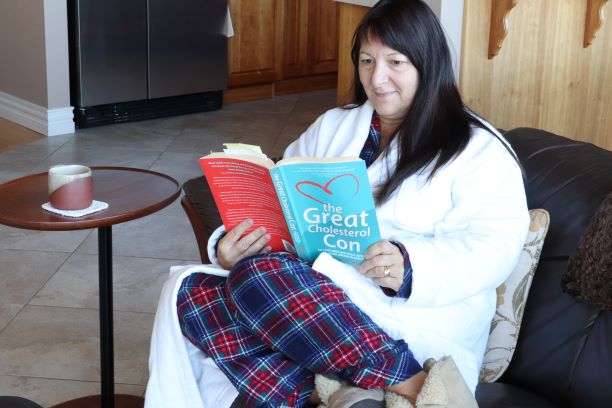

I have always loved reading… I was one of those kids who read with a flashlight under the covers when I was supposed to be going to sleep. One of my favourite features of the Kindle Reader I have now is that I can read it in bed without a flashlight…
As a practicing pharmacist, virtually all of my reading was non-fiction, learning information that would help me be a better pharmacist. But I always loved novels, especially historical ones and those about another culture or a country I’d never visited. Now I try to balance my reading between fiction and non-fiction.
So you can imagine how pleased I was to find an article based on science about the many ways reading fiction is good for your brain… couldn’t wait to share it with you!
Science-based ways reading improves brain function:
-
Improves ability to detect and understand social cues This skill is known as “Theory of Mind” and helps us to interpret the actions and body language of others. If you’re a fan of “Big Bang Theory”, think of Sheldon, a character who reads only scientific literature and has great difficulty understanding the emotions of others and subtleties in language, such as sarcasm. Well-written literary fiction will “show” not “tell”… emotions are shown through actions of the character rather than describing the emotion itself (for example: if a character “storms from the room” the author doesn’t need to say he is angry).
-
Increases empathy Fiction allows the reader to get in touch with the characters’ thoughts and feelings, imagining other realities and how they might feel in that situation themselves. Readers of fiction scored better than non-fiction-only readers on a test to guess a person’s feelings when shown only a photo of their eyes.
-
Sharpens memory and engages imagination Simple 3-word phrases, like “red leather purse” were enough to activate the hippocampus, a center in the brain for memory, in functional MRI tests. When reading fiction, the reader needs to consider both what is being said and what is not said. Often spaces need to be filled in using the imagination. I have often described a good book as a “movie in your mind”, with pictures created by your imagination using cues and descriptions in the book. Unlike movies and television, where all the details are provided, books require the reader to create the pictures and “hear” the voices. And most books last much longer than the average TV show, requiring you to remember details from the beginning that may turn out to be important later on…
-
Improves decision making and emotional processing Modern scanning techniques have shown that reading stimulates key areas of the brain. Any time you exercise part of your brain, it responds by creating new connections between brain cells to increase function. These are the areas of the brain that light up when reading:
-
Prefrontal cortex – area for decision making and recall
-
Lateral temporal cortex – area that deals with emotional association and visual memory
-
Hippocampus – long term memory processing
-
Parietal lobe – understanding emotions and interpreting sensory information
-
Posterior cingulate cortex – memory recall
-
-
Can create effective self-reflection Poetry, especially “high poetry”, such as works by Shakespeare, Wordsworth or Dickinson, activates “autobiographical” memory, your episodes of personal memories of experiences, objects, people and specific events experienced at a particular time and place. Poetry encourages reflection on these episodes to apply personal meaning and understanding to the poetry.
-
Creates serious “mind building” Reading-connected activity in areas of the brain associated with comprehension continues for as long as 5 days. This “shadow activity” is similar to what occurs with muscle building. Reading is like lifting weights for your brain!
-
Improves vocabulary and verbal skills Language constantly evolves. Different authors write in different ways, using different language, exposing you to more words used in a wide variety of ways. Reading a variety of authors teaches new ways of explaining ideas or creating images with words. There is a direct correlation between good verbal skills and reading. Even reading non-fiction can expand your vocabulary while you acquire new information.
-
Slows mental aging Reading is a constant mental exercise for all ages. Word imagery, metaphors, philosophy, abstract ideas and creativity challenge and activate the brain. Lifelong readers demonstrate better processing and understanding of sentence structures, comprehension and memory as they age.
-
Encourages learning from the content you read Non-fiction teaches ideas and facts but well-written fiction can also teach about other cultures, geographical areas, ideas, history and more through story and setting. The key is that the author does the required research to provide accurate details, even though the story line may be fictional.

So, never feel that a good novel is a waste of time. Enjoy imaginative stories along with inspiring non-fiction, knowing that it all keeps your brain active and continuing to develop throughout your life.

 Jeannie Beaudin, Artist and Author