Categories
Uncategorized

This is no Fairy Tale… it’s climate change

Our home was attacked by a giant dragon over the weekend. She circled our house for hours, shaking it and roaring to let us know how strong a monster she was. She threw buckets of water at our windows, and knocked down trees and power poles with her thrashing tail. She blew the sea 3 meters higher than normal with her hot breath. Her name was Fiona.

But, like the house the 3rd little pig built, our house was constructed strong and high. The weather wizards told us Fiona the dragon was coming so we had days to prepare to fight back. Anything that could move was put away or tied down. We had extras gas for our generator, knowing it was likely the power would go out. We made sure all windows were sealed tightly closed. Flashlights were tested and ready, phones and spare batteries were fully charged.

They call this “emergency preparedness” and we may be hearing this term more in the future. Experts are telling us these kinds of storms will become more common because of climate change and we must try to learn more about how to prevent the most serious problems with each one. Repairs need to be made stronger and better to withstand future events. They call this “climate change adaptation”.

In 2019, we had the “storm of the century”, hurricane Dorian. That was just 3 years ago and we’ve already surpassed it with Fiona. What should we expect next? What can we do to prevent becoming repeated victims of climate change? What more can we do to adapt?

A place to start

Preparing ahead, not just when an emergency is looming, but in our everyday decisions can also help. Things like considering how we plan new construction: how strong our buildings are built, how high they are above sea level, what type of windows and doors are used, etc. becomes more important with the bigger and more frequent storms that climate change promises to bring. Like the man who built our home, we all need to pay attention to how high water can get, how strong winds can become, and make choices about how and where to build.

And our existing homes can become better prepared too. Here are some of my ideas for strategies to consider:

  • Keep trees away from houses and parking areas so they can’t cause damage if they fall (falling trees broke two neighbours’ car windows)
  • Install high quality roofing, strong doors and windows when upgrading (our new roof, installed last June, has highest-quality shingles with a 50-year guarantee!)
  • Consider adding hurricane shutters that have saved many windows in the south where these storms are more common (any installers in Atlantic Canada?? You may be busier in the near future!)

Planning for the future

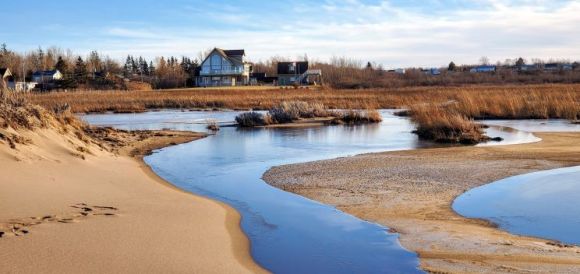
Our provincial Department of Fisheries and Oceans came by yesterday, measuring how high the storm surge had come. The ocean left clear foot-high piles of marsh grass along the edge of our lawn that made it easy to do their measurements. He told us the storm surge was 3 meters (about 10 feet) above normal. That compares to what I’ve been hearing about Florida storms! This information will be used to revise flood maps that will help future planning and building restrictions to keep people (and their property) safe.

I also saw an explanation on the news of why this storm was so strong. Scientists know that hurricanes require a water temperature warmer than 26.5c (79.7f) below them to add power to the storm, providing energy for it to build strength as it passes over water. Normally the ocean is cooler than this in the fall, making storms weaken as they travel north. However, right now, the water off the eastern coast of the US is 27 to 29c (80 to 84f) and, as they explained, this is why hurricane Fiona arrived in Canada with 165 kilometer per hour winds (102.5mph), a “post-tropical storm” with category-2 hurricane winds! This explains how climate change, with warming of oceans, creates stronger storms.

And the news today?

All the news is about hurricane Ian’s devastation of the Florida coast and worries of how it will affect the Carolinas. Here in Atlantic Canada, we’re still working on cleaning up the devastation from hurricane Fiona. Homes throughout our area have torn siding and missing roofing. But we’re lucky compared to Prince Edward Island, Cape Breton Nova Scotia, and Newfoundland, where many more buildings were blown down, damaged, and flooded, and entire roofs were removed. Roads blocked by fallen trees have prevented help from reaching many. We’ve seen Canadian Armed Forces trucks travelling to and from PEI with help and supplies, and we know they are travelling to NS and Nfld too.
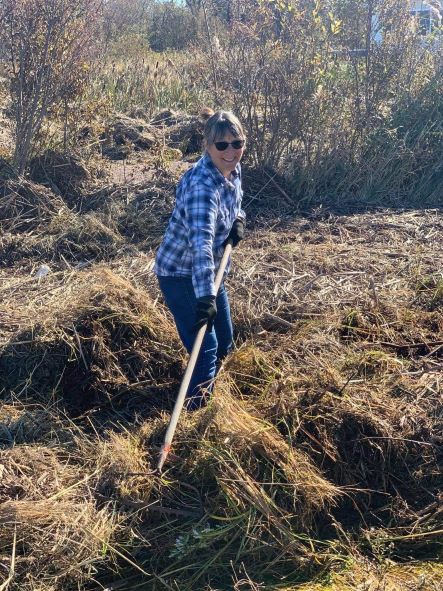
So, I feel like I should be thankful that we withstood the storm well, and look at our “hay removal” lawn project as an opportunity to exercise! They tell us expressing gratitude can improve our mood and lessens our stress. Those of us who escaped with minimal damage can feel thankful it wasn’t worse, but what about those who didn’t make out so well? I’ve been hearing stories of kindness and people reaching out to help strangers. I guess we all could be helped by feeling thankful for neighbours, friends, volunteers, and governments who are offering their help and support. (Maybe I’ve been reading too many psychology books lately…) But we’ll get through this and, hopefully, be better prepared for what future storms may bring!

All about climate change (and adapting to it!)

It appears it’s too late to avoid all the effects of climate change, so we’ll have to adapt as best we can. Support politicians who will work to limit this climate change and help to prevent worsening weather disasters. And if you have other ideas or suggestions for preventing wind and storm damage, please share them in the comments below!

PS: The idea for the dragon analogy was stolen (with permission!) from writer David B. Clear, who is so much funnier to read than I am! You’ll find him on Medium and at his website: davidbclear.com .

#hurricaneFiona #hurricaneIan #climatechange
Categories
Uncategorized

Why didn’t we see this coming?

So many of us are surprised at what is happening these days with the rapid spread of the new coronavirus and so many deaths. But scientists have known for years that this was likely to happen…they said it wasn’t “if” a pandemic would occur but “when” that was in question. The Spanish Flu of 1918 was a good example of how a virus could spread when no one was watching.

If fact, we discussed the possibility of a pandemic at least 15 years ago when I was on the New Brunswick pharmacy regulatory board. We put in place a mechanism to enable quick licensing of retired pharmacists to continue providing basic pharmacy services to the public, should too many of those on the front lines become ill.

Again, when I was learning about viral infections as part of my training to give injections and to teach other pharmacists how to do immunizations, I learned that there are two basic types of viruses…those that spread easily and those that cause severe infections in the lungs. Fortunately, most viruses are one type or the other. But when a virus combines the ability to spread from person to person easily with the ability to cause severe illness, it becomes a candidate for causing a dangerous pandemic. And when it’s a completely new virus, no one has immunity. The new coronavirus that causes COVID-19 is one of these (fortunately) rare ones. And we are quickly seeing and feeling its effects.

Reading about science…

One problem is that too many of us don’t hear what our scientists are saying. Science is often hidden behind pay walls instead of being openly shared, charging subscription fees or $35 per article to read the evidence. And, too often, the results of studies are written in scientific lingo that the average person can’t understand.

Sometimes, science news is shared by non-scientists who don’t translate the information accurately, causing confusion and misunderstanding. An example is the current stockpiling of chloroquine and hydroxychloroquine, based on news reports that they might prevent or treat COVID-19. Experimenting with potent drugs based on rumour and hearsay can be dangerous. There have been reports of patients who have ended up in hospital after taking chloroquine based on sketchy news reports. As yet, no proof exists that chloroquine or hydroxychloroquine work, that either is safe to use against this virus, or what dose should be used. Scientists have organized methods to test drugs safely and thoroughly before they are used by sick patients. Perhaps our scientists, themselves, should write summaries of their research work that can be clearly understood by all and are accessible to the public and news media.

Believing the facts…

For some, being part of a social group with certain beliefs keeps minds closed to the facts. Humans are social beings and, when faced with a choice of being included in a group or standing up for the facts we have been shown, many need to stay with their social group, finding ways to “prove” the facts must be wrong. We’ve all seen videos of teenagers partying on beaches, who have convinced themselves the warnings don’t apply to them… people crowded in parks, convinced that only those over 80 need to worry…

It’s also harder to make choices that you know will cost you money. But governments, listening to the scientists, are making the tough decisions that will save lives. Doctors and scientists are telling us what is likely to happen if we don’t change our behaviours quickly to prevent the spread of the COVID-19 virus infection. We are starting to see the results of our slow early reactions.

But we are displaying a similar lack of attention to what scientists are saying is going to happen as a result of climate change. We certainly need to focus on following the advice of experts right now to avoid exposure to this virus but, hopefully, we are learning a good (if costly) lesson. We need to heed the advice of experts who warn us of potential world problems.

In spite of the difficulties in making changes when a problem isn’t yet affecting our daily lives, it is much less costly and “inconvenient” to prevent problems than it is to fix them after they occur. And prevention, wherever it can be applied, can save lives and prevent suffering. Forgive me for going off on a bit of a tangent, but one of my pet peeves is the “war on cancer” – while it would be wonderful to find a cure for all cancers, many could be prevented. We need more research into causes of diseases like cancer and better strategies to prevent them. This would extend lives, prevent suffering and save a lot of money that could be used to better everyone’s lives.

Occupying ourselves during isolation…

You know, it’s interesting how science fiction—the product of people’s imagination—can sometimes predict the future… I’m not talking about zombies, of course, but, just as they foresaw landing on the moon, sci-fi writers have imagined various scenarios where disease could disrupt society. Some of these imagined disaster movies and books, like Contagion and Andromeda Strain, have resurged in popularity, as movie fans compare the sci-fi version to the current crisis.

Spoiler alert… Andromeda Strain has a happy ending with quick action taken by government (I read it last year) but I haven’t seen Contagion yet. Maybe I’ll watch it this evening, just to see how the writer’s imagined crisis compares to what is happing now…

Or, to pass the time while self-isolating to reduce the magnitude of this crisis, maybe we can learn about the next potential one…climate change. I found a list of the best (and potentially most accurate) shows, as recommended by The Climate Reality Project (click here). Just like cancer and virus infections, it’s better and easier to prevent environmental damage than it is to try to fix it after it’s occurred… and costs less in money and lives to do it sooner rather than later.

But if watching a scary movie isn’t right for you right now… perhaps a phone call or video chat with family or friends (very easy with FaceTime, Messenger or other chat apps) and a feel-good novel (maybe a cozy mystery or romance?) might be just the things to pass the time and stay in touch with loved ones.

What are you doing to occupy yourself during this time of isolation? Or are you one of the many on the front lines we are so thankful for, working hard to help protect us? Post a comment below!

#COVID19 #climatechange

References/Further reading:

Why Facts Don’t Change Our Mind – James Clear

Must See Movies About Climate Change – The Climate Reality Project