Categories
Uncategorized

How to Swallow Pills

Many people have trouble swallowing medication because pills feel different than food when we put them into our mouths. But swallowing is a natural function that we don’t think about most of the time. When we are born, we already know how to swallow! So, this blog is about ideas you can try to make swallowing medication easier.

Why worry?

Part of the problem with swallowing a pill is the worry that it will get “stuck” in your throat. But the average bite of food is much larger than most pills. So, relax. Look at how little that pill is compared to a fork loaded with food…

Use your normal swallowing process

First, it’s a common misunderstanding that “gravity” will help a pill go down, and some people tip their head back when they try to swallow their medication. But tipping the head back actually makes the throat narrower, making it harder to swallow.

Think about when you swallow food. You chew the food and as you swallow it, you are looking down at your plate, planning your next mouthful. In this position your throat is more open, making swallowing easier. Your tongue moves the food to the center of your mouth then pushes it back to where the muscles in the throat take over, pushing it down to your stomach. You certainly don’t need to tip your head back to make a mouthful of food go down easily!

So, with a pill, of course you don’t want to chew it (unless your prescription says to do so!). If your mouth is dry, take a drink of water first. Or, take a drink of water anyway, dry mouth or not, just to “practice” your normal swallowing movements. Place the pill on the front part of your tongue, not at the back where you may be more likely to stimulate the gag reflex. With your chin down, take another large sip of water and pretend the pill is a piece of meat you have already chewed up. Do the same swallowing movement you did with the drink of water you just took.

If the pill does seem to get “stuck”, continuing to drink water usually does the trick to move it along. And eating a bite of solid food afterward, such as a piece of bread, does an even better job of ensuring that pill makes it all the way down into the stomach.

Capsules and coated tablets may easier…

If it’s a powder-filled capsule you’re trying to swallow, it will float up to the back of your throat when your chin is lowered and be the first thing to go down when you swallow the water. Easy peasy! The capsule shell also becomes slippery when it gets wet, making it slide down easily. These are reasons that capsules are easier to swallow than tablets.

Many tablets have a coating that quickly becomes slippery, making them easier to swallow than uncoated ones. You may have noticed an “easy to swallow” version of Tylenol that has a red coating like this.

But uncoated tablets can easily be carried by the water as the tongue naturally pushes it toward the back of the throat. I just think “meat” when I’m swallowing. Meat is usually still a lump even after it’s been chewed.

For some people, taking a small spoonful of a food you don’t need to chew, like apple sauce or yoghurt, can work better than water, since the thickness decreases the feel of the tablet in the mouth. It’s a little inconvenient to carry apple sauce around if you take tablets several times a day, but could be a “stepping stone” to learn to swallow pills more easily. Like everything else, swallowing pills gets easier with practice.

And if none of that works?

If none of this works for you, you could consider crushing the medication. However, it’s very important that you make sure this won’t change how the pill works. Delayed-acting and time-release tablets cannot be crushed, as this will allow all the medication to be absorbed into your system right away. Be sure to ask your pharmacist if it’s ok to do before trying this.

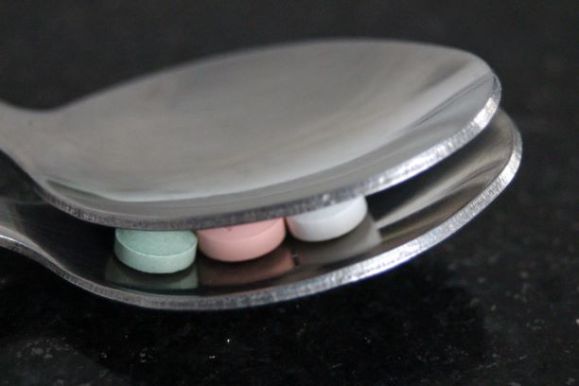
Most pharmacies carry pill crushers that can make this easier, and many of these devices leave the crushed bits in a little container to make it easy to mix with a soft food, like apple sauce, yoghurt or pudding. You also could try crushing the tablet between 2 spoons, as in the photo, if you don’t have a tablet crusher:
Another option for some medications, is to get it in liquid form. Again, this is not for controlled-release medications. If the medication is not commercially available as a liquid, sometimes your pharmacist can prepare a liquid for you from the tablets. I often did this as a compounding pharmacist.

So, if necessary, ask your pharmacist about this possibility. They will likely need to research whether the drug is stable in solution, as some medications can quickly degrade when dissolved in water, and they may want to discuss this change with your doctor. Occasionally, when a drug could not be dissolved in a watery base, I would mix it with an oil, such as canola oil, and flavour it with peppermint oil (for example, aspirin for a child).

So, if you have trouble swallowing pills there are many solutions. I hope something in this article will help you take your medication more easily! And, of course, like everything else, you will get better at taking pills with practice!

#swallowingpills #compounding
Categories
Health

Fungi are not “Fun guys”!

A reader asked if I could also talk about fungal infections of the skin… Like fungal nail infections, these are also very common, quite unpleasant and sometimes misdiagnosed…

Fungal skin infections, also called “tinea corporis”, include infections such as Athlete’s Foot, Jock Itch, and Ringworm (caused by fungus, not worms!). The scalp can also become infected with fungus and this is a common cause of itchy dandruff.

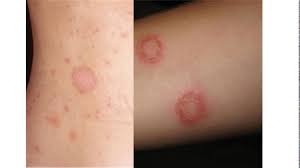
Fungal skin infections often grow as a red circular rash that is brighter red and slightly raised at the borders as the fungus grows into healthy skin. The rash is usually itchy but not painful, and can spread into new skin as round red “dots”. Sometimes the red border is not visible, leaving only itchiness and rough skin, making diagnosis more difficult.

Along with their related personal history (How long have you had the rash? How did it start? etc.), I often consider the characteristics of 3 basic types of infectious skin rashes when helping a client decide what non-prescription treatment to try. These are the criteria I use to base my treatment recommendations:

  • Bacteria – usually painful, red, and form pus and scabs as the infection advances.

  • Virus – less common (cold sores are an example), painful, usually see water-filled “bubbles” or vesicles on the surface of the skin in the early stages.

  • Fungus – itchy, not usually painful, often a circular rash, tends to spread in “dots”

All of these infections are contagious. They can be spread through direct skin contact with an infected person or animal, or via objects recently touched by an infected person or animal. Fungal infections are fairly common in dogs, cats and cows (if you have one of those!). Occasionally an infection can develop from prolonged contact with contaminated soil.

Skin fungal infections

Skin fungus often starts with a flat scaly area that is red and itchy, spreading outward forming a raised red “ring” that is roughly circular. The infection is more active as it moves into uninfected skin, creating the raised red border that is characteristic of this type of infection. The center may look clear, scaly or have scattered red bumps.

The infection affects only the outer layer of skin in most cases. Rarely it will invade lower skin layers, but usually only in people with a compromised immune system.

Risk factors

  • Living in a warm climate and wearing tight clothing or shoes that don’t breathe (trapping moisture). Fungi like to grow in warm moist environments.

  • A weakened immune system

  • Close contact with an infected person or animal, or sharing clothing, bedding, towels, etc.

  • Skin-to-skin sports (e.g. wrestling). If sports equipment becomes contaminated and is packed away while still damp (e.g. hockey gear), it can become a source of fungal skin infection.

Diagnosis

If the outer “ring” is not visible, it is easier to misdiagnose a fungal skin infection. Examining skin scrapings with a microscope can confirm the diagnosis of a skin infection, but often a “trial and error” approach is used – if the rash hasn’t improved after using an antibacterial cream or corticosteroid cream (helpful for rashes caused by irritation or eczema), then it is logical to try an antifungal cream, especially if itching is present.

Some doctors will take a “multi” approach if unsure of the infection type, prescribing a cream containing an antifungal, antibacterial and a corticosteroid to cover several causes at once.

Treatment

  • Treating an infection early gives a better chance of success with creams. If a large area is involved or the person has a weakened immune system, they may need to take an antifungal medication by mouth. However, as you will recall from last week’s blog, these have significant side effects.

  • Apply the cream to the rash area and into the uninfected skin in the surrounding area also to prevent spread. Follow any instructions on the label. Continue to use the cream for 2 weeks, or for several days after the visible rash is gone to ensure all the fungus is destroyed. If the rash has not cleared in 2 weeks, see your doctor. Be sure to tell him/her what treatment you have used.

  • Keep the area as dry as possible – fungus likes a moist environment. If the infection is on your foot, treat your shoes with an antifungal spray and let dry well between uses to prevent reinfection.

  • Change towels/wash cloths used on the infected area often to prevent reinfection.

  • If the infection is very itchy, you can alternate antifungal cream with a corticosteroid cream (such as hydrocortisone 0.5 to 1%) to reduce itchiness. Scratching can worsen or spread the infection. Depending on the rules in your state or province, you may be able to ask your pharmacists to make a cream with both ingredients (adding hydrocortisone powder to an antifungal cream) for convenience.

  • Ask your vet to check your pet for infection and treat if present.

  • Don’t share personal items if you have an infection to avoid infecting others.

  • If you have a chronically itchy scalp with dandruff, try an antifungal shampoo. If severe or long-standing, I would suggest a higher strength antifungal shampoo, such as Selsun Regular (stronger than Selsun Blue) or Nizoral shampoo. Your pharmacist can also make cetrimide 1% with hydrocortisone 0.5% in water for you. This is used by applying drops to wet hair after shampooing, rubbing into the scalp (it will foam), and leaving in. This has the advantage of longer treatment contact than a shampoo could provide, and is not visible on the hair once it dries. Again, keep in mind that some states (strangely) do not allow compounding without a prescription.