Categories
Health Public Health

Flu season? Who cares…

You’re healthy. A little flu won’t hurt you. And you hate needles. Why bother with the flu shot? Well, it’s not just about you…
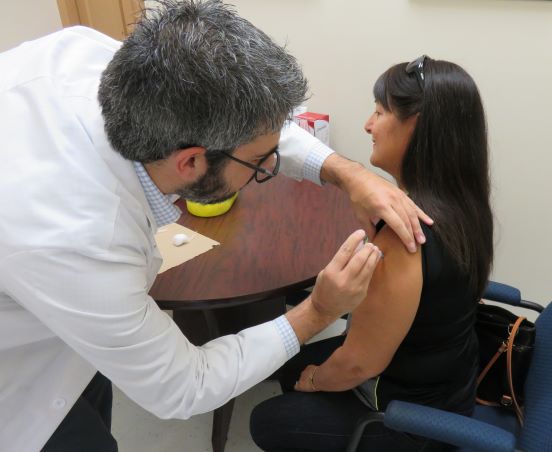
You see, when you get the flu, even just a mild case, you can pass it along to others, and they may not be as healthy as you are. That sweet little old lady in front of you in the grocery line or the young woman in the doctor’s office, that you didn’t know was taking chemo, could be exposed to the virus you just caught because you didn’t get your shot. And they could become very ill because their immune system isn’t as strong as yours. If you don’t get the flu, you can’t pass it on.

Protect the herd…

And, while we’re talking about virus infections, I should tell you about something called “herd immunity”. This term means that if most of the the population (or “herd”) in an area is vaccinated to protect them from a virus, then those who are more vulnerable and those who can’t (or won’t) get a vaccine will be better protected.

But a majority of the “herd” needs to get their flu shot for the effect to make a difference. If too few are protected, then enough people are vulnerable to let an epidemic spread. We’ve seen this lately with some of the childhood vaccines… Diseases like mumps and measles had become quite rare, but in recent years news articles have described local areas and sports teams where groups of people have become sick with these viruses. Untrue rumours on the internet have convinced many parents that there is a connection between the measles/mumps vaccine (MMR) and autism. In spite of having been proven incorrect, articles continue to circulate around the internet about this false connection.

Reactions are rare but…

Most people tolerate vaccines well – the slightly sore arm or mild fatigue that sometimes occurs is nothing compared to a full-force flu. And, in the elderly, the very young, and those with chronic disease or a weakened immune system, it can be life-threatening. People die from the flu every year.

A very few serious reactions to vaccines are reported, due to allergies or sensitivities, and this is why you need to stay for 15 minutes after your shot. If you should have one of those rare reactions, you will receive treatment for it right away. Doctors will recommend that people who have had a serious reaction do not take that vaccine again or that they receive it in a hospital setting. This is another case where herd immunity, ensuring that friends, co-workers and family are vaccinated, can be important.

So do your part to protect yourself and others — find a pharmacy or clinic that gives flu shots. Most pharmacies do now, and they’re free there for most people just as they are at your doctor’s office. Roll up your sleeve and take a deep breath… it’s done in seconds and hardly hurts at all.

And, to feel the injection less, here’s what to do:

  • Relax. It hurts a lot more if the muscle is tight.

  • Ask the person injecting to wait until the alcohol evaporates. It only takes a few extra seconds.

  • Don’t move. You want the needle to go straight in and straight out quickly.

  • Distract yourself. Even taking a deep breath can be enough distraction to take attention away from the injection.

  • Apply pressure right away. Your brain will register pressure instead of pain.

    • Often an injector will press lightly on your arm while giving the injection, for the same reason.

    • They will also make sure the injection is well into your muscle – it hurts less there and works better too.

    • The injector will use a cotton ball to apply pressure. You can take over so they can finish up their paperwork.

  • If the area is sore later, apply a cold compress (a refrigerated ice pack or ice cubes wrapped in a cloth). You can also take a dose of Ibuprofen or Acetaminophen (Tylenol) to reduce soreness at the site of the injection, a common side effect.

So, lots you can do to make your flu shot practically painless!

Categories
Health

The Vaccine Debate

Vaccines are described as the single most effective medical intervention in history…more lives have been saved by vaccines than by any other treatment. In fact, vaccines have been so effective in preventing diseases that many people alive today do not realize how severe diseases like polio, measles, mumps, diphtheria, tetanus and pertussis can be.

I should confess that I am biased in favour of vaccinating – I was one of the first pharmacists to be certified to give vaccines in the province of New Brunswick and continued on to work with a team of nurses and pharmacists who taught and certified hundreds of pharmacists in several Canadian provinces. To do this, I studied large amounts of scientific information about many aspects of vaccines and their use.

Vaccines are overwhelmingly safe…most reactions are minor, such as a sore arm or mild fever. All reactions are carefully tracked and documented to detect any potential problems as soon as possible. Severe anaphylactic (allergic) reactions occur less than 2 times per million doses given, but every person administering vaccines is trained to detect and treat these severe reactions and must be equipped with medications needed to do so.

Concerns have been expressed about the possibility that giving several vaccines at once could overwhelm the immune system, but scientists confirm our immune systems have the capacity to handle several thousand vaccines at once. They point out that during a normal day, a child is exposed to several hundred different antigens that trigger the immune system into action, and this is what a vaccine does.

An article in 1998 suggested that the measles vaccine was causing autism, but this has been disproven long ago. In spite of this, some parents still refuse to vaccinate their children based on this and other misinformation.

The mercury-containing preservative, thimerosol, has also been of concern to some parents. Although it was never demonstrated to cause a mercury-related health problem, it has been removed from all child vaccines manufactured since 2001, except flu vaccine that comes in multi-dose vials, most likely due to the number of allergies to this ingredient. Note that single-dose influenza vaccine does not contain this ingredient.

Another common vaccine ingredient that has drawn concern from parents is formaldehyde, used to inactivate viruses and bacterial toxins in vaccine manufacturing. Although most is removed from the final product, a very small amount remains. The human body actually produces its own formaldehyde when proteins are processed, and a baby’s body at any given time will contain 10 times the amount that would be in a vaccine. This small amount has been shown to be completely safe and our bodies have mechanisms to eliminate it, along with the formaldehyde we regularly produce ourselves. Far more dangerous amounts are found in second-hand cigarette smoke and car exhaust, and most dangerous are the workplace exposures to formaldehyde, such as hairdressers exposed to some hair smoothing products that produce formaldehyde when used.

Although we rarely see many of the childhood diseases we vaccinate against now, they still exist and could quickly become commonplace again. We saw this with pertussis (whooping cough) in our province. Because of higher rates of reactions from a vaccine that contained whole inactivated viruses, immunization rates dropped and over a thousand cases were documented in one season. Pertussis is similar to a mild cold in a healthy adult, but can be fatal to a small baby. Government’s response was to inform the public and step up vaccine availability to bring the disease under control again. There is ongoing research to ensure that the resurgence is not due to decreased effectiveness of a newer improved vaccine with fewer reactions.

It is true that some vaccines are more effective than others. The shingles vaccine, for example, only reduces occurrence of the disease by about 50%, although it is pointed out that cases tend to be less severe in those who have been vaccinated, and “post herpetic neuralgia”, pain that can continue for weeks or months after a bout of shingles, was also reduced. Many feel that even this level of resistance to getting shingles makes it worthwhile taking the injection.

It’s flu season now, so let’s talk about the flu vaccine… The severity of influenza will vary from year to year, depending on the nature of the strains going around that particular year. Because the flu virus changes frequently, researchers track influenza cases around the world and choose 3 to 4 strains that they expect could cause the worst illness, creating a new combination each year.

The flu is not just a bad cold…it kills 300,000 to 500,000 people in an average year around the world, mostly the elderly. Young children are also at increased risk, as are pregnant women, and those already in poor health or with chronic conditions like asthma or heart disease. Vaccinating a pregnant woman also gives protection to her baby, a definite plus since the vaccine cannot be given to children under 6 months of age.

Some don’t bother getting the vaccine, stating they are healthy and not worried about catching the flu, but we all need to keep in mind that we could pass the illness on to someone who is more vulnerable than we are. If more people are vaccinated, it is less likely we will have a large epidemic – this is referred to as “herd immunity”…the whole community is protected because there are fewer people who can spread the virus to others.

I have had clients claim that they “caught the flu” from the flu vaccine, but this is not possible. The pieces of virus in the vaccine are dead and cannot start to grow causing an infection…it’s just not possible. It is possible, however, to catch the flu from someone else in the first 2 weeks after a flu shot because it takes 2 weeks for antibodies that protect us from the virus to develop in our bodies.

However, I did read about one incorrectly made batch of vaccine that reached the market in the ‘90s that actually did cause some severe illness. The manufacturing problems were detected and corrected to avoid recurrence of a similar problem. The manufacturing of vaccines is highly regulated to ensure “bad batches” do not occur today.

Vaccines containing an “adjuvant”, an extra ingredient designed to increase response to the vaccine in those with weaker immune systems, are also known to have somewhat increased reactions such as pain in the area of the injection and mild fever. The special vaccine produced to fight the H1N1 flu epidemic of 2009 contained an adjuvant to ensure the highest level of immunity possible would be produced. This H1N1 virus was similar to the one that caused the Spanish Flu of 1918. That epidemic killed 50 to 100 million people, about 3 to 5% of the world’s population at that time, many of them young healthy adults.

Again this year, experts are predicting a flu season that could be more severe than others. Getting a flu shot is free for many, and takes just a few minutes. And it’s available as close as your neighbourhood pharmacy or doctor’s office. So why not take a few minutes and protect yourself and others around you from a preventable illness!

If you have any questions about vaccines that I haven’t answered, click the “Comments or Questions” button, or ask your pharmacist or doctor!