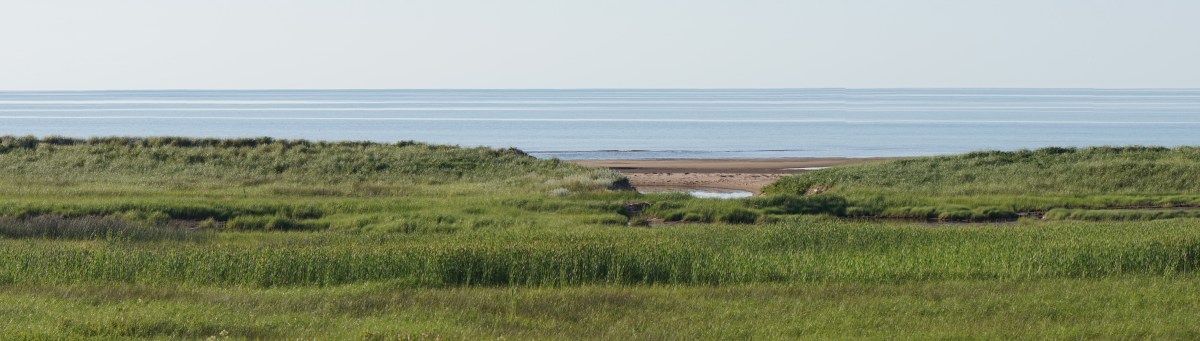
There seems to be a problem in the water…fecal bacteria above acceptable limits are showing up in water tests in some areas of the New Brunswick coastline.
I had a great discussion with my neighbour, Natasha Bell, this week about issues that increase the risk of pollution on our beaches. Initially concerned about the impact of a large proposed campground nearby, she quickly realized that the greater issue is damage to the delicate ecology of the shoreline along the entire coast of our province – and the potential for it to worsen with further development of the coastline. This lead her to become involved in a growing movement to protect our New Brunswick coastline. She established a local group, along with another concerned neighbour, Pierre Gagnon, to create awareness in members of our village council about our concerns.
They subsequently joined forces with 3 other similar groups, creating a large group that has been named SWWAT (Save our Waters, Wetlands and Tourism) to have a stronger voice with our provincial government. I attended a meeting last evening with Natasha and Pierre to discuss future actions concerned citizens can take to identify and correct existing problems and to prevent development of future problems along the NB coastline. It was attended by people from Shediac to Murray Beach, ready to exchange ideas and take action.
The issues are similar along the entire Atlantic coastline and, in fact, in many watershed areas of both fresh and salt waterways. Wetlands have been seen as “wasteland” and simply filled in to create developments for human use. Even my home was built into the wetland before existing regulations were in place. We have returned a swath of land along our property to natural vegetation along an area of water drainage from higher ground, both to try to restore some of the filtration function that was lost and because we love the appearance of the natural vegetation.
But as I thought about what we had discussed after talking to my neighbours and attending a SWWAT meeting, I wondered what I could do to help. I realized that in many ways this is an issue of education and awareness:
-
We need to educate people who use the coastline for recreation or industry that every small action is cumulative – everyone needs to be aware that actions that cause a small amount of damage can add together to cause significant problems for humans, birds, sea life and the overall ecosystem of the coastline.
-
We need to create awareness in municipal and provincial government employees and elected politicians who make decisions that affect our shores:
-
about the facts around issues that are causing damage now;
-
about the importance of finding and correcting the sources of existing problems that are potential health hazards;
-
and about the importance of considering both the current and future impact of decisions and legislation that are passed.
-
It isn’t simply about testing water quality so Public Health can predict when beaches should be closed, it’s about finding and correcting the causes of bacteria in coastal waters and taking action through legislation and policy that will correct existing problems and prevent future deterioration of the ecological systems along our shores.
-
-
-
We also need to educate our youth – the next generation – to ensure this wonderful resource is available in the future. Just on our small stretch of beach, we have had late night fires that consumed snow fencing used to prevent erosion of dunes and burned Christmas trees placed against damaged dune areas to trap sand. We’ve also had to pick up broken glass and garbage from impromptu midnight beach parties! But youth can also be a passionate force for positive change, educating their parents at the same time. We realized that the way to reach young people is through engaging their schools and increasing our reach through social media and our website. Youth communicate through electronic media!
-
We need to continue to research solid facts surrounding this issue and communicate these to government and the public to create knowledge and an awareness of the severity of the problem.
-
We want to continue to engage the attention of news media to enable wider awareness of our concerns.
Because I am a blogger and have already created a website and marketing materials when I had my business, I volunteered to work on similar approaches to spread the word about these environmental issues. It’s not only the health of people like me who use the beaches for recreation that is at stake, but also the tourism, fisheries and ultimately the economic health of coastal areas.
The SWWAT group has two requests of government:
-
Moratorium – We are asking the Provincial Government to impose a temporary moratorium on significant development within 500 meters of wetlands draining into Northumberland Strait until the sources of fecal contamination have been identified and mitigated.
-
Legislation – We are asking the Government to legislate a long-term wetlands protection plan supported by strict enforcement of protective regulations.
These actions will protect the health and safety of families and visitors to the beaches, as well as the future of the tourism and fisheries industries in the area.
Will you join our cause? Whether you are a resident of the area, enjoy vacationing there, or just want to help a worthy cause, please sign our petition. Help us to direct government attention to saving our shores for all to enjoy in the future!

 Jeannie Beaudin, Artist and Author